
Why the Ranking Model Is the Wrong Game for National Experts
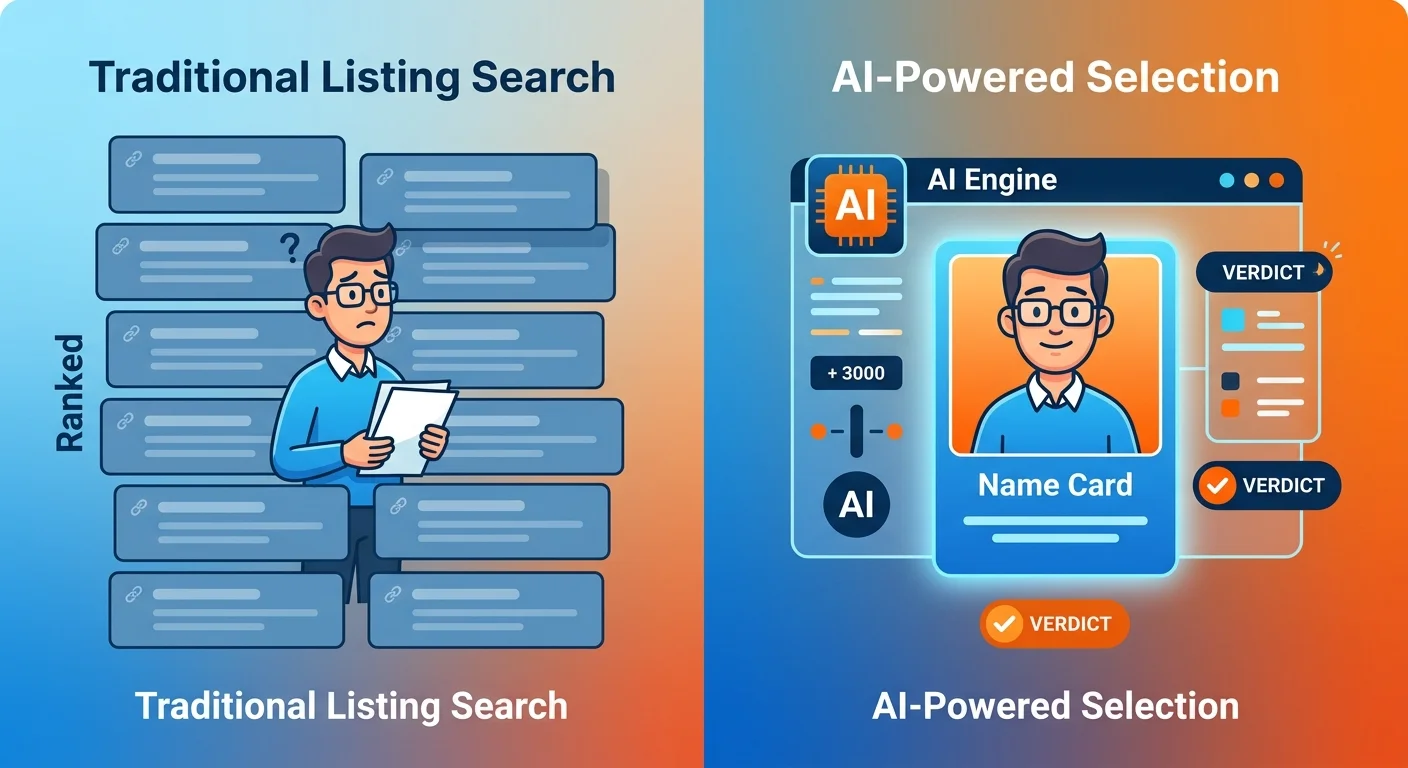
The ranking model was built for a world that’s leaving.
And every practice still chasing Page 1 is training for a competition that no longer decides the outcome.
Traditional search gave you a seat at the jury table. One of ten options. A user could evaluate you, dismiss you, click the next result.
Conversational AI doesn’t call a jury. It delivers a verdict. Either your name is the verdict, or you’re not in the case.
That’s not a metaphor. It’s the architecture.
Every dollar spent chasing keyword positions is a dollar not spent building the infrastructure that actually determines who gets named.
Why Traditional SEO Fails National Expert Positioning
Traditional search optimization was built to solve a discoverability problem.
Conversational AI doesn’t have a discoverability problem. It has a credibility problem. Those aren’t variations of the same issue – the tactics that fix one actively destroy the other.
Keyword density, backlink volume, meta tag optimization – every one of those signals was engineered to satisfy a crawl-and-rank algorithm.
AI answer engines don’t rank. They reason. They’re evaluating entity trust, semantic depth, and citation consistency. They’re deciding who is credible enough to name out loud to a real person asking a real question.
That’s a different standard. Most practices have zero infrastructure built to meet it.
For practices scaling nationally, this breaks down fast.
When the Local AI Authority Engine is built correctly, a single-location practice can establish verified national expertise. But only if the underlying infrastructure is machine-readable across every geography the AI considers. A keyword strategy tuned for one city doesn’t transfer – it has to be rebuilt from the foundation.
Ranking tactics won’t get you there.
Authority Infrastructure will.
Who This Is Not For
This isn’t for every practice. Let’s be honest about that upfront.
If you’re expecting booked appointments in 60 to 90 days, this won’t satisfy that timeline.
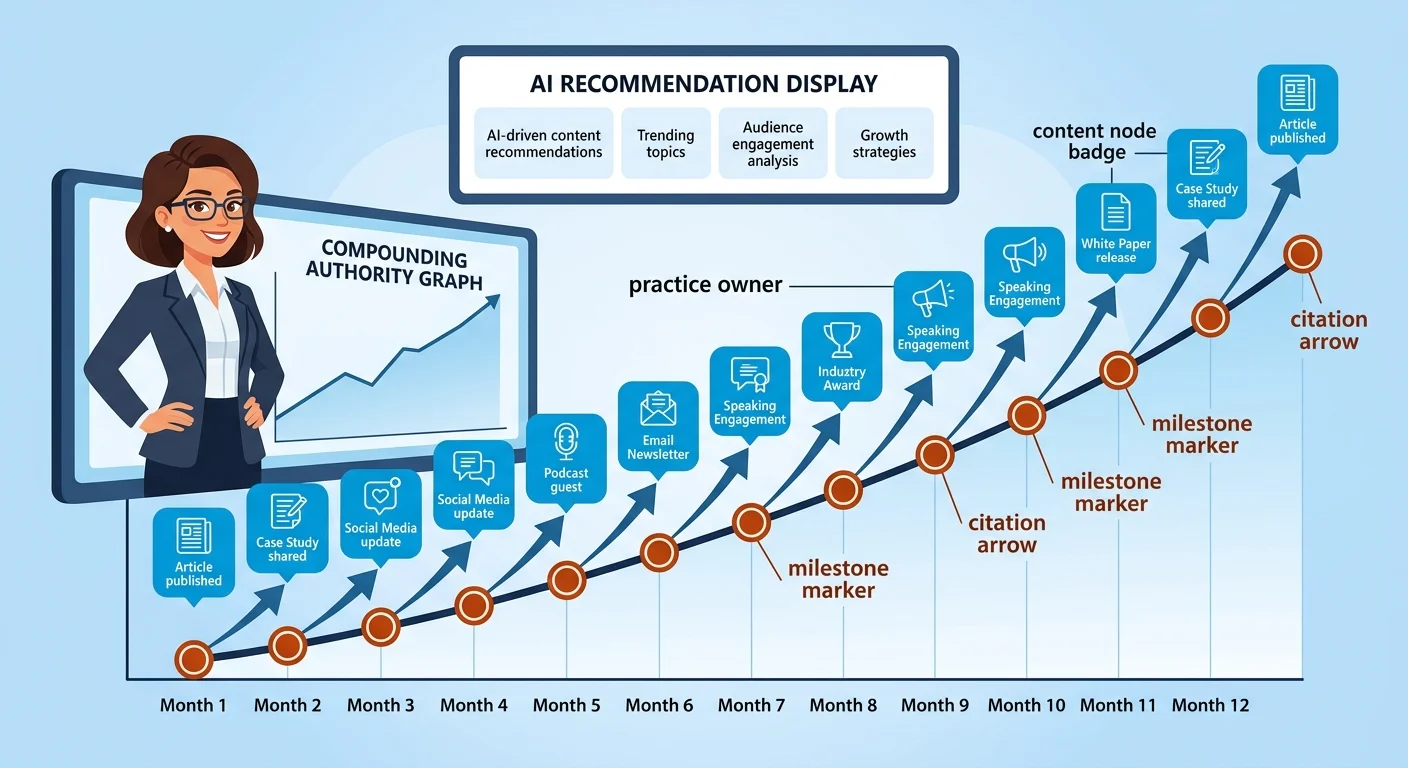
Authority Infrastructure compounds. It doesn’t spike. The practices that win national AI recommendations are the ones that commit month over month – not the ones that run a quarter and bail.
Walking away hands that ground to whoever kept building. That’s not a risk. That’s a certainty.
If you’re comparing this to a monthly retainer package, or looking for the result without the infrastructure investment – this isn’t for you. No hard feelings.
The verdict belongs to the practice that did the work. That’s not negotiable.
| Dimension | Traditional SEO Logic | Conversational AI Logic |
|---|---|---|
| Goal | Appear in a ranked list of results | Be named as the single recommended answer |
| Output format | Ten blue links – user evaluates and chooses | One verdict – AI chooses before the user sees anything |
| Core ranking signal | Keyword density, backlink volume, meta tag optimization | Entity trust, semantic depth, citation consistency |
| How the engine decides | Crawl-and-rank algorithm scores pages against each other | Reasoning model evaluates credibility and names the most authoritative source |
| Geographic scalability | City-level keyword targeting – each market requires its own campaign | Machine-readable Authority Infrastructure that signals verified expertise across geographies |
| What compounds over time | Position volatility – rankings shift with every algorithm update | Entity trust – authority signals accumulate and reinforce each other month over month |
| Failure mode | Invisible on Page 2 – user may still find a competitor | Absent from the verdict entirely – user never sees your name |
What National AI Authority Actually Requires
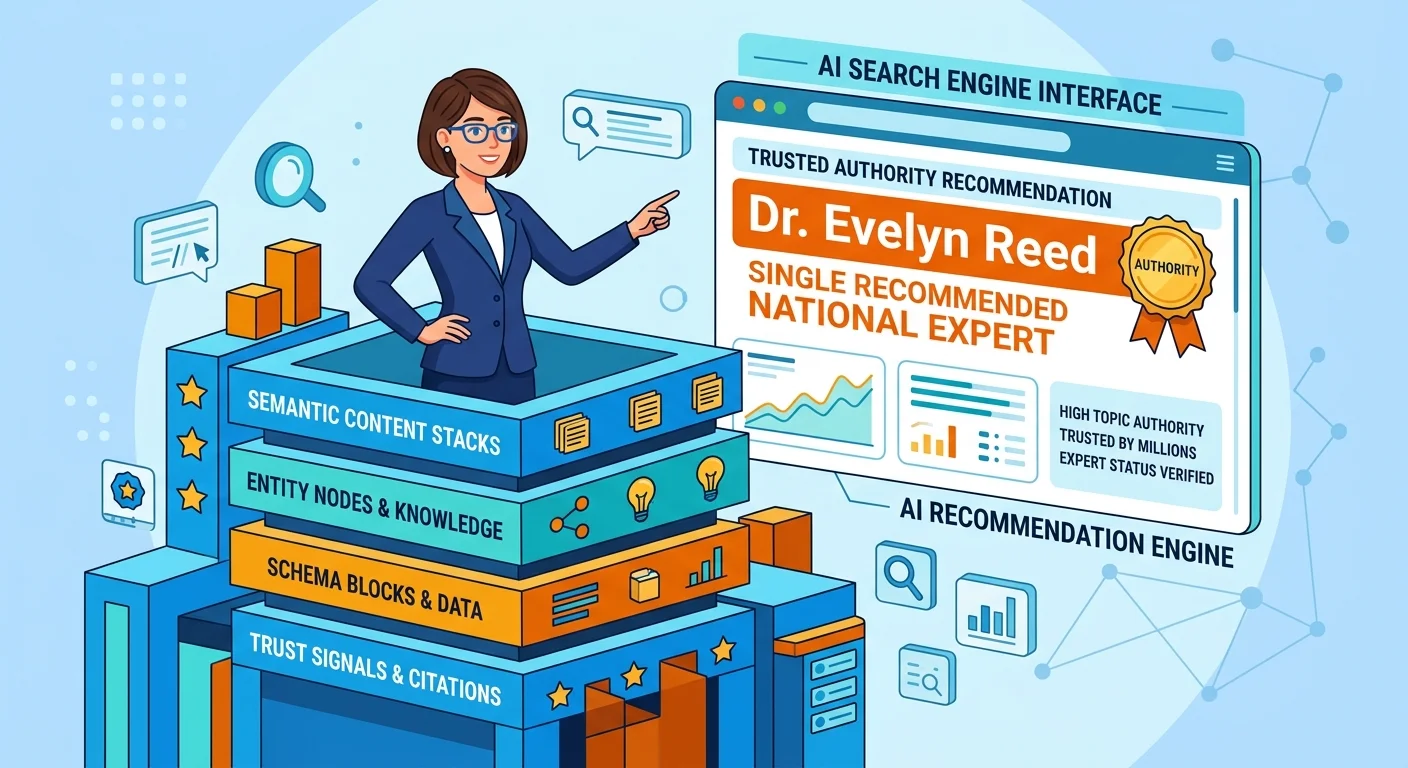
National AI Authority is an infrastructure problem.
Not a content problem. Not a keyword problem. Infrastructure problems require infrastructure solutions – and most practices are still throwing content tactics at a machine that doesn’t respond to them.
Four pillars determine whether an AI engine names you or ignores you: Entity Identity, Structured Authority Signals, Semantic Density, and Citation Velocity.
These aren’t marketing concepts. They’re machine-readable signals. The engines processing queries aren’t scanning for keywords. They’re reasoning about trust – deciding who is credible enough to say out loud to someone asking a real question.
And that reasoning is already running at scale. Over one-third of organizations globally are using generative AI regularly in at least one business function. The engines handling those queries don’t work like the ones your current strategy was designed for.
When OpenAI launched its SearchGPT prototype in July 2024, the direction became undeniable. Published analysis confirmed that real-time search was being fused directly with generative reasoning. The verdict model wasn’t a prediction anymore.
It was already being assembled.
Every practice sitting on the sideline waiting for this shift to feel urgent is handing that ground to whoever moved first. And that ground doesn’t come back.
Entity Trust: The Currency AI Engines Run On
Entity Trust is the currency AI engines run on.
Not a score. Not a ranking. It’s the machine’s answer to one question: can I verify this entity is who they claim to be – and trust them enough to say their name out loud?
For a practice scaling nationally, this compounds fast.
AI engines don’t assume geographic reach. They verify it. A specialist with deep entity signals in one market but no structured authority signals across state lines gets recommended locally – and ignored everywhere else. The recommendation doesn’t follow your reputation. It follows your infrastructure.
The mechanics of how those signals extend – and why entity consistency matters more than physical presence – are exactly what practices working through multi-state authority signals need to understand before they build.
Entity Trust is built through specificity.
Schema markup that verifies your credentials. An author profile that ties published expertise to a named individual. External citations from sources AI engines already treat as credible. Each signal tells the machine: this entity is real, verified, and worth naming.
Without these, an AI engine can’t distinguish you from any other practitioner claiming the same specialty. So it names the one it can verify. That’s not a quirk. That’s the standard – and it doesn’t bend for practices that haven’t done the work.
Why a ‘Pretty’ Digital Presence Is Structurally Invisible
Here’s what the marketing industry sold for years: a visually impressive digital presence signals authority.
Clean design. Fast load times. Responsive layout. Those things matter to a human visitor scanning your homepage.
To a conversational AI engine, they are structurally invisible.
AI engines don’t see what a patient sees. They parse structured data, schema markup, and semantic signals embedded beneath the surface.
A practice with a beautifully designed presence and no machine-readable infrastructure is, to an AI engine, effectively anonymous.
The real client case studies show this dynamic clearly – practices with strong visual brands but weak entity architecture getting bypassed entirely for competitors with less polish and more structure.
The verdict goes to the practice that built for the machine.
Not the one that built for the brochure.
| Authority Signal | What AI Engines Read | What Most Practices Publish | Gap |
|---|---|---|---|
| Entity Identity | Schema markup verifying practitioner credentials, specialty, and named authorship tied to a verified individual | A generic ‘About Us’ page with a biography paragraph and headshot | AI engines cannot distinguish this practitioner from any other clinician claiming the same specialty – so they name the one they can verify |
| Structured Authority Signals | Machine-readable technical architecture: structured data, semantic markup, and crawlable entity relationships embedded beneath the visible surface | A visually polished presence optimized for human visitors – clean layout, fast load, responsive design | The entire digital presence is structurally invisible to a conversational AI engine reasoning about who to recommend |
| Semantic Density | Topic-specific content dense with verified, authoritative language that signals genuine depth of expertise across a defined specialty | Generalist content written for broad keyword reach – surface-level, interchangeable with any competitor in the same field | AI engines cannot assign specialized credibility to a practice whose published content reads the same as every other practice in that market |
| Citation Velocity | Consistent external references to the practitioner’s name, positions, and practice from sources AI engines already treat as credible | Isolated presence – no external source corroboration, no third-party citations, no mention beyond the practice’s own properties | The AI engine has no external validation to cross-reference – entity trust remains unverifiable, and the practice gets passed over for one with corroborating signals |
| Geographic Authority Signals | Structured entity signals that extend verified expertise across multiple markets – not just the practice’s primary city | Local optimization built for a single market: city-specific keywords, one Google Business Profile, no cross-market entity architecture | A practice gets recommended locally and ignored everywhere else – AI engines don’t assume reach, they verify it |
| Named Expert Authority | A verifiable individual tied to published expertise – a named author profile connected to AI Authority articles, credentials, and external mentions | An anonymous institutional voice – content published under a brand name with no individual practitioner attribution | AI engines have no named entity to assign credibility to – institutional content without a verified individual carries significantly weaker authority signals |
The Four Pillars of a Machine-Readable Expert Identity
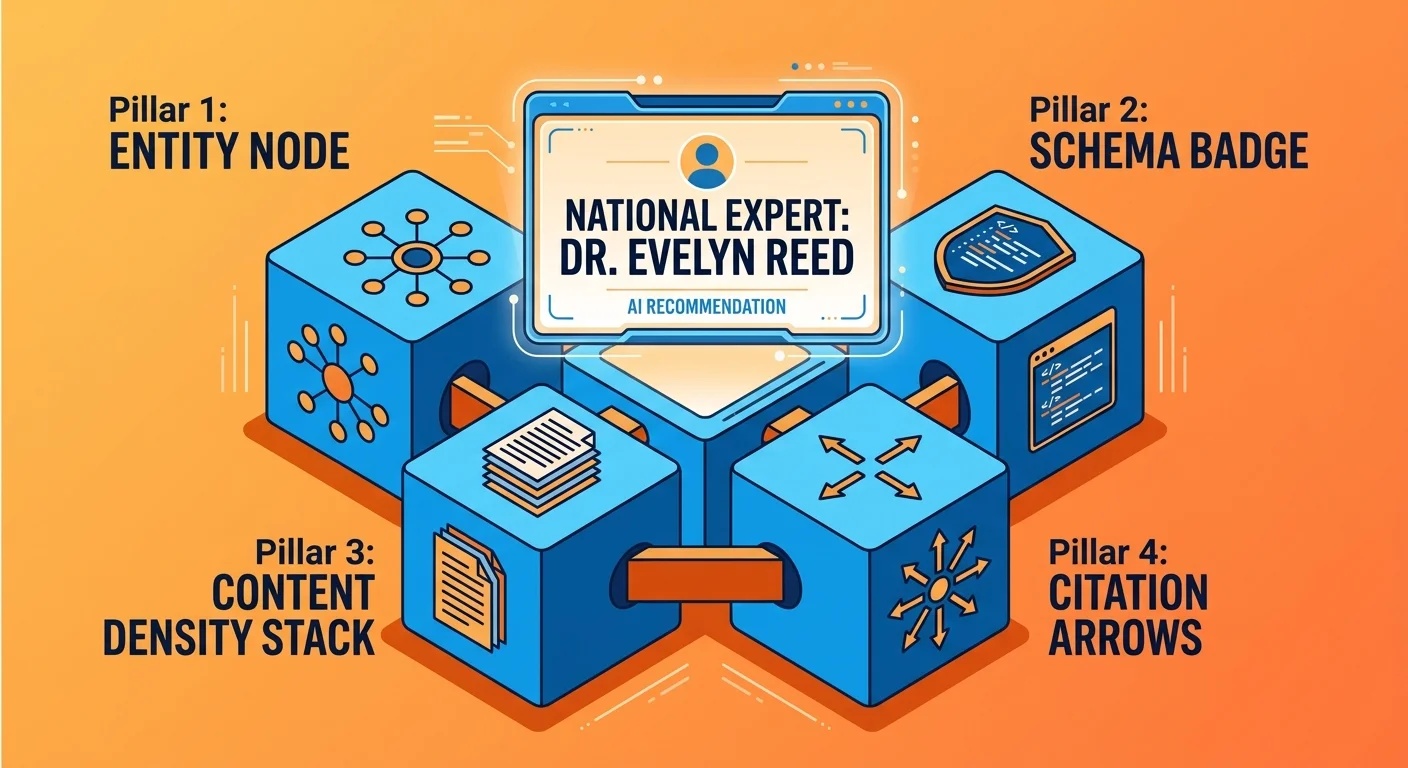
Four pillars. That’s the whole blueprint.
Entity Identity, Structured Authority Signals, Semantic Density, and Citation Velocity. The practices that get named nationally by AI engines have built on all four. Not three. Not four with one done halfway.
Each pillar answers a different question the AI engine is asking before it commits to a name.
Miss one and the structure collapses. Build all four and the verdict starts going your way.
Pillar 1: Entity Identity
Entity Identity is the foundation. Everything else stands on it.
Before an AI engine names you, it has to verify you. Your name, your specialty, your credentials, your practice structure. Not because it’s curious – because it’s accountable for the recommendation it’s about to make to a real person asking a real question.
The FTC guidance made this explicit: deceptive advertising rules apply in AI environments exactly as they do everywhere else.
AI engines absorb that institutional pressure. They reward entities that are unambiguous and verifiable. They pass over entities buried in generic claims and unstructured data. Ambiguity isn’t a neutral condition. It’s a disqualifier.
Entity Identity means your name, your specialty, and your authority signals all point to the same clearly defined entity – across every surface an AI engine can read.
Schema markup. Author profiles. Structured business data. The machine needs to close the verification loop. If any piece is missing, it can’t close it. And a loop it can’t close is a name it won’t say.
Pillar 2: Structured Authority Signals
Structured Authority Signals are the technical layer. The one most practices have never touched.
They’ve built for visual presence. They’ve ignored machine-readable architecture entirely. Those are not the same investment.
A well-designed page tells a patient they’re in good hands. Schema markup tells an AI engine the same thing – in a language it can actually parse.
Without structured signals, the AI has no reliable mechanism to extract your credentials, your specialty scope, your service geography, or your publication history. So it moves on. To whoever gave it something to work with.
The order of what gets structured first matters more than most practices realize.
See how one clinic built a verified national patient funnel from a single location – because the sequence of that build is exactly what determines how fast authority compounds.
Pillar 3: Semantic Density
Semantic Density is about depth. Not volume.
Publishing more content doesn’t make you the expert. Publishing content dense with verified, topic-specific language – the kind that signals genuine expertise rather than broad familiarity – is what shifts the AI’s evaluation.
AI engines reason about expertise by analyzing the specificity and consistency of language across everything tied to your entity.
Shallow content reads to a machine the way a vague answer reads to a professor who knows the subject cold. The machine knows the difference between someone who’s familiar with a specialty and someone who has spent years inside it.
Semantic Density is built through AI Authority articles that go deep. Not wide.
Every piece of content is a signal. It either reinforces the machine’s confidence that you’re the expert in your specialty – or it dilutes that signal by covering too many topics too shallowly.
Focus is a feature. Practices that try to be authoritative on everything end up verified on nothing.
Pillar 4: Citation Velocity
Citation Velocity is the pillar that closes the loop.
Entity Identity and Structured Authority Signals establish who you are. Semantic Density establishes what you know. Citation Velocity establishes what others say about you – and AI engines weight external corroboration heavily when deciding who is trustworthy enough to name.
The FTC’s formal inquiry into generative AI investments and partnerships in January 2024 made something structural visible: the institutions shaping AI behavior are paying close attention to how entities get cited and validated.
AI engines follow the same logic. A practice referenced consistently by credible external sources – healthcare directories, institutional publications, professional associations – accumulates citation signal that moves the verdict. That’s not a growth hack. That’s the standard the machine is already applying.
Citation Velocity compounds. That’s the mechanism worth understanding.
Early citations build the base. Each additional credible reference increases the machine’s confidence in your entity. The practice that started building six months ago is not at the same place as the one starting today.
The gap widens every month. Not as a threat. As a structural fact.
| Pillar | Core Component | What It Signals to AI | Common Gap |
|---|---|---|---|
| Entity Identity | Schema markup, named author profiles, structured business data, credential verification | This entity is verifiable – its name, specialty, and authority signals all resolve to a single, unambiguous source | Unstructured or inconsistent business data across platforms; no schema; credentials exist on the page but are invisible to the machine |
| Structured Authority Signals | Machine-readable architecture: specialty schema, service geography markup, publication history, credential tagging | This entity has provided the technical signals required to extract and validate its scope of expertise | Visual-only presence with no underlying machine-readable layer; AI engine has nothing to parse and moves to whoever gave it structured data |
| Semantic Density | Depth of topic-specific language across all content associated with the entity – AI Authority articles, author profiles, published material | This entity demonstrates genuine, sustained expertise in a defined specialty – not broad familiarity | Content covers too many topics too shallowly; the machine reads surface-level familiarity instead of deep authority and discounts the entity accordingly |
| Citation Velocity | Consistent external references from credible sources – healthcare directories, institutional publications, professional associations | Third-party credible sources independently corroborate this entity’s authority, making it trustworthy enough to name | Entity exists only in its own content ecosystem; no external corroboration; AI engine cannot confirm the entity is recognized beyond its own claims |
How AI Engines Verify National Expertise
Here’s the mistake most practices make. They assume AI recommendation works like search did – right keywords, right links, right list position. That model is gone. It didn’t evolve. It got replaced.
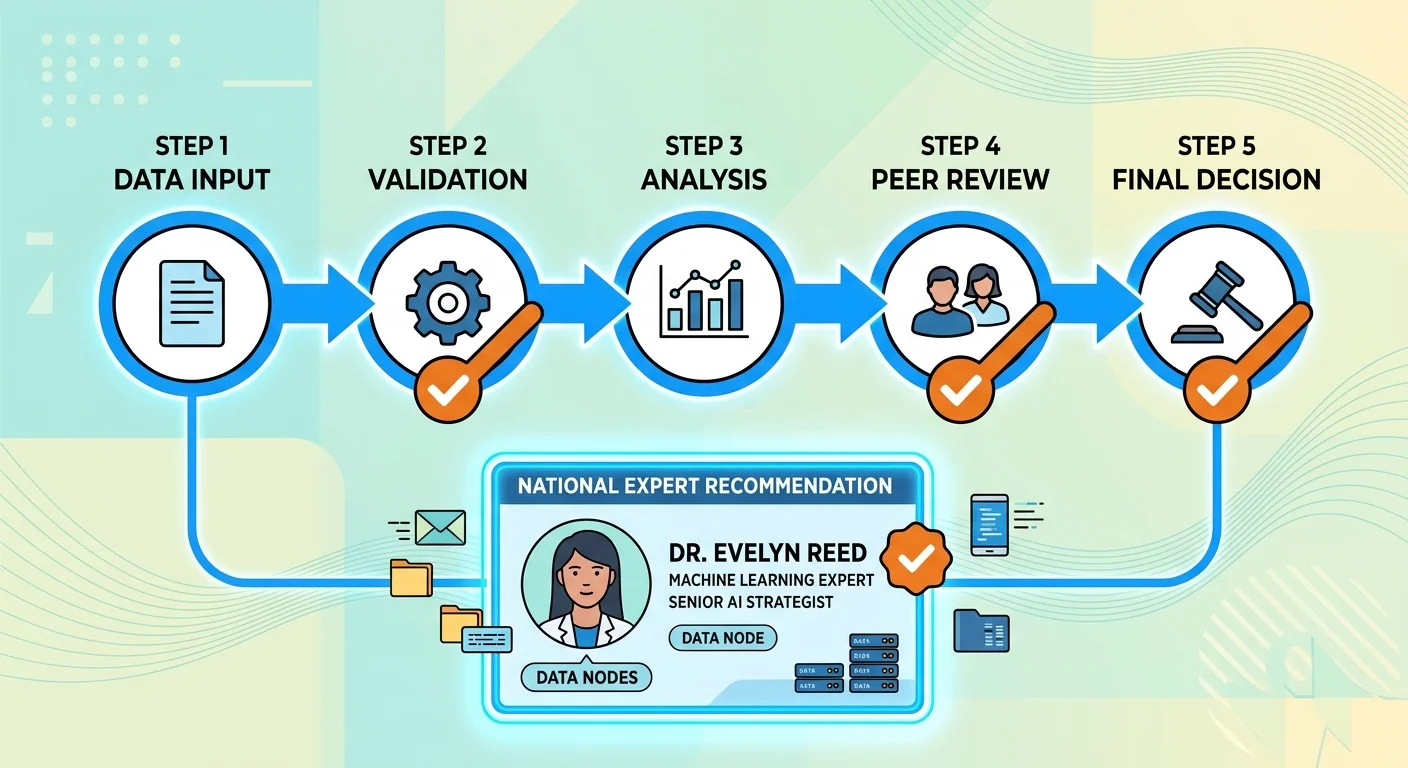
Conversational AI engines don’t hand the patient a list and let them choose. They run an internal verification chain – a sequence of checks against structured data, entity signals, and external corroboration. The practice that clears the chain gets named. Every other practice doesn’t exist in that answer.
That chain is the difference between building for visibility and building for recommendation. Those aren’t the same objective. Treating them as interchangeable is exactly why most authority-building efforts never produce a verdict.
The Verification Chain: From Query to Named Recommendation
The verification chain starts the moment a query hits the engine. A patient asks who the leading expert in a given specialty is. The engine doesn’t scan for the highest-ranked page. It asks: which entity can I verify, trace to a named individual, and confirm has published credible depth on this subject?
Entity Identity gets checked first – can the engine confirm this is a real, structured, consistently described practitioner? Structured Authority Signals come next – schema markup, credential data, machine-readable architecture that supports the claim. Semantic Density follows – does the published body of work signal genuine expertise, or just surface familiarity? Citation Velocity closes the loop – are credible external sources referencing this entity on their own, without prompting?
Every step is a gate. Pass all four and the engine has what it needs to render a verdict. Fail one and it moves to whoever did clear the bar. How impressive the practice looks to a human visitor is completely irrelevant.
Why Geographic Presence Is Not the Gating Signal
Here’s where the old mental model does the most damage. Practices assume national AI recommendations require a national physical footprint – multiple locations, state-by-state licensing pages, a local presence in every target market. That logic made sense in the directory era. Conversational AI engines don’t gate national recommendations on geography.
What the engine verifies is entity consistency and subject authority. Not zip codes. A practitioner whose credentials, specialty language, and external citations are structurally coherent across every surface an AI can read will get recommended well beyond the walls of their physical location. Whether solo practitioners can realistically compete at national scale is worth answering directly – because the barrier isn’t size. It’s structure.
Geographic signals matter for local recommendations. For national expertise, the gating signal is depth of entity verification – and that’s a machine-readable infrastructure problem, not a real estate problem. Gartner projects traditional search engine volume will drop 25% by 2026. The queries flowing through geographic-list logic shrink. The queries flowing through AI verdict logic grow. Practices building entity authority now are positioning for the channel that wins. Practices waiting for geographic logic to return are optimizing for a model on its way out.
| Verification Step | What the AI Engine Checks | Pass Condition | Fail Condition |
|---|---|---|---|
| Entity Identity Check | Whether the practitioner exists as a clearly defined, consistently described entity across all machine-readable surfaces – schema markup, author profiles, structured business data, and directory listings | Entity name, specialty, credentials, and practice structure are unambiguous and verifiable. The AI can close the verification loop without gaps. | Entity data is inconsistent, missing schema markup, or spread across conflicting descriptions. The AI cannot confirm who this entity is and moves on. |
| Structured Authority Signals Check | Whether machine-readable architecture is in place beneath the surface – credential data, specialty scope, service geography, and publication history in a format the engine can parse | Schema markup is present and accurate. Credential and specialty data are structured so the AI can extract and validate them without inference. | Page is visually polished but machine-unreadable. No schema. No structured credential data. The AI has nothing reliable to extract and skips to the next entity. |
| Semantic Density Check | Whether the body of published content signals genuine subject-matter expertise – through specificity, consistency, and depth of topic language – rather than broad surface familiarity | AI Authority articles go deep on a defined specialty. Language is specific, consistent, and signals years of expertise rather than general awareness of a topic. | Content covers many topics shallowly. The AI reads broad familiarity, not expertise. The entity does not clear the depth threshold required for a national recommendation. |
| Citation Velocity Check | Whether credible external sources – healthcare directories, institutional publications, professional associations – are independently referencing this entity with consistency and frequency | Multiple credible external sources cite the entity independently. External corroboration confirms the entity’s authority in the specialty to the AI’s satisfaction. | External citations are absent, sparse, or limited to low-authority sources. The AI has no independent corroboration and cannot confirm the entity is trustworthy enough to name. |
Building the Content Layer That Signals National Authority
Getting named is the opening argument. Staying named is the verdict that matters.
The engine doesn’t lock in a recommendation forever. It re-evaluates. Every new query is another moment where a better-structured entity can step in and take the position you built.
McKinsey’s global survey found that over one-third of organizations are already using generative AI regularly in at least one business function. That number is moving in one direction.
More adoption means more queries. More queries means more verdict moments. And more verdict moments means more competitors who figured out the infrastructure game while you were watching your Google rankings.
Pew Research put a number on the consumer side: more than 50% of US adults had used or were familiar with ChatGPT as of early 2024. That’s not a trend to monitor from a distance. That’s the patient population actively asking questions and getting names back.
They’re already getting verdicts. The practices building content depth today are the names those verdicts return. The ones waiting are donating that position to whoever didn’t wait.
How AEO Content Compounds Authority Over Time
AI Authority articles aren’t content for content’s sake. Each one is a structured signal – a machine-readable proof point that a named entity has genuine depth on a specific subject.
The engine reads it that way. It either reinforces confidence in your entity or it doesn’t register. There’s no partial credit.
Here’s the mechanism worth understanding. The first AI Authority article builds a baseline signal. The second reinforces it. By the time a coherent cluster exists around a specialty topic, the engine has a body of evidence.
Not a single data point. A pattern. That pattern is what separates a practitioner the engine can confidently name from one it passes over. One article is a signal. A cluster is a verdict.
What this looks like in practice is documented in how a single-location clinic built a national patient funnel – a real example of structured Authority Infrastructure and consistent content execution compounding together over time.
The sequence matters. The consistency matters more. Both have to be right.
The Execution Trap: Why Most Practices Stall Here
Most practices get this. Most practices stall anyway.
Not because the work is too hard. Because execution without a validated system produces content that looks authoritative to a human reader and registers as generic noise to the engine deciding who gets named.
That’s the execution trap.
Publishing AI Authority articles that aren’t structurally anchored to your entity, your specialty language, and your verified credentials doesn’t build Semantic Density. It produces volume without signal. And volume without signal is invisible to the engine making the verdict. It’s not a step forward. It’s activity that costs real time and produces nothing the machine can act on.
The practices that escape it are treating content as infrastructure. Not output.
Every AI Authority article is written to deepen the machine’s confidence in a specific entity’s expertise on a specific subject. That’s a different brief than "publish something useful." It requires a system built around signal architecture – not editorial instinct.
ITech Valet built that system so execution doesn’t fall on the practitioner. The practitioner’s job is the specialty. Getting them named for it is ours.
| Execution Stage | Activity | Authority Signal Produced | Timeline |
|---|---|---|---|
| Foundation Build | Establish Entity Identity across all machine-readable surfaces – schema markup, credential data, specialty language, named practitioner anchors | AI engines can confirm a real, consistently described entity exists before the first content signal is evaluated | Prerequisite – must precede all content execution |
| Initial Signal | Publish first cluster of AI Authority articles anchored to a single specialty topic – structured to reinforce the named entity’s depth on that subject | A baseline body of evidence the engine can trace back to a verified practitioner in a defined specialty | Early stage – each article compounds on the last |
| Cluster Deepening | Expand AI Authority article coverage into adjacent specialty topics, credential-supported claims, and subject-specific depth that generic content cannot replicate | Semantic Density that separates the entity from surface-level competitors in the engine’s internal verification chain | Mid-stage – signal strength increases with each addition |
| External Corroboration | Build Citation Velocity through presence on credible external platforms – healthcare directories, professional associations, institutional publications – that AI engines treat as independent validators | Third-party confirmation that the entity’s authority claims are recognized beyond its own published surfaces | Ongoing – velocity compounds as citation sources accumulate |
| Sustained Authority Hold | Maintain consistent content execution and entity signal reinforcement so no better-structured competitor displaces the verdict at the next query cycle | A compounding authority position the engine can confidently name across repeated queries on the same specialty subject | Continuous – authority decays without active maintenance |
Frequently Asked Questions
Good. You’ve got questions.
So does everyone who gets this far. Here’s the difference: you’re getting straight answers.
Timelines. Geography. How the verification chain actually works. The objections most practitioners raise – answered the same way the rest of this was written.
A verdict. Not a hedge.
What is the difference between traditional SEO and AEO for national brands?
Traditional SEO gets you onto a list. A patient searches, sees ten results, and picks one to click. You’re optimizing for a position. The patient still does the evaluation.
Conversational AI doesn’t produce lists. It produces a verdict. One name. One recommendation. The patient asks who the leading expert is – and the engine names someone. Or it doesn’t name you.
For national brands, that distinction is everything. Traditional optimization is competitive at the list level – ten practices can all "win" by landing on page one. Conversational AI is winner-take-all. The entity with the strongest verification chain gets named. Every other entity is absent from the case.
That’s not a variation of the old model. It’s a structural replacement of it. Gartner projects traditional search engine volume will drop by 25% by 2026 – the list is shrinking while the verdict is growing. Practices still building for the list are optimizing for the channel that loses.
How long does it take to build National AI Authority so AI engines recommend my business?
Anyone giving you a specific month is selling certainty they don’t own. There’s no honest answer that names a number.
Here’s what’s actually true. The four pillars – Entity Identity, Structured Authority Signals, Semantic Density, and Citation Velocity – are sequential. The foundation has to be structurally sound before the content layer compounds. The content layer has to accumulate before Citation Velocity builds. These aren’t parallel tracks. They’re gates. Each one clears before the next one opens.
Also true: the practices building Authority Infrastructure today are not at the same starting line as the ones who begin six months from now. The gap compounds in both directions. Every month of execution advances the practice that moved. Every month of delay advances whoever did.
So the real question isn’t how long this takes. It’s how far ahead you want to be when the verdict runs.
Do I need physical offices in multiple states to be recommended as a national expert by AI?
No. This is one of the most expensive misconceptions in the national authority conversation.
Conversational AI engines do not gate national recommendations on geography. They do not verify zip codes. They verify entities. An entity is verified through structured credentials, specialty-specific published depth, and external citation from credible sources – not through physical addresses in multiple states.
A practitioner whose Entity Identity is structurally consistent, whose credentials are machine-readable, and whose Semantic Density signals genuine expertise in a defined specialty will get recommended well beyond their physical location.
The engine isn’t asking where you are. It’s asking whether it can verify who you are – and whether the evidence supports naming you as the expert. That’s an infrastructure question. Infrastructure doesn’t require a lease in every city you want to serve.
How do AI engines verify the expertise of a specific practitioner?
AI engines run a verification chain. Not a search.
When a query asks who the leading expert in a specialty is, the engine doesn’t scan for the most-visited page. It checks whether it can independently confirm the entity’s existence, credentials, and depth of subject authority.
Entity Identity gets checked first: is this practitioner consistently described – same name, same credentials, same specialty language – across every surface the engine can read? Structured Authority Signals follow: is there schema markup, verifiable credential data, and machine-readable architecture that supports the claim? Semantic Density comes next: does the published body of work signal genuine expertise or surface familiarity? Citation Velocity closes it out: are credible, independent external sources referencing this entity – or is the claim entirely self-asserted?
Pass all four and the engine has what it needs to render a verdict. Fail any one and it names whoever cleared the bar. Pew Research found more than 50% of US adults using or familiar with ChatGPT as of early 2024. That verification chain is already running – at scale – on queries about your specialty, right now.
Why is a well-designed digital presence invisible to conversational AI engines?
Because a well-designed website is built for human visitors. Conversational AI engines aren’t human visitors.
Clean layout. Professional photography. Compelling copy. Those things communicate something to a patient landing on a page. They communicate nothing to a machine that can’t render them.
What the engine reads is the structured data underneath: schema markup, entity definitions, credential signals, and the machine-readable architecture that either confirms or fails to confirm the entity being claimed.
OpenAI launched its prototype SearchGPT in July 2024 to integrate real-time search with generative AI – and the pattern holds across every conversational engine. They parse structured signals. Not aesthetics.
A digital presence with no schema, no entity anchoring, and no machine-readable credential structure is invisible to the verification chain – regardless of how authoritative it looks to a human. That’s the infrastructure gap. And it’s solvable. But not by redesigning the visual layer. It requires building the machine-readable Authority Infrastructure the engine actually interrogates when it decides who to name.
The Verdict: One Answer, One Name
Here’s what the whole machine comes down to.
Conversational AI doesn’t hand the patient a list. It reads one name out loud. One verdict. Every other practice in your specialty isn’t ranked lower – they’re not in the room.
Either your name is the verdict, or you’re not in the case.
Entity Identity, Structured Authority Signals, Semantic Density, and Citation Velocity are not tactics you layer on top of what you already have.
They are a verification chain. Each gate is a question the engine asks before it commits to a name. Fail one and the chain breaks. The engine moves to whoever didn’t.
The practices that get named nationally built machine-readable Authority Infrastructure before they needed it. Not in response to losing ground. In anticipation of it. That timing is not incidental – it’s the entire competitive advantage.
The first move is a 15-minute call.
It shows you exactly what AI engines return when someone asks who the leading expert in your specialty is. Not a projection. Not a benchmark estimate. The actual answer the machine gives right now – and whether your name is in it.
If the results don’t make the problem obvious, walk away. But if they do – and they usually do – you’ll know exactly what needs to be built.
This is a structure problem. Structure is solvable. The only question is whether you solve it before a competitor does. Because the engine doesn’t wait, and neither does the gap.
Here’s the thing – you don’t have to guess where you stand. Fifteen minutes. Your name. Your specialty. You’ll see exactly what the engine says when someone asks who the national expert is. Either you’re the answer, or someone else is. That gap doesn’t close on its own.