
Why Geographic SEO Hits a Hard Ceiling

Proximity-based SEO was built for a world where search engines returned lists.
That world is done. Most clinics just haven’t gotten the memo yet.
Geofenced content, location-keyword saturation, map-pack optimization – every one of those tactics shares the same assumption: patients search by city.
But when someone types "who is the best specialist for my condition" into ChatGPT or Gemini, no city appears in that query. The engine doesn’t return a map. It returns a name. And that name belongs to whoever built the deepest entity trust – not whoever claimed the tightest local footprint.
Gartner predicts traditional search engine volume will drop 25% by 2026 as conversational AI queries replace the old scroll-and-click behavior.
Clinics still doubling down on proximity tactics are optimizing for a shrinking channel. A larger one is opening around them right now. Most of them don’t know it – and that ignorance is compounding every month.
Why Proximity-Based SEO Fails in an AI Search World
Proximity-based tactics were built for local map algorithms – systems that rewarded physical distance and citation density inside a geographic radius.
AI answer engines don’t work that way. Not even a little.
AI engines evaluate entity signals. Does this practice have a coherent identity across the web? Does it publish consistent, authoritative content on a defined specialty? Do credible third-party sources reference it as a trusted voice?
None of those questions have a zip code in them. That’s the whole problem. The national entity scaling playbook makes this distinction explicit – and the national expert AI engines recommend framework builds on it directly: authority is earned at the entity level, not the address level.
According to published analysis on health-seeking behavior from Pew Research Center, approximately 35% of U.S. adults use digital resources to research medical conditions before they ever contact a provider.
Those searches increasingly happen inside AI interfaces – not Google Maps. A clinic invisible to AI entity logic is invisible to a third of the patient population before the first question is even asked.
The Geofence Trap Most Clinics Don’t See Coming
Here’s the thing: most clinics don’t realize they’re trapped until the gap is already wide.
They optimize for their city, rank in their metro, and assume the work is done. Then a patient three states away asks an AI engine who the best specialist in their field is – and a competitor with stronger entity signals gets named instead. The local clinic never entered the conversation. Didn’t even know there was one.
The physical address was never the constraint. The entity signal was.
A single-location practice with a weak Entity Foundation, shallow Semantic Density, and no Citation Velocity is invisible at the national level – regardless of how well it ranks locally. The Local AI Authority Engine exists precisely to close that gap, rebuilding the infrastructure AI engines actually use to decide who gets named.
| Search Behavior | Traditional Local SEO Result | AI Engine Result |
|---|---|---|
| Patient types a city name plus specialty into a search bar | Practice appears in a local map pack or ranked list for that metro area | Query is too geographically narrow for AI to return a single trusted entity – result is a generic list, not a recommendation |
| Patient asks an AI engine who the best specialist is for a condition (no city mentioned) | Practice is invisible – no local keyword match triggers the result | AI returns the entity with the strongest combination of Entity Foundation, Semantic Density, and Citation Velocity – geography is not a factor |
| Patient researches a condition and asks for a trusted provider recommendation | Practice may rank for condition-related keywords locally, but is not positioned as a national authority | AI cites the practice whose content most thoroughly covers the condition and whose entity signals confirm deep specialization |
| Patient in a different state searches for a specialist in a niche field | Practice does not appear – proximity-based geo-fencing logic excludes out-of-state results by design | AI surfaces the entity with the highest trust signal for that specialty, regardless of the patient’s or practice’s location |
| Patient asks a follow-up question about a specialist they heard about | Practice depends on the patient already knowing the name – discovery via local tactics does not reach out-of-market patients | AI confirms or surfaces the practice if its entity signals are consistent and credible across authoritative third-party sources |
| Patient compares multiple providers across regions for a complex or elective procedure | Practice competes only within its local map radius – no visibility beyond its physical footprint | AI evaluates entity authority at the national level – a single-location practice with strong entity infrastructure competes directly with multi-location groups |
What National AI Authority Infrastructure Actually Looks Like
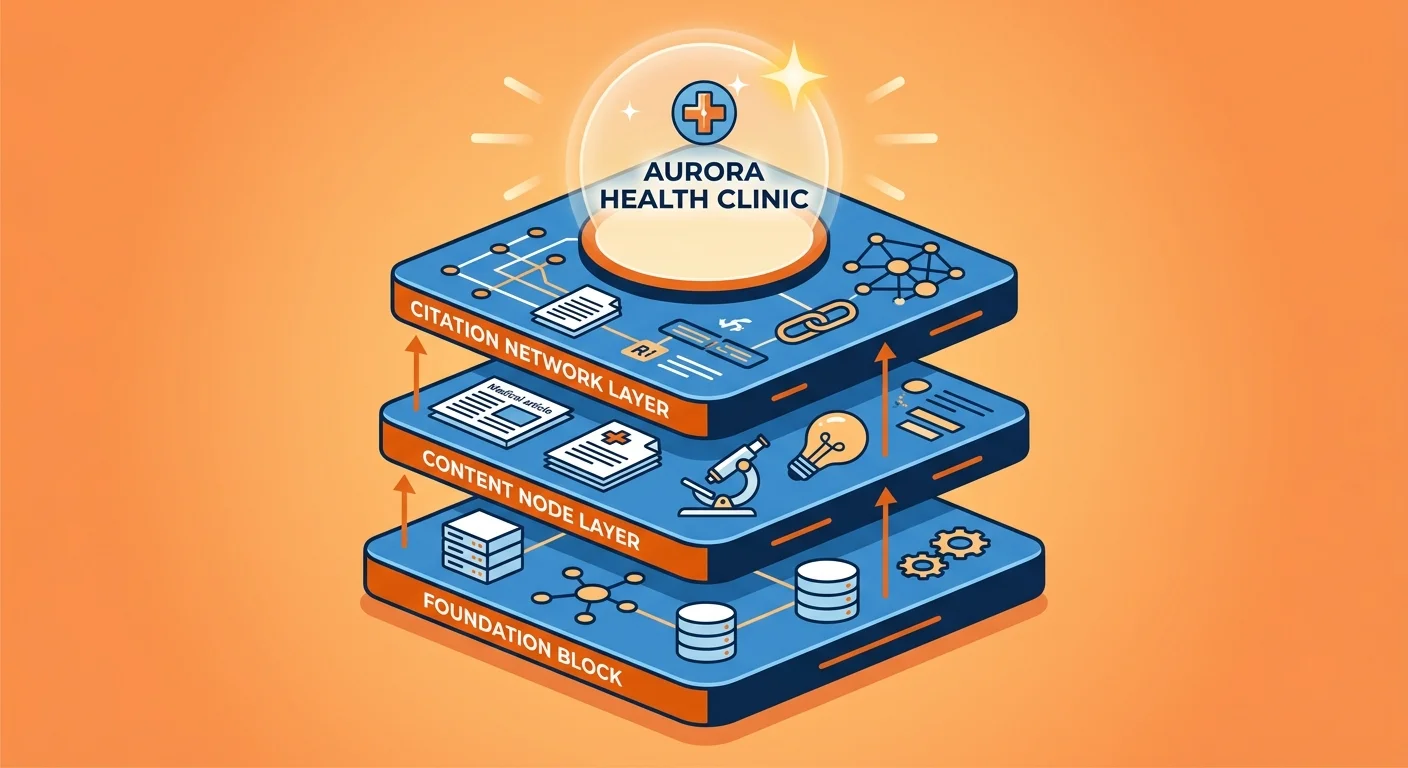
Here’s what most practices get wrong: they treat national visibility as a content problem. It’s not. It’s an infrastructure problem. AI engines don’t read your blog and decide to trust you. They read signals – structured, layered, compounding signals – and they decide based on those.
The model has three layers: Entity Foundation, Semantic Density, and Citation Velocity. That stack is what lets a practice with one physical address show up in AI recommendations for patients who’ve never heard of that city.
Each layer answers a specific question the engine asks before it commits to a recommendation. Get all three right and the zip code stops mattering. Miss one and the whole structure is fragile – and the engine names someone else.
McKinsey research puts it plainly: over 70% of modern patients expect digital engagement when researching healthcare providers. That expectation doesn’t carry a zip code.
Pew Research Center found that roughly 35% of U.S. adults already use online resources to research medical conditions before contacting a provider – and those searches increasingly happen inside AI interfaces. Patients aren’t filtering by metro area. They’re asking who the most credible expert is. The practice with the strongest entity signal gets named. The practice with the prettiest website gets skipped.
The Entity Trust Stack: Schema, Semantic Density, and Citation Velocity
Entity Foundation is where the engine starts. Schema markup, consistent NAP signals, clearly defined specialty taxonomy, verified third-party directory presence – these are the structured signals that tell an AI engine exactly who this practice is and what it’s built for.
Skip this layer and nothing above it lands. You can publish content all year. Without a coherent Entity Foundation underneath it, the engine can’t confirm the entity. And an entity it can’t confirm doesn’t get recommended.
Semantic Density is where most practices fall completely flat. Publishing content that broadly touches a specialty is not the same as publishing content that demonstrates deep, consistent topical authority on a defined niche.
AI engines measure depth of coverage. How completely does this entity address the actual problems patients in this specialty face? Practices serious about how to become the national expert AI engines recommend have to treat AEO content as infrastructure – not a content calendar they fill when there’s time.
Citation Velocity is the layer that compounds. When credible third-party sources – directories, industry publications, institutional references – consistently reference a practice as a trusted voice, AI engines treat that as external validation.
Gartner predicts traditional search volume will drop 25% by 2026 because AI engines have gotten better at exactly this kind of validation logic. The engine isn’t counting backlinks. It’s asking: does the broader web treat this entity as credible? Citation Velocity answers that question – and the answer gets stronger every month execution continues.
Who This Model Is Not Built For
This model is not for every practice. Worth saying plainly.
If you need measurable patient bookings in sixty days, this infrastructure won’t get you there in that window. Entity Foundation comes first. Semantic Density compounds on top of it. Citation Velocity deepens over months of consistent execution. That’s the sequence – and you can’t skip it.
If you want something you can switch on for a quarter and turn off when cash gets tight – that’s a different product. Not a worse one. Just not this one. This model builds an authority asset, not a campaign.
But for a practice willing to build it correctly – one address, one specialty, one authority infrastructure rebuilt from the ground up – the physical location stops being the ceiling.
The entity signal becomes the asset. And unlike a paid campaign that goes dark the moment the contract ends, authority compounds. Every month of execution makes the next month stronger. The practices that started this build six months ago are already harder to displace.
One address. No satellite offices. Named three states away. That’s the engine. That’s what’s worth building.
| Infrastructure Layer | What It Builds | AI Signal It Sends | Without It |
|---|---|---|---|
| Entity Foundation | A coherent, machine-readable identity – schema markup, consistent NAP signals, verified directory presence, and clearly defined specialty taxonomy | Tells AI engines exactly who this practice is, what it specializes in, and whether its identity is consistent across the web | AI engines cannot confirm the practice’s identity or specialty – no recommendation is possible regardless of content volume |
| Semantic Density | Deep, consistent topical authority built through AEO content that addresses the full range of problems patients in a defined specialty actually face | Signals that this entity has genuine expertise – not surface-level familiarity – on a specific clinical niche | The practice appears broad and generic – AI engines have no basis for recommending it as the authoritative voice in any defined specialty |
| Citation Velocity | A growing body of credible third-party references – directories, institutional sources, industry publications – that validate the practice as a trusted voice | External validation that the broader web treats this entity as credible, compounding the engine’s confidence in the recommendation over time | Authority exists only inside the practice’s own content – no external validation means AI engines have no confirmation the entity is trusted beyond its own claims |
| National Scope Signal | Content architecture and entity signals structured around specialty and condition – not city, zip code, or metro area | Removes geographic restriction from the recommendation logic – the engine evaluates expertise, not proximity | The practice is only visible to patients who already know to search locally – invisible to everyone asking open specialty questions inside an AI interface |
| Authority Compounding | Each layer reinforces the others over time – Foundation stabilizes identity, Semantic Density deepens topical trust, Citation Velocity accelerates external validation | Signals an entity that grows more credible with each month of execution – not a static profile that decays without ongoing investment | Authority plateaus or erodes – a practice that stops executing loses ground to competitors whose signals continue compounding |
How AI Engines Decide Who to Recommend Nationally
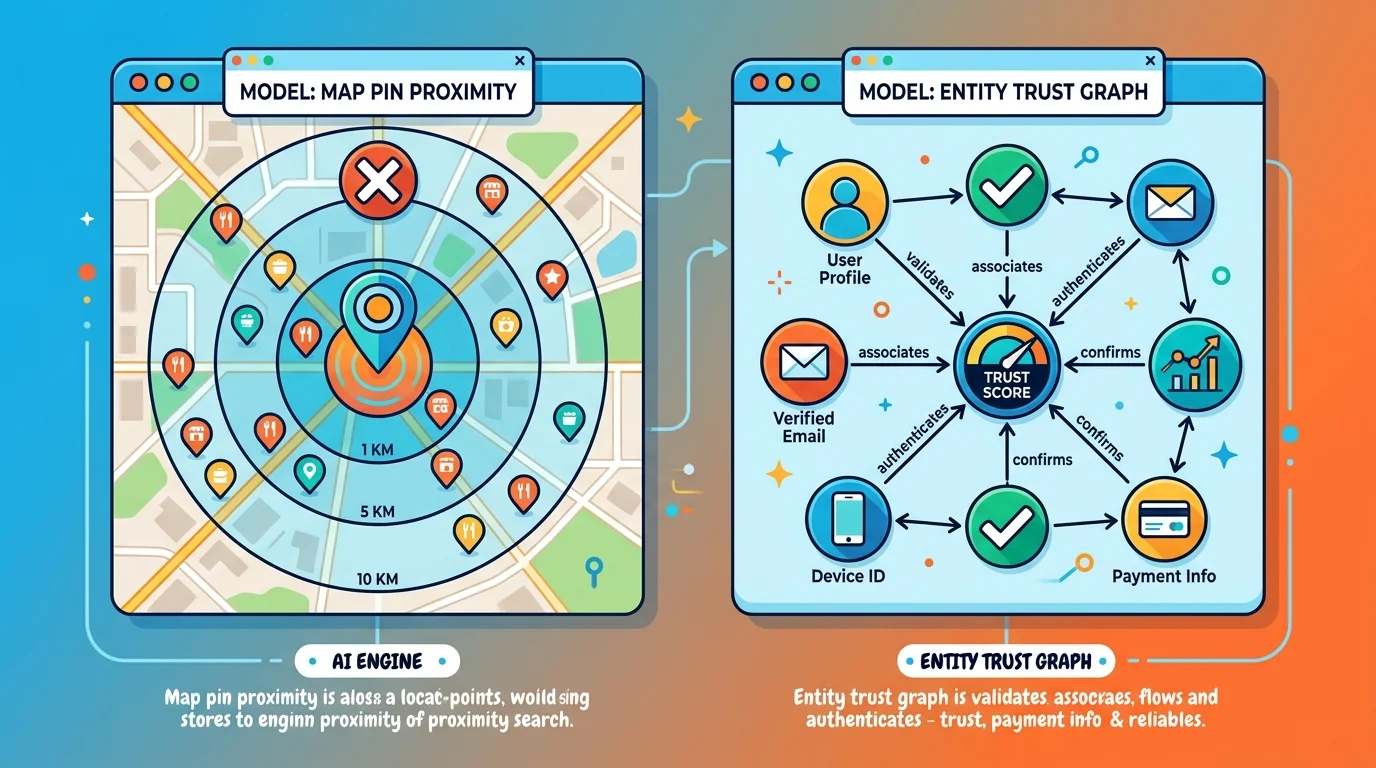
AI engines don’t rank practices. They recommend entities.
That distinction is not semantic. It changes everything about how a single-location clinic should be building national visibility right now.
When a patient asks an AI engine who the best specialist is, the engine isn’t cross-referencing a map. It’s running an entity evaluation. Does this practice have a coherent, trusted identity across the web? Does its content demonstrate deep topical authority? Do credible third-party sources treat it as a legitimate voice?
Gartner predicts traditional search engine volume will drop 25% by 2026 as conversational AI queries replace the old scroll-and-click behavior. That shift isn’t coming. It’s already underway. And the evaluation logic driving it has no proximity filter built in.
McKinsey found that over 70% of patients expect active digital engagement when researching and selecting healthcare providers. They’re not filtering by metro area inside an AI interface. They’re asking who the most credible expert is.
The engine answers with whoever built the strongest entity trust.
The physical address was never the constraint. The entity signal was.
Entity Trust vs. Proximity: How the Ranking Logic Changed
Proximity-based tactics were engineered for local map algorithms. Those systems rewarded physical distance, citation density inside a geographic radius, and location-keyword saturation.
AI engines don’t run those calculations.
The question an AI engine asks is not "where is this practice?" It is "does the broader web treat this entity as a credible, specialized authority?"
None of that evaluation has a zip code in it. The separation between entity signals vs practicing across state lines is exactly this: authority infrastructure operates at the entity level, while clinical care delivery operates at the jurisdictional level. Those are two separate tracks that do not interfere with each other.
A practice with a strong entity foundation, deep Semantic Density, and consistent Citation Velocity gets recommended to patients who’ve never heard of its city.
That’s not a loophole. That’s how the technology actually works. The engine isn’t penalizing single-location practices for having one address. It’s rewarding whoever built the deepest trust signals – regardless of where that address is.
Why Most Single-Location Practices Lose the National Recommendation
Most single-location practices lose the national recommendation before they ever knew they were competing for it.
They rank well locally. They assume their digital presence is solid. And they never realize the entity signals AI engines actually evaluate are either missing or too shallow to register at a national level. Local visibility and national entity trust are not the same thing. Treating them like they are is the mistake that keeps practices invisible.
The National Institutes of Health confirmed it: regulatory variation across jurisdictions is the chief operational barrier for scaling multi-state telehealth delivery. That’s a real friction point. But it’s a clinical delivery problem.
It’s not an authority infrastructure problem. A practice doesn’t need to treat patients in forty states to be recommended by AI engines to patients in forty states. The AEO content execution that builds national entity trust is a marketing infrastructure investment. And it compounds in a way that proximity-based tactics never could.
| Signal Type | Google Maps Logic | AI Answer Engine Logic | Clinic Action Required |
|---|---|---|---|
| Location Proximity | Primary ranking factor – physical distance between searcher and practice determines recommendation priority | Ignored – entity evaluation operates at the web-wide trust level, not geographic distance | Remove proximity dependency from content strategy; build entity signals that function without a zip code |
| Identity Verification | Consistent NAP data across local directories and Google Business Profile | Coherent schema markup, defined specialty taxonomy, and verified third-party presence across institutional sources | Rebuild Entity Foundation with structured schema, accurate taxonomy, and directory presence that extends beyond local citation networks |
| Topical Authority | Location-keyword saturation in page titles and meta descriptions | Depth and consistency of published content demonstrating specialized expertise on a defined niche | Invest in Semantic Density – not broad content volume, but deep coverage of the specific problems patients in the specialty actually face |
| Third-Party Validation | Citation count within a defined geographic radius | Credible external references from directories, industry publications, and institutional sources treating the entity as a trusted voice | Build Citation Velocity through sustained presence in authoritative sources that signal credibility to AI engines over time |
| Search Trigger | User enters location-modified query (‘chiropractor near me’, ‘best dentist in [city]’) | User asks a conversational question about a condition, specialty, or recommendation without specifying geography | Optimize content and entity signals for condition-level and specialty-level questions – not location-modified keyword patterns |
| Competitive Boundary | Practices compete within a defined metro radius – geographic walls limit both exposure and threat | No geographic ceiling or floor – any practice with stronger entity trust can be recommended to patients anywhere | Treat national visibility as achievable from one address; the competitive boundary is entity signal depth, not physical market territory |
Compliance Guardrails: What National Reach Means for Telehealth Regulations
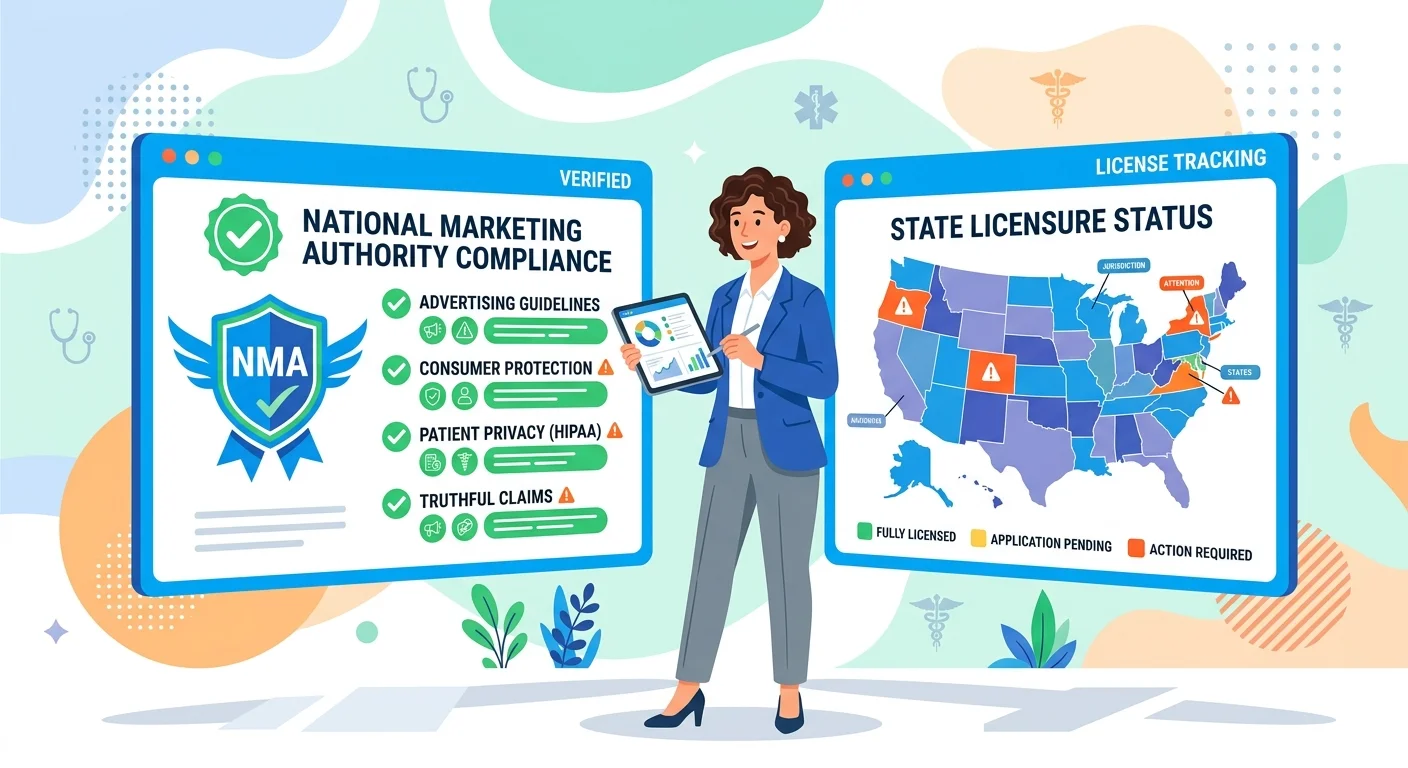
Here’s the question every practitioner asks the moment national reach enters the conversation: does marketing to out-of-state patients create a licensing problem?
No. And understanding exactly why is what separates practices that scale from practices that stay trapped inside a zip code.
Marketing is not practicing. Those are two different tracks with two different regulatory frameworks.
A clinic can build national entity trust, publish deep topical authority content, and get recommended by AI engines to patients in states where it holds no clinical license. Because it is not delivering clinical care across that distance. It is being recognized as a credible authority. That recognition is the engine.
Research published by the National Institutes of Health confirms it plainly: regulatory variation across jurisdictions is the chief operational barrier for multi-state telehealth delivery.
That is a clinical delivery problem. It does not touch authority infrastructure.
Keep those two tracks separate and the compliance problem disappears entirely.
Marketing Authority Nationally vs. Practicing Across State Lines
Telehealth clinics practicing across state lines face real obligations. The cross-state licensing framework governs care delivery – interstate licensing compacts, state-specific regulations, the whole compliance stack.
None of that applies to publishing authoritative content, building entity trust signals, or appearing in AI recommendations.
The framework says nothing about whether an AI engine can name your practice to someone in another state. Because that is not a clinical act. That is a trust signal.
Here’s what that means in practice: the geographic limit on clinical delivery does not create a geographic limit on authority.
A practice licensed in one state can hold national entity trust. AI engines will recommend it to patients across the country – because authority operates at the entity level, not the address level.
That is not a loophole. That is how the technology works.
Practices that try to shortcut national reach by flooding the web with city-specific pages are solving the wrong problem. The fifty-city landing page strategy fails at the entity level in ways that proximity-based tactics never warned them about.
AI engines do not validate authority by counting location pages. They evaluate whether the entity itself is credible. The geographic workaround strategy misreads the engine entirely.
You can also see how this plays out in practice across our AEO case studies.
FTC Standards and What Every Clinic Publishing Health Claims Must Know
There is one compliance layer that applies to marketing – and it has nothing to do with geography.
The FTC compliance standards require that any public marketing claims about health outcomes or clinical efficacy be backed by competent and reliable scientific evidence. That standard applies whether a clinic is marketing locally or nationally.
Same rule. Regardless of reach.
For practices building national authority through AEO content execution, that FTC standard is not a guardrail. It is a competitive filter.
Content built on verifiable clinical depth – the kind that demonstrates real topical authority instead of generalized marketing language – satisfies the FTC requirement by default. And it is exactly what AI engines reward with authority signals.
Publish what is true. Publish it with depth. The compliance and the authority build from the same source.
| Activity | Regulatory Body | Compliance Requirement | AEO Content Impact |
|---|---|---|---|
| Delivering clinical care across state lines via telehealth | HHS / State Medical Boards | Must comply with interstate licensing compacts and state-specific telehealth regulations – active licensure required in the patient’s state | No impact – clinical delivery and authority infrastructure are separate tracks entirely |
| Publishing topical authority content and AEO articles | FTC (marketing compliance) | Health outcome or efficacy claims must be backed by competent and reliable scientific evidence | Direct alignment – depth-first, evidence-backed content satisfies FTC standards and builds the entity trust AI engines reward |
| Appearing in AI engine recommendations for patients in unlicensed states | None – no regulatory body governs AI-generated recommendations | No licensing obligation applies to being named by an AI engine to a patient in another state | Fully permissible – authority infrastructure operates at the entity level, not the jurisdictional level |
| Building national entity trust signals (schema, citations, content depth) | None directly applicable | No geographic restriction on publishing authoritative content or earning third-party citations | Core mechanism – entity signals accumulate nationally regardless of where the clinic’s single address is located |
| Making explicit clinical outcome guarantees in marketing content | FTC | Marketing claims about clinical results require substantiation by reliable scientific evidence – applies locally and nationally at the same standard | Avoided by design – AEO content builds topical authority through depth and accuracy, not outcome promises |
| Scheduling and onboarding out-of-state patients for in-person care | State Medical Boards / Facility Licensing | Governed by the clinic’s state license scope – patient must travel to the licensed location for care | Neutral – authority infrastructure drives national awareness; care delivery logistics remain the practice’s operational decision |
Frequently Asked Questions
Here’s where it gets practical.
Practitioners don’t just want the framework. They want to know if this actually applies to them – and what the limits are.
These are the questions that come up every time national entity authority enters the conversation. Straight answers only.
How can a single-location clinic attract out-of-state patients without opening new physical offices?
Build national entity trust and the engine does the reaching for you.
AI engines don’t ask how many locations a clinic has. They ask whether the entity is credible. When a patient three states away asks who the most qualified specialist is in a given field, the engine runs an entity evaluation – not a proximity check.
A practice with a strong Entity Foundation, genuine Semantic Density, and consistent Citation Velocity shows up in that answer. The clinic’s physical address is not a factor. The entity signal is the only thing being evaluated.
What is the difference between local search signals and national entity signals in AI answer engines?
Local signals are built for proximity. They reward physical distance, geographic citation density, location-keyword saturation – the mechanics of map-pack algorithms.
National entity signals run on completely different logic. The question isn’t "where is this practice?" It’s "does the broader web treat this entity as a credible, specialized authority?"
McKinsey research shows over 70% of modern patients expect active digital engagement when researching healthcare providers – and they’re doing that research inside AI interfaces that run entity-level evaluations, not geographic ones. Local signals get a practice on a map. National entity signals get it named as the answer.
How do AI search engines verify the authority of a clinic’s medical claims across multiple states?
AI engines don’t verify clinical claims directly. But they do evaluate whether the entity behind those claims is credible – and that evaluation runs through all three layers.
Is the Entity Foundation coherent and consistent across the web? Does the content demonstrate genuine Semantic Density on the relevant specialty? Does Citation Velocity show that credible third-party sources treat this practice as a legitimate authority?
The FTC requires that any public marketing claims about health outcomes be backed by competent and reliable scientific evidence. Content built to satisfy that standard is exactly what AI engines reward with authority signals. Factual depth and regulatory compliance point in the same direction. That’s not an accident – it’s the whole game.
Will marketing nationally through AEO content violate telehealth regulations if the clinic only holds one state license?
No. Marketing is not practicing. Those are two entirely separate tracks governed by two entirely separate regulatory frameworks.
Telehealth licensure rules apply to clinical care delivery – treating patients across state lines. They don’t apply to publishing authoritative content, building entity trust signals, or appearing in AI recommendations.
A clinic can be named by an AI engine to a patient three states away without holding a clinical license in that state. Because it isn’t delivering care across that distance – it’s being recognized as a credible authority. That’s a marketing outcome. The regulatory framework has nothing to say about whether an AI engine can name your practice to someone in another state.
How long does it take for a single-location practice to start appearing in national AI recommendations?
There’s no honest timeline to give – and any agency that offers one is selling something.
Here’s what is true: authority compounds. Gartner predicts traditional search engine volume will drop 25% by 2026 as conversational AI replaces the old discovery model. The practices building entity trust now are compounding that advantage every month. The ones waiting for a guaranteed number are watching the window close.
Every month of AEO content execution builds on the last. Entity Foundation, Semantic Density, and Citation Velocity reinforce each other. The compounding is real. Manufacturing a timeline isn’t.
What does ‘entity trust’ actually mean – and why does it matter more than keyword rankings for national reach?
Entity trust is the degree to which the broader web – AI engines, credible third-party sources, structured data signals – treats a practice as a coherent, legitimate, specialized authority.
It’s not a score. It’s not a ranking. It’s a verdict.
McKinsey found that over 70% of modern patients expect active digital engagement when selecting a healthcare provider – and they find those providers through AI interfaces that run entity trust evaluations directly. A practice with strong entity trust gets named. A practice without it stays invisible, regardless of how well it ranked before the model shifted.
Proximity-based signals don’t scale across state lines. Entity trust does. For national reach, it’s the only currency that matters.
One Address. A National Footprint. Here’s the Move.
The physical address was never the constraint. The entity signal was.
A single-location clinic can hold national entity trust, get recommended to patients in states it has never operated in, and build a patient acquisition engine that compounds month over month. Not because it found a loophole. Because it built what the technology actually rewards.
Entity Foundation. Semantic Density. Citation Velocity. Those three layers don’t care where the clinic is. They care whether the entity is trusted.
Every practice sitting inside a zip code right now is either building that trust or watching a competitor do it.
There’s no neutral position. AI recommendations are happening in your market right now. The engine isn’t waiting for you to get ready.
Practices that move first compound the fastest. The ones that wait hand that ground to whoever didn’t – and it doesn’t come back.
One address. No satellite offices. Named three states away.
That’s not a lucky outcome. That’s what happens when you build the right infrastructure and don’t stop executing.
The only question left: is your practice building it – or is your competitor already ahead of you?
One address. No satellite offices. Recommended three states away. That’s not a fantasy – it’s what entity trust actually does when it’s built correctly. The only question is whether AI engines are saying that about your practice right now, or your competitor’s.