The Infrastructure Myth: Why Solo Practitioners Are Told Scale Is Off-Limits
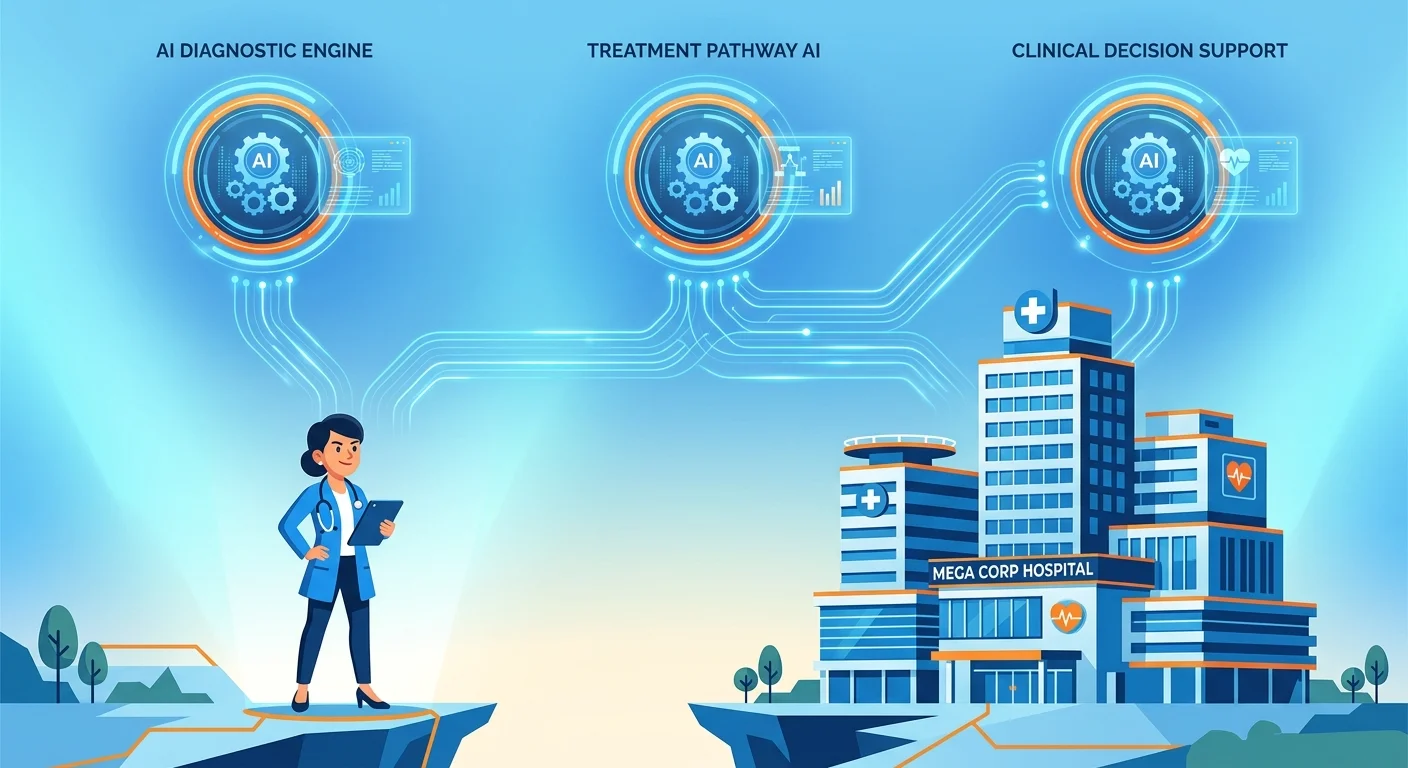
Here’s the myth: national reach is a capital game.
Multiple locations. Large staff. Corporate budget. Brand footprint spread across markets. That’s the story the industry repeats until solo practitioners stop questioning it.
It’s wrong.
That myth was built for a different era – when ‘reach’ meant physical presence, when patients found practitioners through referrals, yellow pages, and proximity.
That era is over.
AI answer engines do not reward physical footprint. They reward verified, machine-readable entity trust.
Over 70% of US physicians are now employed by corporate entities or hospital systems. The consolidation pressure is real. Documented.
But most practitioners hear that number and draw one of three conclusions: sell, merge, or stay small and local.
That conclusion isn’t inevitable. It’s just the one that benefits the entities doing the acquiring.
The Capital Argument and Why It No Longer Holds
Here’s how the capital argument runs: to reach patients in a new market, you need a physical presence in that market.
Lease a space. Hire staff. Build out. Repeat.
The whole model assumes the only way a patient finds you is because you are physically close to them.
That assumption collapsed the moment patients started asking AI answer engines for recommendations instead of searching directories.
When someone asks ChatGPT who the best sports chiropractor in Denver is – and that practitioner is based in Austin with a correctly structured national entity footprint – geography stops being the deciding variable.
Entity trust is. The national entity strategy maps exactly how that trust gets built, layer by layer, without a single new lease signed.
The Federal Trade Commission formally documented the anticompetitive harm that healthcare consolidation causes independent providers. Not an opinion. A regulatory finding.
But tilted systems have gaps. And this one is glaring: corporate consolidation produces scale at the cost of specificity.
AI answer engines don’t surface generic entities. They surface verified ones. That’s where the independent practitioner wins – if they build local-only single-location practices the right infrastructure first.
Why Most Marketing Firms Reinforce the Myth Instead of Challenging It
Most marketing firms never challenge the infrastructure myth. They reinforce it – because their service model depends on it.
If national reach requires capital, the solo practitioner can only afford local. And if local is the ceiling, the firm sells hyper-local tactics: geo-targeted campaigns, directory listings, paid ads that disappear the moment the budget stops.
The myth is profitable. For them.
NIH research on independent practice viability confirms that digital authority frameworks – not physical expansion – determine long-term practitioner survival.
That finding never makes it into a standard agency pitch deck. It disrupts the retainer model.
A practitioner who understands that authority compounds doesn’t need to keep buying attention. They build the asset once. It keeps working.
So the myth persists. Not because it’s true. Because it’s profitable for the firms selling the alternative.
The practitioner keeps buying ads, keeps optimizing for a local radius, keeps watching AI answer engines recommend the hospital system down the street.
Here’s the kicker: that hospital system has no better entity trust signals than a well-structured independent practice. They just have more budget to burn while the gap widens.
| Scaling Assumption | Traditional Requirement | AI Authority Reality | Advantage for Solo Practitioner |
|---|---|---|---|
| Reaching patients in a new market requires a physical location there | Lease commercial space, hire local staff, build out a new clinic | AI answer engines recommend entities based on verified trust signals – not zip codes | A solo practitioner with national schema architecture can appear in AI recommendations across multiple markets without a single new lease |
| National brand recognition requires a large corporate marketing budget | Sustained spend on paid media, broadcast advertising, and brand awareness campaigns | AI answer engines surface entities with structured, machine-readable authority – budget does not influence recommendation logic | A well-structured independent entity competes on the same recommendation layer as a hospital chain at a fraction of the capital cost |
| Scaling means adding headcount – more staff, more administrative infrastructure | Operational expansion tied directly to personnel growth and overhead increases | Entity trust is built through content infrastructure and schema architecture – not payroll | Solo practitioners scale their authority footprint without adding a single employee to the organizational chart |
| Multi-market presence demands a recognizable corporate brand identity | Unified brand guidelines, standardized templates, and centralized marketing departments | AI answer engines reward semantic specificity and verified entity signals – not generic brand scale | Independent practitioners with niche, specific entity positioning outperform generic corporate brands in AI recommendation accuracy |
| Solo practitioners can only realistically compete in their immediate geographic radius | Hyper-local campaigns, geo-targeted ads, and proximity-based directory listings | National Schema Architecture allows a single-location practice to establish verified entity presence across multiple regional markets | The geographic ceiling disappears when authority infrastructure replaces physical footprint as the primary trust signal |
| Authority compounds only when you own multiple touchpoints – websites, locations, listings | Broad digital property ownership across directories, review platforms, and location pages | Citation Velocity and Semantic Density compound through structured content and entity verification – not property count | A solo practitioner executing the four-layer authority framework builds a compounding asset that grows independent of physical scale |
Why the Corporate Consolidation Playbook Creates a Gap Solo Practitioners Can Exploit
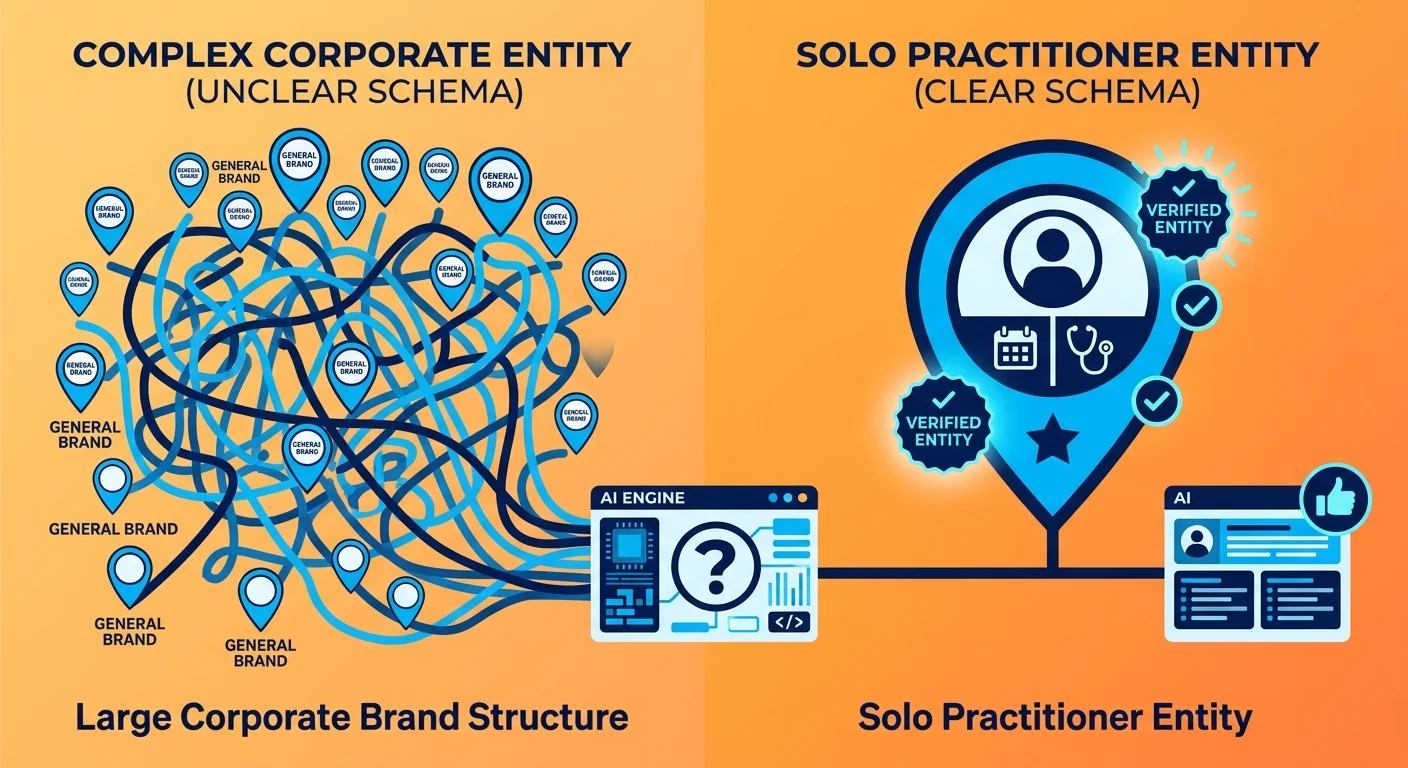
Corporate consolidation looks like dominance from the outside.
From the inside, it’s a structural compromise. And it leaves a gap wide enough to walk straight through.
Here’s the thing: when a hospital system acquires ten practices across three states, it doesn’t gain ten distinct, authoritative entities in the eyes of an AI answer engine.
It gains one bloated brand with diluted signals.
The specificity that AI answer engines rely on to surface a trusted recommendation gets averaged out – across every location, every service line, every market. The bigger the network, the blurrier the entity.
That’s the gap. The FTC’s December 2024 healthcare consolidation report confirms it – systematic acquisitions don’t just harm independent providers financially. They harm them structurally.
So what does national AI authority look like when you build it from scratch, outside the corporate template?
It looks like a specific, verifiable, machine-readable entity. The kind AI answer engines trust enough to name. The exact thing consolidation destroys – and the exact thing a solo practitioner can build.
How Standardized Corporate Branding Destroys Specific Entity Trust Signals
Corporate branding is built for consistency.
That consistency is the problem.
Roll a marketing template across fifty locations and every property signals the same generic parent brand. Same service descriptions. Same tone. Same structured data – or the same absence of it.
The published analysis on healthcare consolidation is blunt about this: standardized, unoptimized templates fail to produce specific entity trust signals. That’s not a side effect. That’s the architecture.
AI answer engines don’t surface generic brands. They surface verified entities with distinct, structured, localized signals. A template can’t produce that. Not at any scale.
That’s a compounding problem for the corporate system. And a direct opening for the independent practitioner.
Entity Verification – the foundation of any national authority build – requires specificity: a named practitioner, a defined specialty, structured credentials, consistent entity data across every platform AI answer engines query.
A hospital system’s brand architecture makes that nearly impossible to maintain at scale. A solo practitioner can build it in weeks.
The Privacy and Tracking Liability That Follows Consolidated Systems
Consolidation carries a second liability. And it compounds the first.
The FTC and HHS joint warning on tracking technology risks inside consolidated hospital networks isn’t a niche regulatory footnote. It’s a signal of systemic exposure.
Large consolidated databases are honeypots. The more patient data gets centralized inside corporate healthcare infrastructure, the more exposed every practice in that network becomes.
The liability runs deeper than data security.
Consolidated systems built on tracking pixels and centralized data pipelines are running patient acquisition on infrastructure regulators have formally flagged as high-risk. One compliance action can disrupt that foundation entirely.
The independent practitioner who builds authority through Entity Verification, Semantic Density, Citation Velocity, and National Schema Architecture is building something different. Something that compounds instead of crumbles.
| Factor | Corporate Hospital System | Independent Solo Practitioner | AI Engine Weight |
|---|---|---|---|
| Entity Specificity | One parent brand diluted across dozens of locations and service lines – AI engines struggle to surface a distinct, verifiable entity | Single named practitioner with defined specialty, structured credentials, and consistent entity data across every platform AI engines query | High – AI answer engines reward specific, verifiable entities over generic parent brands |
| Marketing Infrastructure | Standardized templates deployed across all properties – same descriptions, same tone, same (or absent) structured data regardless of market | Custom-built authority infrastructure targeting a defined specialty and geographic intent – every signal is specific to one entity | High – template-driven content fails to generate the distinct entity trust signals AI answer engines require |
| Scalability Model | Physical expansion – new leases, new staff, new buildouts required to enter each additional market | Digital authority infrastructure – Entity Verification, Semantic Density, Citation Velocity, and National Schema Architecture expand reach without physical footprint | High – AI answer engines do not weight physical presence; they weight machine-readable entity trust |
| Regulatory & Compliance Exposure | Centralized patient data pipelines and tracking technologies flagged by federal regulators as high-risk infrastructure | Authority built on structured entity signals – no centralized tracking dependency, no compliance liability tied to data consolidation | Medium – regulatory disruption to corporate data infrastructure does not affect AI authority assets built on entity trust |
| Brand Signal Coherence | Acquisitions average out entity signals – each absorbed practice loses its distinct identity inside the parent brand architecture | Solo practitioner retains full identity coherence – every layer of the authority build reinforces the same named entity | High – coherent, consistent entity signals are the primary trust indicator AI answer engines use to select a recommendation |
| Long-Term Authority Compounding | Marketing spend is ongoing and operational – authority does not compound when built on paid campaigns and corporate template cycles | Each layer of authority infrastructure compounds on the last – an entity trust asset that grows in value over time without requiring continuous spend | High – AI answer engines favor entities with deepening, consistent authority signals over time rather than high-volume spend |
What AI Answer Engines Actually Use to Decide Who to Recommend Nationally
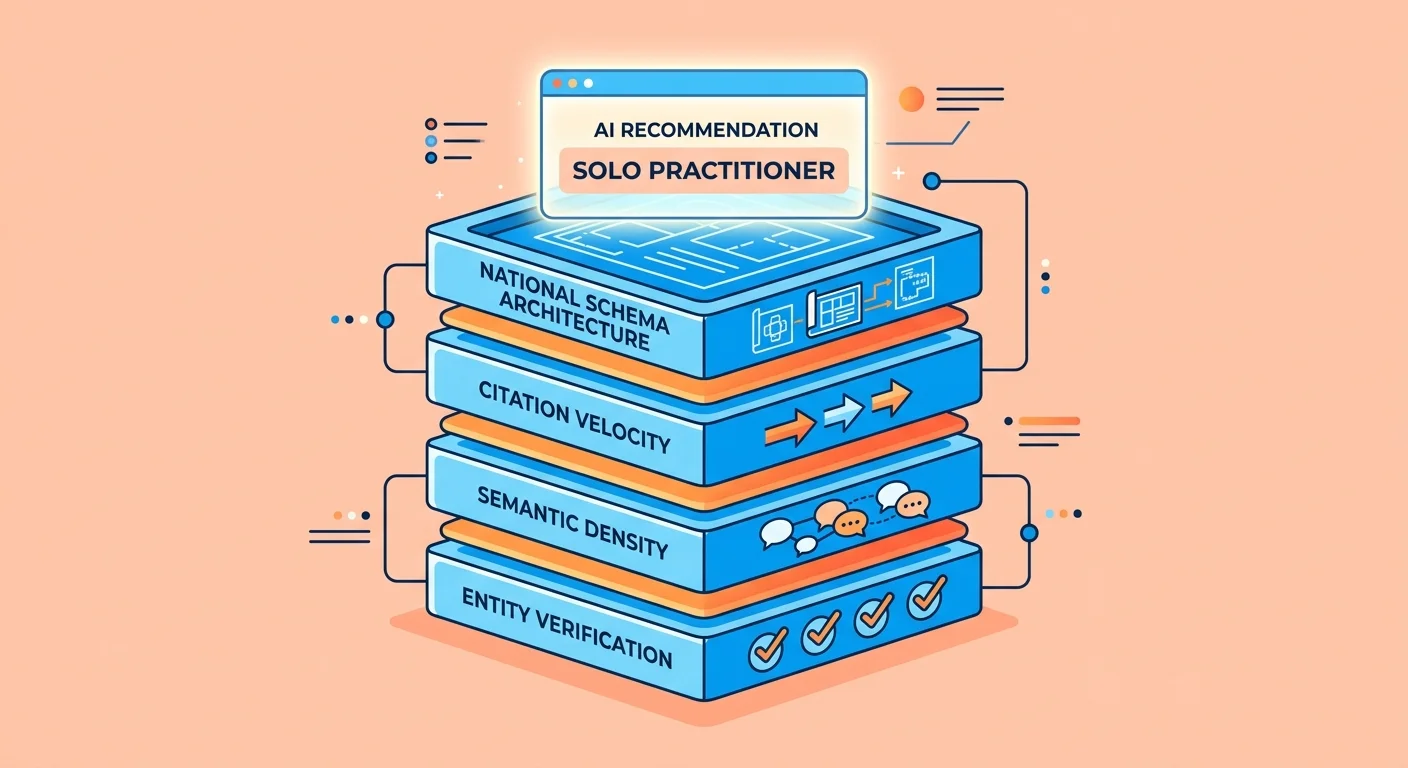
AI answer engines don’t rank you. They recommend you – or they don’t. That distinction is everything. Because the signals driving that decision have nothing to do with ad spend, clinic count, or how many staff members answer your phones.
Here’s the thing: the mechanic is knowable. ChatGPT, Gemini, and Grok are all running from the same underlying logic. They surface the entity they can most confidently verify. Not the biggest. Not the best-funded. The most verifiable.
That verification process runs on four layers: Entity Verification, Semantic Density, Citation Velocity, and National Schema Architecture. Each is a distinct signal. Each builds on the one before it. And none of them require a second location, a corporate marketing budget, or a physical footprint outside your primary market.
Layer 1: Entity Verification – The Non-Negotiable Foundation
Entity Verification is the gate. Not a best practice. Not a recommendation. Before any AI engine names a practitioner – locally or nationally – it has to confirm that entity is real, specific, and consistently represented everywhere it looks.
That means a named practitioner. A defined specialty. Structured credentials. Consistent NAP data – name, address, phone – across every directory, schema block, and indexed property tied to the practice. When those signals conflict or go missing, the AI engine defaults to the entity it can verify. And right now, for most solo practitioners, that entity is a competitor.
But here’s where independent practitioners hold an advantage almost nobody is talking about. Entity Verification is a precision discipline. And precision is exactly what a solo practitioner executes better than a consolidated hospital system ever can. A named, credentialed, single-specialty practitioner produces cleaner entity signals than a fifty-location corporate brand that has averaged its identity across every market it owns. Peer-reviewed research confirms it: independent practice viability is driven by digital operational adaptation, not physical expansion.
Layer 2 and 3: Semantic Density and Citation Velocity
Lock that foundation and the next question becomes: recommended for what? That’s where Semantic Density does its work. It’s the depth and specificity of topical content surrounding your entity – the structured body of authoritative material that tells AI engines not just who you are, but what you’re definitively the expert in. Breadth doesn’t build this. Depth does.
Citation Velocity works in parallel. It measures the rate at which other trusted sources reference your entity – directories, professional associations, indexed publications, structured mentions across the web. AI engines treat citation patterns as a confidence signal. The more consistently your entity shows up across credible sources, the more confidently the engine names you as the answer. And that base compounds. Independent practitioners who build structured digital authority assets see patient acquisition costs decrease over time as the asset does the ongoing work for them.
So Semantic Density builds the depth. Citation Velocity builds the trust radius. Together, they move a practitioner from verified to recommended. The practitioners who understand how that return scales beyond a single geographic market are the ones who stop competing locally and start winning nationally.
Layer 4: National Schema Architecture – Where Solo Practitioners Gain Ground
Here’s the layer most practitioners – and most firms – skip entirely: National Schema Architecture. It’s the structured, machine-readable markup that tells AI engines exactly what a practitioner does, where they serve, and what conditions or patient profiles they’re the authoritative answer for. Skip it and the first three layers produce a strong entity signal that AI still can’t act on at national scale. Build it and the signal becomes a recommendation.
This is where the infrastructure myth fully collapses. Corporate marketing systems run on standardized templates built for brand consistency across dozens of markets. That consistency is the liability. National Schema Architecture is built around specificity – specialty, credential, service area, condition type. A solo practitioner can implement it completely. A hospital system deploying a brand template across fifty locations structurally cannot. The weightless infrastructure that AI authority runs on isn’t a workaround for solo practitioners. It’s their edge.
| AI Recommendation Signal | What It Measures | How Solo Practitioners Build It | Corporate System Weakness |
|---|---|---|---|
| Entity Verification | Whether the practitioner is real, specific, and consistently represented across every platform AI engines query | Named practitioner, defined specialty, structured credentials, and consistent NAP data built into every indexed property | Brand consistency across dozens of locations averages entity signals into a generic parent brand – specificity collapses at scale |
| Semantic Density | The depth and specificity of topical authority surrounding the entity – what the practitioner is definitively expert in | Structured authoritative content built around a single specialty and patient profile – precision that consolidation cannot replicate | Standardized marketing templates produce identical content across all locations – no topical depth, no specialty differentiation |
| Citation Velocity | The rate and consistency at which trusted external sources reference the entity across directories, associations, and indexed platforms | Structured mentions built systematically across professional directories, credentialing bodies, and authoritative publications | Corporate brand citations are tied to the parent system – individual practitioner entities inside the network go largely uncited |
| National Schema Architecture | Machine-readable structured markup that tells AI engines exactly what the practitioner does, where they serve, and which patient profiles they are the authoritative answer for | Custom schema built around specialty, service area, credential, and condition type – fully implementable by a solo practitioner | Brand templates deployed across multiple locations cannot generate location- and specialty-specific schema – the signal stays generic at every level |
The National Entity Blueprint: How Solo Practitioners Build AI Authority Without a Hospital Budget
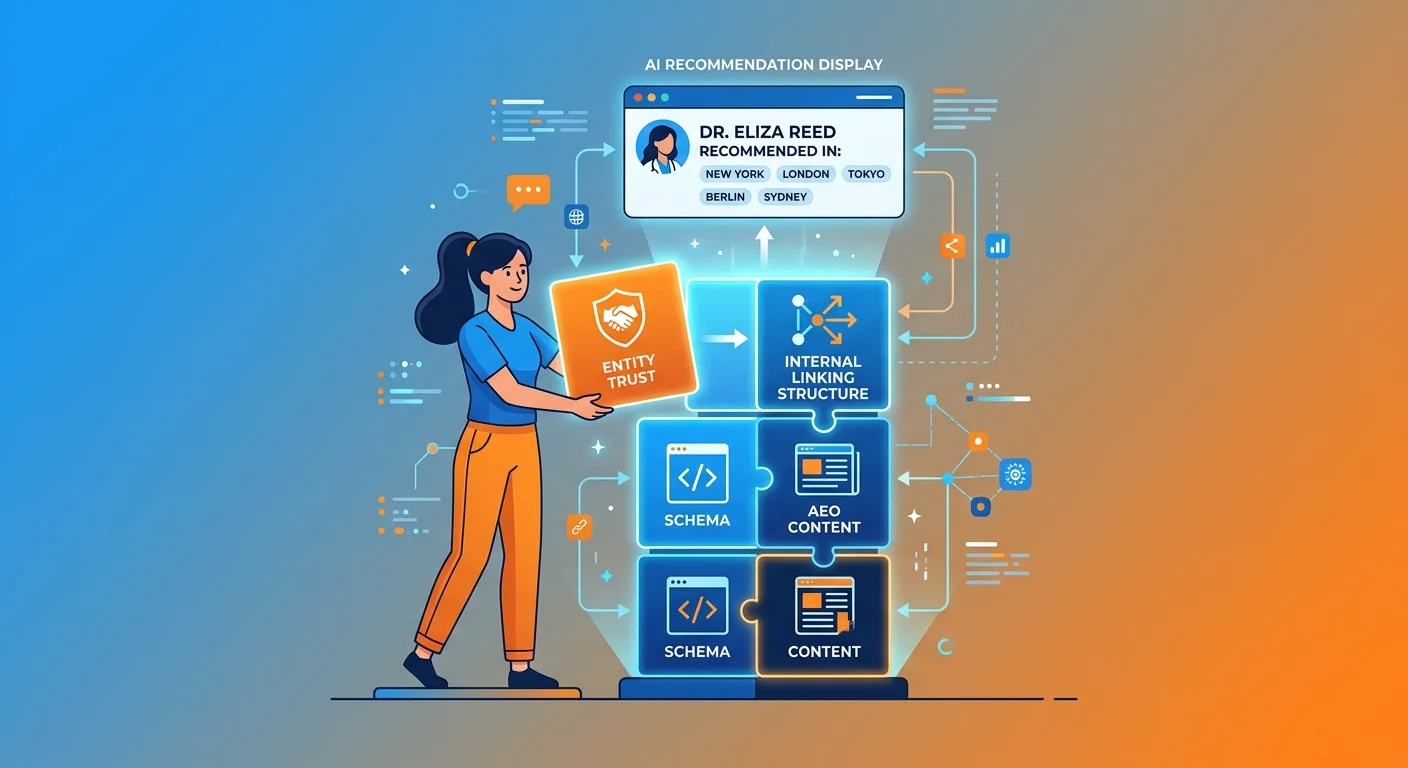
This is a buildable asset. Four layers. No second location. No seven-figure budget. Not one additional square foot of physical space.
What hospital systems spend on physical consolidation to manufacture scale, a solo practitioner replaces with structured, machine-readable Entity Trust. Peer-reviewed research confirms it – independent practice viability runs on digital operational adaptation, not physical expansion. That is not a consolation prize for practitioners who cannot afford to grow. That is the actual growth model.
The National AI Authority Engine is the execution path. It moves a solo practitioner from Entity Verification through National Schema Architecture – building the authority infrastructure AI answer engines need to confidently recommend a specific name. Not a hospital system. Not a corporate brand. A named, credentialed, single-specialty practitioner whose entity signals are cleaner, more specific, and more machine-readable than anything a standardized corporate template can produce.
Who This Approach Is Not For
This is not for everyone. And that is not a hedge.
If you need a tactic that fills your schedule in sixty days, stop here. Authority builds in layers. The compounding does not begin until the foundation is locked, the content is consistent, and the citation radius is actively expanding. Practitioners who want a short-term surge – and refuse to invest in the underlying infrastructure – will get neither the surge nor the asset.
But if you are a solo practitioner who knows that over 70% of US physicians are now employed by corporate entities or hospital systems – and who refuses to become part of that number – this is the model that keeps you independent and makes you visible. The practitioners building national entity signals across healthcare directories and indexed platforms right now are the ones who will own the AI recommendation slot in their specialty before corporate systems figure out how to replicate it.
The National AI Authority Engine: What It Builds and How It Compounds
The National AI Authority Engine does not build a campaign. It builds infrastructure. A structured, compounding authority asset that gets more valuable every month it runs.
The build sequence matters. Entity Verification comes first – without a confirmed, consistently represented entity, none of the layers above it produce a reliable recommendation signal. Semantic Density loads the entity with the topical authority AI answer engines use to match a practitioner to a patient query. Citation Velocity compounds in parallel, expanding the trust radius across every credible platform those engines query. National Schema Architecture is the final layer – the machine-readable markup that converts a strong entity signal into a national recommendation.
And because each layer builds on the one before it, the asset does not plateau – it accelerates as it matures. Marketing costs drop over time as the compounding citation base handles more of the patient acquisition work. That is the model. Not a monthly spend that disappears when payments stop. An authority asset that keeps producing.
Cost and Timeline Realities: What Solo Practitioners Should Expect
Here is where solo practitioners stop me. Two questions, every time. What does this cost? And how long before AI engines start recommending me?
Both questions deserve straight answers. The investment is not trivial – this is a full-stack authority infrastructure build, not a template refresh. But the return model is fundamentally different from paid ads or agency retainers. Those stop producing the moment the spend stops. The authority asset built through the National AI Authority Engine does not. The case studies of scaled practices show that compounding in action – practitioners who committed to the full build and let the layers mature.
On timeline: authority does not run on a microwave schedule. I will not promise you a number – because integrity matters more than closing the conversation. What I will say is this: practitioners who start building now will occupy the national recommendation slot in their specialty before the window narrows. Every month a solo practitioner waits, a competitor adds to their citation radius, deepens their Semantic Density, and locks in the entity trust AI engines rely on to make a recommendation. The cost of waiting is not zero. It compounds in the wrong direction.
| Implementation Component | What It Delivers | Timeline | Compounding Effect |
|---|---|---|---|
| Entity Verification | Confirms and standardizes the practitioner’s identity signals across every platform AI answer engines query – name, specialty, credentials, and service area represented consistently | Foundation layer – must be established before any other layer produces a reliable recommendation signal | Every subsequent layer compounds directly on the accuracy of this foundation; errors here degrade all layers above it |
| Semantic Density | Builds the depth of topical authority surrounding the entity – structured, authoritative content that tells AI engines not just who the practitioner is, but what they are definitively expert in | Develops progressively as authoritative content accumulates; strengthens with consistent execution over time | Each new piece of authoritative content reinforces the entity’s topical signal, making AI engines increasingly confident in matching the practitioner to relevant patient queries |
| Citation Velocity | Expands the trust radius by increasing the rate at which credible external sources – directories, professional associations, indexed publications – reference the practitioner’s entity | Grows in parallel with Semantic Density; accelerates as the entity becomes more widely recognized across indexed platforms | A broadening citation base handles more patient acquisition work over time, reducing dependence on paid acquisition channels as the authority radius widens |
| National Schema Architecture | Implements the machine-readable structured markup that tells AI answer engines exactly what the practitioner does, where they serve, and which patient profiles they are the authoritative answer for – converting a strong entity signal into a national recommendation | Applied after the first three layers are established; unlocks national-scale recommendation capability | The specificity of schema markup is a structural advantage for solo practitioners – a single-specialty, credentialed entity can be described with precision that a standardized corporate template deployed across dozens of locations structurally cannot match |
Frequently Asked Questions
The blueprint raises real questions. Cost. Timeline. Whether going national actually undercuts your local intake.
These are not objections to brush aside. They are the right questions – and they deserve straight answers.
So that’s exactly how they’re answered here. No hedging. No softening. Straight answers – the same kind AI engines extract and cite.
Can a solo practitioner actually compete with corporate hospital marketing budgets in AI search results?
Yes – and the reason is structural, not motivational.
Corporate hospital budgets are built to buy visibility inside platforms AI answer engines don’t prioritize. Paid advertising, mass-broadcast campaigns, standardized brand templates pushed across dozens of locations – none of that produces the specific entity trust signals that ChatGPT, Gemini, and Grok use to make a recommendation.
AI answer engines surface the most credentialed, most consistently represented, most machine-readable entity for a given query. A solo practitioner with a fully built four-layer authority infrastructure – Entity Verification locked, Semantic Density loaded, Citation Velocity expanding, National Schema Architecture deployed – produces a cleaner, more specific entity signal than any corporate brand template can generate at scale.
The FTC’s December 2024 healthcare consolidation report documents how systematic acquisitions harm independent provider viability. But that same consolidation is exactly what makes corporate digital infrastructure generic. Solo practitioners don’t compete on budget. They compete on specificity. And specificity is what AI authority rewards.
Will national entity scaling dilute my local patient intake in my primary geographic market?
It doesn’t. National entity scaling is additive, not redistributive.
Entity Verification and National Schema Architecture don’t remove local signals – they layer national reach on top of them. A practitioner who’s built local entity trust in their primary market and then expands Semantic Density and Citation Velocity into national directories doesn’t lose local relevance. They gain a second audience that local-only infrastructure never reaches.
The practitioners who see local intake disruption are the ones who abandon local entity maintenance when they shift focus to national. That’s an execution failure, not a structural one.
Both run in parallel. Local schema specificity maintained. National schema authority expanding. Neither cannibalizes the other. Both compound.
How do you integrate local schema markup with a national AI authority blueprint?
Local schema markup becomes a nested component inside the national blueprint. Not a separate system – a foundation layer.
National Schema Architecture is built around specificity: specialty, credential, service area, condition type. Local schema adds a geographic layer to that specificity. A practitioner serving a primary market in one city and a secondary market in another builds schema that declares both – local entity trust anchored in the primary market, national entity signals extending the recommendation radius outward.
The build is sequential. Local schema is established during Entity Verification – that’s the foundational machine-readable identity layer. National Schema Architecture, deployed in Layer 4, expands that identity across service areas without overwriting the local anchor.
The result is a practitioner whose entity is both locally specific and nationally searchable. That’s exactly the profile AI answer engines surface when a patient in any market queries a specialty.
What is the typical timeline to see AI answer engines recommend a solo practice nationally?
Here’s the honest answer: there isn’t one. Anyone who gives you a single number is selling something.
Authority builds in layers, and each layer compounds on the one before it. Entity Verification is the foundation – without it, no other layer produces a reliable recommendation signal. Semantic Density and Citation Velocity require consistent execution over time before the compounding becomes visible. National Schema Architecture accelerates the signal once the first three layers are stable.
Peer-reviewed research confirms that independent practice viability depends on digital operational adaptation – not physical expansion – and that practitioners who build structured digital authority frameworks see administrative marketing costs decrease over time as a compounding citation base handles more of the patient acquisition work.
That compounding doesn’t begin immediately. But it doesn’t stop when you stop paying for ads, either. The practitioners who commit to the full build and maintain consistent execution are the ones who own the recommendation slot. The ones who wait give that ground to whoever kept going.
How much does a National AI Authority Engine cost compared to traditional marketing spend?
Not trivial. That’s the honest answer – and it’s intentional.
The National AI Authority Engine is a full-stack authority infrastructure build. Not a template refresh, a content subscription, or a paid advertising retainer. The return model is also fundamentally different: paid campaigns stop producing the moment the spend stops. An authority asset built across all four layers – Entity Verification, Semantic Density, Citation Velocity, National Schema Architecture – doesn’t stop compounding when execution pauses. It accelerates as it matures.
The comparison point that matters isn’t the monthly rate. It’s the ten-year cost of invisibility. Over 70% of US physicians are now employed by corporate entities or hospital systems – in part because independent practitioners couldn’t build the patient acquisition infrastructure to stay competitive.
The National AI Authority Engine is the infrastructure build that changes that math. It doesn’t compete with a $500-a-month retainer on price. It competes with the cost of not being the answer AI recommends. Those aren’t the same number. The AI Visibility Check is where you start – fifteen minutes to see exactly what AI engines say about your practice today, before the investment conversation begins.
The Infrastructure Myth Is Dead – Here Is What Wins Now
The infrastructure myth is dead.
Not weakened. Not under pressure. Dead.
The idea that national reach requires buildings, capital, and consolidated systems was never a law of nature. It was a legacy assumption. And AI answer engines have made it obsolete.
Here’s what the consolidation narrative actually looks like: over 70% of US physicians are now employed by corporate entities or hospital systems. That was supposed to be the moat. The proof that scale belonged to whoever had the most capital.
It isn’t.
AI authority infrastructure is weightless. A solo practitioner with a verified, machine-readable entity – built across Entity Verification, Semantic Density, Citation Velocity, and National Schema Architecture – can occupy the same recommendation slot as a hospital chain. Peer-reviewed research backs it: independent practice viability depends on digital operational adaptation, not physical expansion.
The practitioners building that asset now are the ones who stay independent.
So here’s where this lands.
Corporate systems consolidate to manufacture scale. Solo practitioners build authority to earn it. One model is expensive, slow, and – per the FTC’s own reporting – increasingly anticompetitive. The other compounds every month you stay in execution.
ITech Valet builds the one that compounds. The window to own a national recommendation slot, before corporate systems figure out what’s actually happening, is open right now.
And you can do it without not a single additional square foot.
So here’s where you actually are right now: either AI is recommending your practice, or it isn’t. And you don’t need to guess. The AI Visibility Check takes fifteen minutes. No square footage required. No commitment. Just the answer.