
Two Different Games: What AI Engines Actually Measure vs. What Licensing Laws Govern
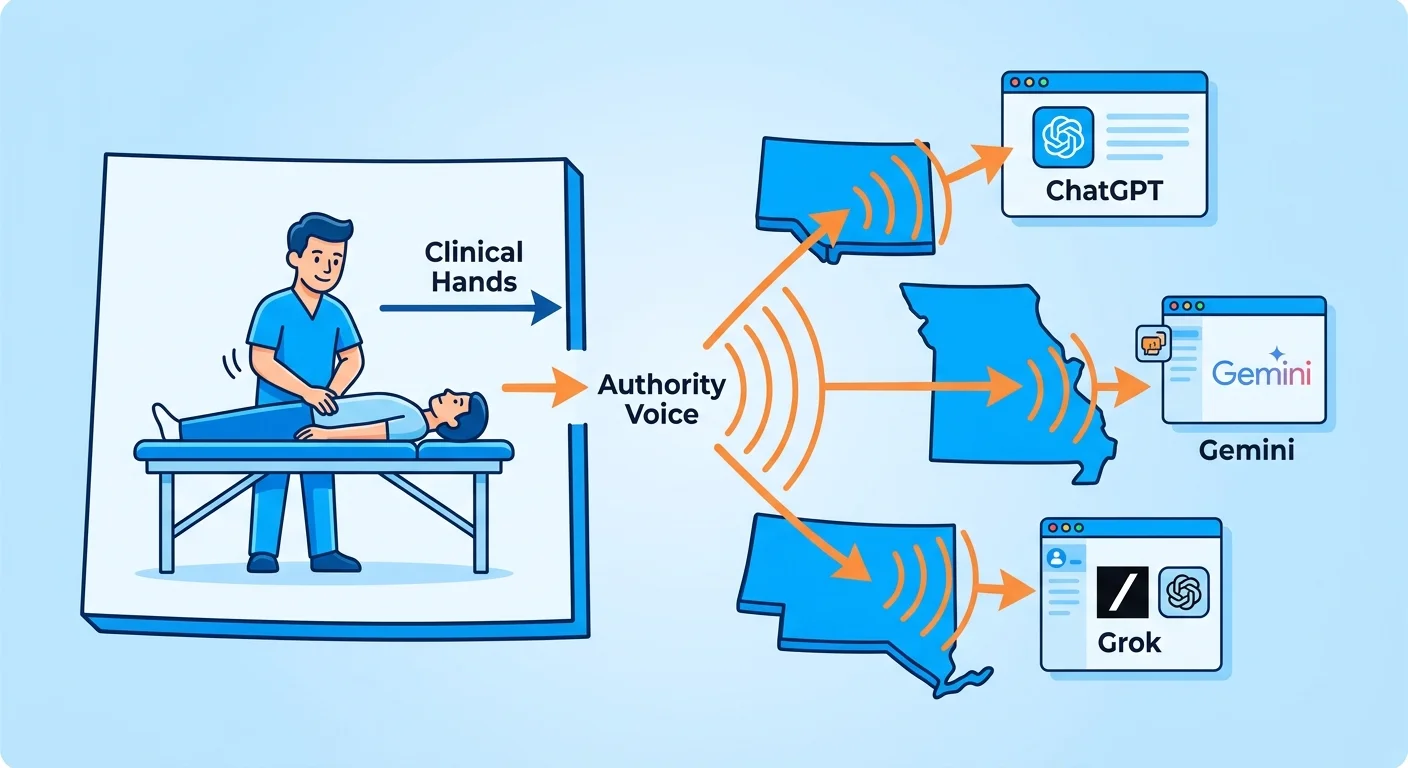
Most local clinics aren’t scared of national AI visibility because they misunderstand the technology. They’re scared because they’ve mixed up two things that have nothing to do with each other – where they’re licensed to treat patients, and where they’re allowed to be known.
Those aren’t the same game. Licensing law governs the Transaction Layer – the clinical, hands-on-the-patient interaction. AI authority operates entirely within the Authority Layer – the educational, schema-verified, entity-signal infrastructure that conversational engines read when deciding who to recommend. One is a geographic leash on your hands. The other has no leash at all.
That separation isn’t academic. Gartner predicts search engine volume will drop 25% by 2026 as users shift to AI engines for direct answers. The practices capturing that shift won’t be the ones with the biggest geographic footprint. They’ll be the ones who figured out they don’t need a license in every state – they need authority signals in every AI engine.
The Geographic Leash on Clinical Practice
Here’s how licensing actually works. Under current federal guidelines from HHS, a healthcare provider must hold a license in the state where the patient is physically located at the time of service. That’s the Transaction Layer in full effect – telehealth calls, in-person treatment, every direct clinical exchange. The hands stay inside the lines.
But that leash is on the hands. It is not a leash on the voice.
A chiropractor in Austin publishing authoritative educational content on spinal decompression isn’t practicing medicine in California. They’re building entity trust. ChatGPT doesn’t query state licensure databases before citing someone as a national expert on a topic. It checks whether that entity has been consistently verified across authoritative domains, structured data, and semantic content – infrastructure that lives entirely within the Local AI Authority Engine framework, not inside any licensing board’s jurisdiction.
Why the Industry Gets This Wrong Every Time
Traditional agencies don’t separate these two layers. They hear ‘national reach’ and immediately start imagining compliance catastrophes – unauthorized practice of medicine, multi-state licensing fees, regulatory exposure. So they pull back. They tell local practices to stay local. Then they build a strategy that locks those practices into invisibility everywhere outside their zip code.
That’s not compliance. That’s confusion dressed up as caution.
The mistake is applying Transaction Layer rules to the Authority Layer. Licensing law doesn’t restrict where a practice’s entity signals travel – it restricts where clinical service can be delivered. Those are different documents, different regulatory frameworks, and entirely different games. Any practice building a national entity footprint needs to own that distinction before publishing a single AI Authority article.
The clinics staying invisible nationally aren’t being careful. They’re working from a map drawn for the wrong territory. If your agency is treating your information footprint like it’s subject to the same rules as your clinical license – you need a new agency. And you need this fixed now.
| Dimension | Clinical Licensing Scope | AI Entity Signal Scope |
|---|---|---|
| What governs it | State licensure boards and federal telehealth regulations | AI engine entity evaluation algorithms and structured data signals |
| Geographic reach | Limited to the state where the patient is physically located at the time of service | No geographic boundary – entity signals travel wherever AI engines operate |
| What it controls | Who can deliver clinical care, treat patients, and bill for services | Which practitioners get cited as trusted authorities on a topic |
| Layer it operates in | Transaction Layer – clinical service delivery | Authority Layer – educational content, schema data, entity identity |
| Primary enforcement mechanism | Licensing boards, state medical practice acts, federal telehealth guidelines | Schema verification, semantic content consistency, citation patterns across authoritative domains |
| What triggers a violation | Treating or consulting a patient outside a licensed jurisdiction | Publishing inaccurate or unsubstantiated health claims regardless of geography |
| Can a single-location practice scale it nationally? | No – clinical service is geographically restricted by definition | Yes – educational entity signals have no jurisdictional ceiling |
The Entity Signal Architecture That AI Engines Actually Read
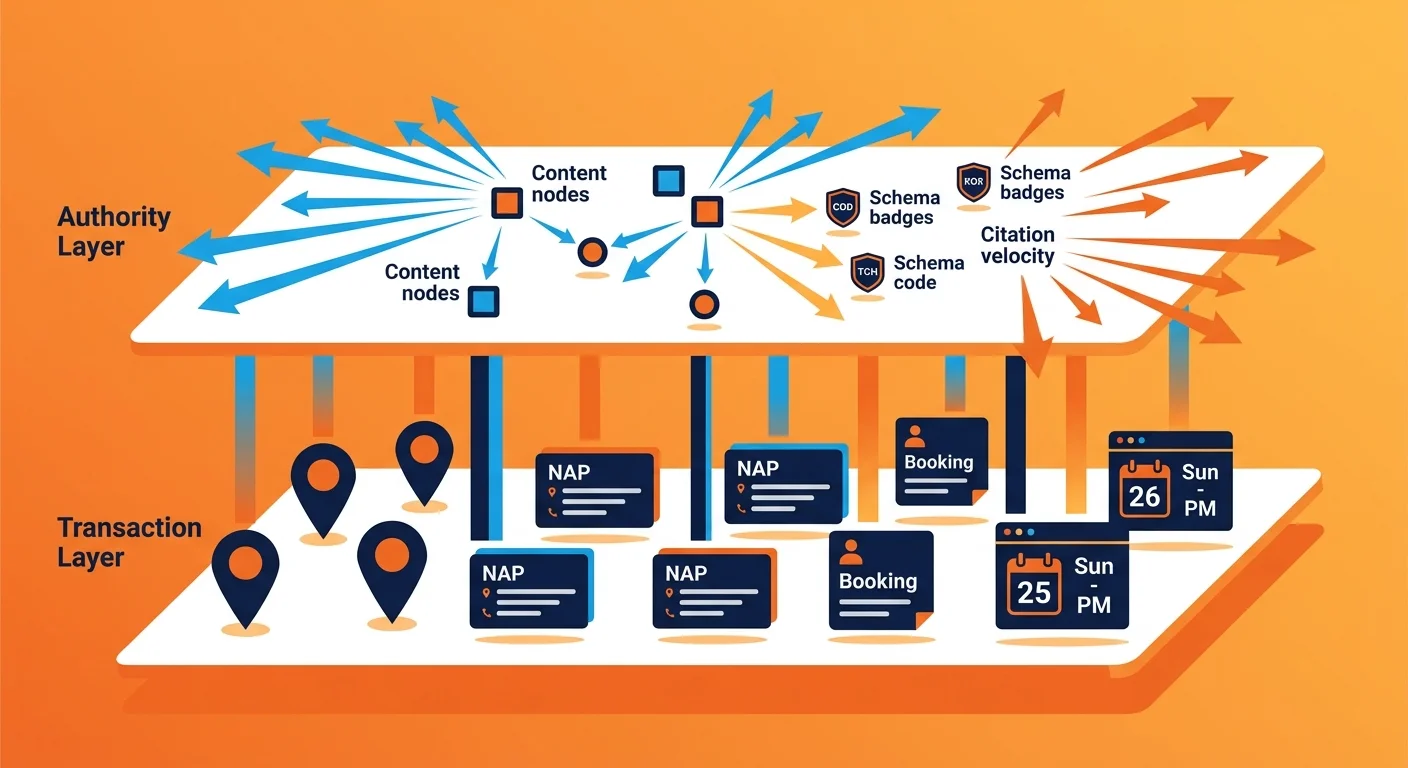
AI engines don’t read your license. They read your entity profile.
That profile is built from a specific stack of signals – structured schema data, NAP consistency, citation velocity across authoritative domains, and topical authority depth.
Some of those signals are inherently geographic. Others travel freely. State lines mean nothing to them.
The mistake most practices make is treating the entire profile as if it’s subject to the same constraints as the Transaction Layer. It isn’t. And that assumption is costing them nationally.
So which signals stay local and which ones travel? That’s the architectural question national entity scaling is built on.
Get it wrong and you’ll build a profile that confuses AI engines – contradictory geographic signals pulling in opposite directions. Or you’ll leave your Authority Layer completely underdeveloped because you assumed the Transaction Layer‘s rules applied there too.
Both outcomes are a loss. Neither is the careful play people think they’re making.
Schema, NAP Consistency, and the Signals That Stay Local
NAP data – Name, Address, Phone – is a Transaction Layer signal.
It tells AI engines where you operate, who you serve locally, and how patients in your immediate market can reach you. It belongs on your Google Business Profile, your schema markup, and every directory listing that anchors your local entity identity.
And it needs to be consistent across all of them. Contradictory NAP data is an entity trust collapse at the local level.
Schema markup for a single-location practice should reflect exactly that – one location, one licensed service area, full stop.
Trying to fake a multi-state footprint through schema fraud isn’t a strategy. It’s a fast path to entity confusion – which is the exact opposite of what AI engines reward. They penalize contradictory signals. They trust precise ones.
Your address is your address. The Transaction Layer signals stay inside those boundaries. That’s not a limitation. That’s the foundation the Authority Layer builds on top of.
Here’s what most practices miss: none of that restricts your Authority Layer.
A correctly structured entity profile separates local clinical identity signals from topical authority signals. Your schema confirms you’re a single-location practice in one state. At the same time, it can establish you as a nationally recognized expert on a specific clinical topic.
Those aren’t contradictory signals. They’re complementary layers. AI engines are built to read both – and the practices that build both are the ones showing up in national recommendations.
The Signals That Travel: Educational Content, Topical Authority, and Citation Velocity
Educational content is an Authority Layer signal. It has no zip code.
When a practitioner publishes accurate, substantive educational content on a specific clinical topic – consistently, over time, with the semantic density and citation patterns that authoritative sources carry – AI engines start treating that entity as a trusted reference on that topic.
That trust isn’t geographically bounded. It follows the content.
Pew Research found that 23% of Americans had already used ChatGPT as of early 2024. Those users aren’t asking which practitioners are licensed in their state. They’re asking who knows what they need to know. Practices that become the answer to that second question are the ones building real equity in the Authority Layer.
Citation velocity – the rate at which authoritative domains reference and validate your entity – compounds across the Authority Layer regardless of where your clinic sits on a map.
A practice ready to go deeper on how this infrastructure actually gets built should study what it takes to become the national expert AI engines recommend in a given specialty. The mechanics are the same whether you’re in a metro or a mid-sized market.
The voice travels. The hands stay home. That’s the whole architecture in one sentence.
This Is Not for Every Practice
This framework isn’t for every practice. And saying so directly is the most useful thing here.
If you need patient volume in the next 60 days, national entity scaling isn’t your play. That’s not a knock – it’s just wrong tool for the job.
The Authority Layer compounds. It doesn’t spike. Practices that build it correctly see their entity trust deepen over time, with AI engines increasing citation frequency as semantic density and topical authority grow.
That’s a different timeline than a paid acquisition campaign. It requires a different mindset. If immediate bookings are the only metric that matters right now – and you’re not willing to invest in the infrastructure that makes AI engines trust you – this model isn’t for you.
And if you want to stay purely local – one market, one patient base, no national ambition – the Authority Layer strategy simply isn’t relevant to your goals. That’s a real and valid business model.
But the practices reading this are the ones already sensing that their expertise has a reach their current infrastructure can’t match. They’re licensed in one state. They’re fielding inquiries from three others. They’re getting cited in publications outside their market.
They know something is there. They just don’t have the architecture to capture it yet. That’s exactly who this is built for.
| Entity Signal Type | Stays Local or Travels Nationally | AI Engine Weight | Licensing Risk |
|---|---|---|---|
| NAP Data (Name, Address, Phone) | Stays Local | High – anchors local entity identity and confirms geographic service area | None – accurate local NAP is legally required and regulatory best practice |
| Google Business Profile | Stays Local | High – primary local entity verification signal for place-based queries | None – reflects licensed service area accurately |
| Schema Markup (LocalBusiness type) | Stays Local | High – confirms physical location, service area, and clinical identity to structured data parsers | None – schema that accurately reflects a single licensed location is compliant by definition |
| Educational Authority Content (Authority Layer) | Travels Nationally | High – topical depth and semantic density establish practitioner as a trusted knowledge entity on specific clinical topics | None – publishing educational content on a clinical topic is not practicing medicine across state lines |
| Citation Velocity (authoritative domain references) | Travels Nationally | High – rate of authoritative external citations compounds entity trust independent of geographic location | None – being cited by authoritative sources carries no licensure implications |
| Topical Authority Depth (semantic content profile) | Travels Nationally | High – consistent, dense, accurate coverage of a specialty signals trusted expertise to AI engines regardless of clinic location | None – topical authority is an information footprint, not a clinical service delivery |
| Conflicting Geographic Schema Signals (e.g., fabricated multi-state addresses) | Stays Local – but damages both layers | Negative – contradictory entity signals create AI engine confusion and erode trust at both the Transaction Layer and Authority Layer | High – misrepresenting service area in structured data creates regulatory and reputational exposure |
Separating the Transaction Layer from the Authority Layer
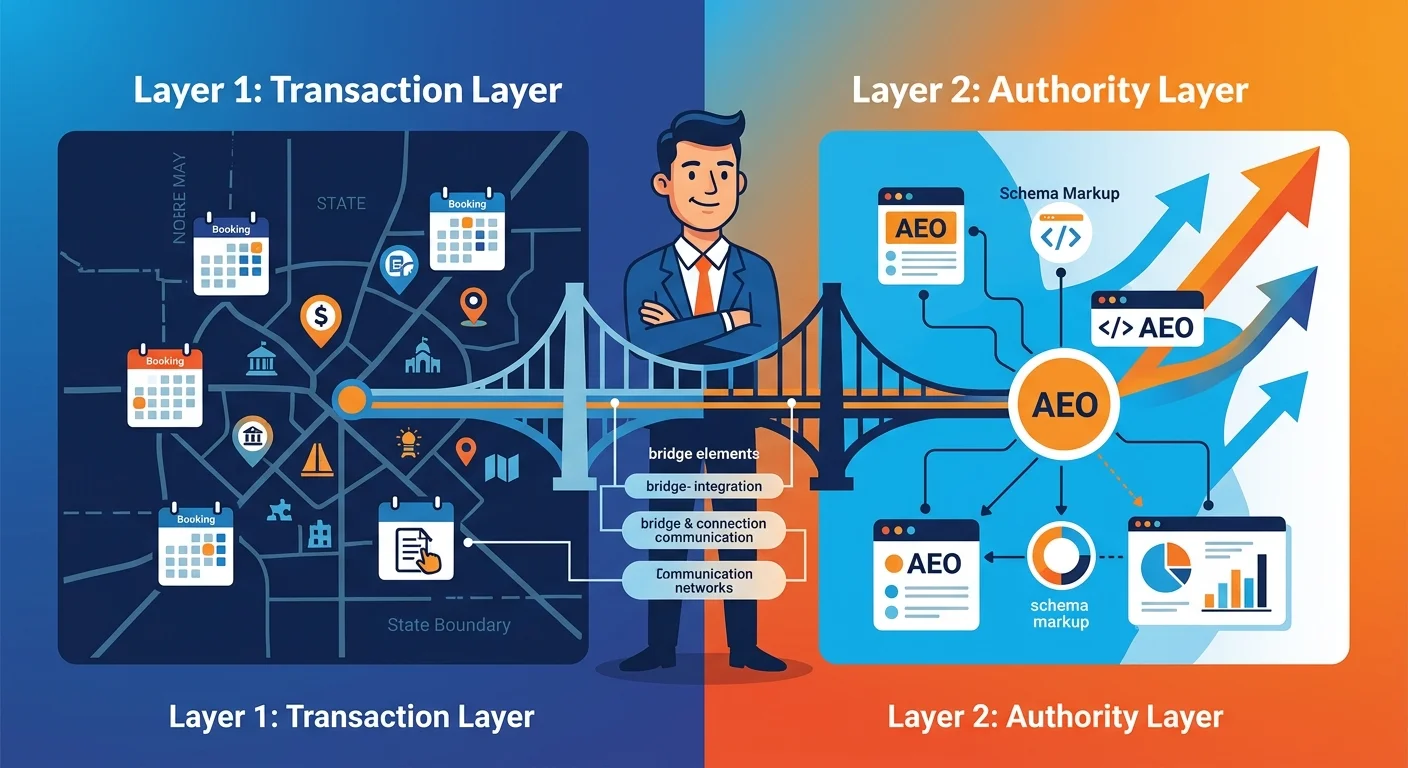
Here’s the line that separates invisible practices from nationally recognized ones.
Your license governs what your hands can do. It has zero say over where your voice travels.
The Transaction Layer is the clinical exchange. Patient on the table, provider licensed in that state, service delivered inside those boundaries. The Authority Layer is your entity profile – the structured signals, educational content, and semantic density that AI engines read when deciding who to name as a trusted expert.
One layer is regulated by geography. The other isn’t regulated by geography at all.
Practices that treat these two layers as one system are building the wrong thing.
They’re applying Transaction Layer rules to an Authority Layer problem. That’s not compliance. That’s confusion dressed up as caution – and it guarantees invisibility everywhere outside the zip code.
How the Transaction Layer Is Structured for Local AI Signals
The Transaction Layer has a clear physical architecture: your NAP data, your Google Business Profile, your schema markup, and every directory listing that anchors your clinical identity to a specific address.
These signals are geographic by design. That’s the point of them.
NAP consistency isn’t optional at this layer. Contradictory name, address, or phone data across directories doesn’t just confuse patients – it confuses AI engines. And confused AI engines don’t make confident recommendations.
Your local booking infrastructure needs to speak with one voice about exactly one place. The CDC’s framework for state and local public health authorities makes the geographic specificity of clinical operations explicit – your local signals need to reflect that same precision.
Your schema markup should confirm what’s true: one location, one licensed service area, one clearly bounded clinical footprint.
Faking geographic breadth at this layer doesn’t expand your reach. It introduces entity confusion – and AI engines that can’t trust your local signals won’t take a risk on your national ones either.
How the Authority Layer Is Structured for National AI Signals
The Authority Layer is built from signals that have no zip code.
None.
Educational content, topical authority depth, citation velocity across authoritative domains, semantic consistency around a specific clinical specialty – those are the signals that build national entity trust.
A practitioner who publishes substantive, accurate content on a specific clinical topic – consistently, over time – trains AI engines to treat that entity as a trusted reference. That trust isn’t geographically bounded. It compounds across every AI engine that reads the same signal stack, regardless of where the clinic’s front door sits.
This isn’t theoretical. You can see exactly how a single-location clinic built a national patient funnel by structuring its Authority Layer correctly – without expanding its geographic footprint or crossing a single licensing line.
The architecture is replicable. Build the Authority Layer around what you know, not where you’re licensed.
Where the Two Layers Connect – and Where They Must Not
The two layers connect at your entity identity – the core verified profile that confirms you are who you say you are.
Your business name, your credentials, your specialty, your consistent presence across authoritative domains: that’s the bridge. Both layers draw from it. Neither one functions without it.
But here’s where practices blow it.
The Transaction Layer‘s local NAP data and service-area schema must never bleed into the Authority Layer‘s national content infrastructure. Don’t tag educational content with city-specific location signals. Don’t structure national topical authority content like it’s a local service page.
Mixing those signals tells AI engines a contradictory story. AI engines that receive contradictory stories don’t take risks on recommendations.
Gartner projects a 25% drop in traditional search engine volume by 2026 as users shift to conversational AI. Get the separation clean and both layers compound in the right direction before that shift lands.
The practices ready for it aren’t the ones with the biggest local footprint. They’re the ones who built a Transaction Layer that’s clean, consistent, and geographically precise – and an Authority Layer that travels everywhere their expertise is worth knowing about.
| Infrastructure Component | Layer 1: Transaction Layer | Layer 2: Authority Layer | Implementation Priority |
|---|---|---|---|
| NAP Data (Name, Address, Phone) | Anchored to a single verified physical address – must be identical across every directory and listing | Not applicable – educational content carries no address-level identity signal | Critical: Transaction Layer foundation; inconsistency here collapses AI confidence at both layers |
| Schema Markup | LocalBusiness schema confirming a single licensed location, service area, and clinical specialty | Entity schema establishing topical expertise, credentials, and authoritative source relationships | Critical: Both schema types are required and must be kept structurally separate – never merged |
| Geographic Signals | City, state, zip code, service-radius data – geographically bounded by clinical licensing | No geographic tagging – educational content must not carry city-specific location identifiers | Critical: Mixing geographic signals from the Transaction Layer into Authority Layer content creates entity contradiction |
| Content Infrastructure | Local booking pages, service descriptions, and clinician profiles tied to a specific licensed address | Substantive educational content on a defined clinical specialty – structured for topical authority and AI citation | High: Authority Layer content must be built with semantic density and citation patterns that signal trusted reference status |
| Directory Presence | Healthcare directories, Google Business Profile, and local citation platforms – all reflecting exact location data | Authoritative topical directories, industry publications, and educational domains that validate specialty expertise | High: Transaction Layer directories anchor local booking; Authority Layer directories anchor national entity trust |
| AI Engine Signal Read | AI reads these signals to confirm geographic identity and route local patient queries to the correct licensed provider | AI reads these signals to identify trusted expert entities on a clinical topic – regardless of physical location | High: AI engines read both layers simultaneously; clean separation ensures both signals compound rather than cancel |
| Primary Performance Outcome | Local patient bookings from patients within the licensed service area | National AI recommendations as a trusted educational authority on a specific clinical specialty | Foundational: Both outcomes are available to a single-location practice – but only if the infrastructure for each layer is built and maintained independently |
FTC and HHS Compliance: What the Rules Actually Say About National Content
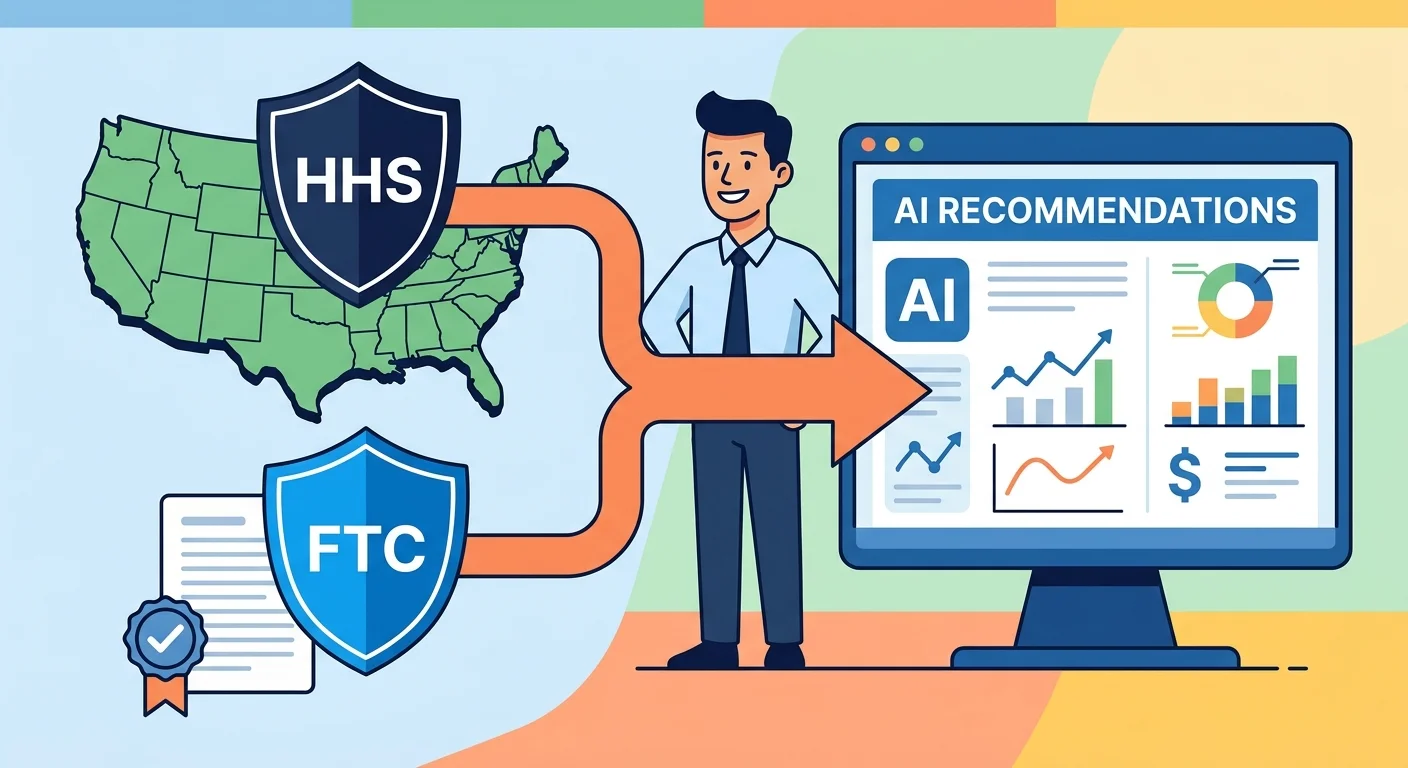
Here’s where most practices get it completely backwards. The compliance question around national health content isn’t about geography. It never was.
The federal frameworks at play here – HHS on licensure, FTC on health claims – aren’t trying to wall off your educational content from a national audience. They’re drawing a line between two entirely different activities. Clinical practice is one. Information is the other. Those activities operate under different rules. Conflating them isn’t compliance. It’s the thing that creates the exposure.
Get it right and national educational authority is structurally sound – not just permitted. Get it wrong and you’re not just invisible to AI engines. You’re exposed.
The HHS Licensure Line: Where Clinical Practice Ends
Here’s what HHS actually says: healthcare providers must be licensed in the state where the patient is located at the time of service. Clinical service delivery requires geographic compliance. The license follows the patient – not the practitioner’s address.
But notice what that framework doesn’t say. It doesn’t say you can’t publish educational content that reaches patients in other states. It doesn’t say your entity profile can’t establish topical authority on a national stage. It says the hands – the actual clinical service – must stay inside the boundaries the license creates. The voice isn’t subject to those same constraints.
That’s the Transaction Layer boundary written in federal language. When a patient books and receives care, that’s a licensed clinical transaction. Your Transaction Layer infrastructure – the schema, the NAP signals, the booking systems – reflects that geographic reality. Your Authority Layer doesn’t. The moment you stop conflating HHS licensure with information limits, national entity scaling stops being a compliance question. It becomes an architecture question.
The FTC Substantiation Standard: What Educational Health Content Must Meet
The FTC standard is the one that blindsides practices. It’s also where the Authority Layer either builds durable credibility – or collapses under its own weight.
Under FTC guidance, health-related advertising claims must be substantiated by competent and reliable scientific evidence. That standard applies regardless of where the content is published or who the audience is. A practice publishing national educational content on a clinical topic isn’t exempt from FTC scrutiny because the content is labeled "educational." If it makes health claims, those claims need to be defensible.
That’s actually a feature, not a constraint. The content that clears the FTC bar – accurate, evidence-grounded, specific to a clinical specialty – is exactly what AI engines weight as authoritative. Vague, unsubstantiated health claims don’t pass FTC review. And they don’t build AI entity trust either. The compliance standard and the authority-building standard point the same direction: publish content that’s actually correct.
Building a Compliant National Content Footprint
Building a compliant national content footprint starts with one clean architectural decision: educational content lives in the Authority Layer, not the Transaction Layer. That means it doesn’t carry local service-area signals. It doesn’t position itself as a substitute for a consultation. And it doesn’t make clinical promises that imply a provider-patient relationship across state lines.
And that separation isn’t optional. Moving from a locally anchored entity profile to a nationally recognized knowledge entity requires your educational content to live in a structurally distinct layer from your clinical service content. Practices that have done the work to understand how that technical transition from local to national actually functions know this isn’t a content strategy decision alone. It’s a schema and entity architecture decision – and it has to be made before a single piece of national Authority Layer content goes live.
The practices that get this right – and you can see how it plays out in clinical scale case studies – aren’t walking a compliance tightrope. They’re on solid ground because the layers are clean. The hands stay licensed and local. The voice builds authority that no state line can contain.
| Governing Body | What It Regulates | Threshold for Compliance | Applies to Educational Content? |
|---|---|---|---|
| HHS | Clinical service delivery across state lines | Provider must be licensed in the state where the patient is located at the time of service | No – applies to clinical transactions only, not educational content |
| FTC | Health-related advertising and content claims | Claims must be substantiated by competent and reliable scientific evidence | Yes – applies to any health claim regardless of whether content is framed as educational |
| CDC / State Public Health Authorities | Clinical operations and health signal monitoring within geographic jurisdictions | State and local public health legal frameworks govern operational boundaries | No – governs clinical operations, not informational or educational publishing activity |
Frequently Asked Questions
The framework holds. But the questions get sharper from here. Licensing, compliance, infrastructure, timeline – each one gets a direct answer below.
These aren’t edge cases. They’re the questions that separate the practices building national authority right now from the ones still waiting to feel certain.
How do AI search engines recommend clinics across state lines if the clinic isn’t licensed there?
AI engines don’t check your license before recommending you. They check your entity signals – your verified identity, your topical authority, your consistency across authoritative domains.
Licensure governs what your hands do. It has zero say over what AI engines read.
Pew Research found 23% of Americans were already using ChatGPT as of March 2024. Those engines build recommendations from structured data and content authority – not from state licensing databases. A clinic in Texas gets recommended to a patient in Ohio because the Authority Layer built around that clinic’s expertise is what the AI trusts.
The Transaction Layer stays local. The Authority Layer has no zip code.
Can a single-location practice establish nationwide AI authority without violating state licensure laws?
Yes. Full stop.
The licensing question and the authority question aren’t the same question. HHS is clear: licensure requirements are triggered by clinical service delivery – specifically, when a provider delivers care to a patient in another state. Publishing educational content that reaches a national audience isn’t clinical service delivery. It’s information.
The Authority Layer is built on information, not on clinical transactions.
A single-location practice can establish nationwide AI authority by building a knowledge entity profile that AI engines recognize as the trusted national expert on a clinical specialty – without ever delivering a clinical service outside its licensed state.
Keep the separation between the Transaction Layer and the Authority Layer clean, and the entire strategy is legally coherent.
What happens when a practice has mismatched entity signals across different geographic regions?
Mismatched entity signals are a trust-collapse problem. Full stop.
AI engines build recommendations by cross-referencing your entity identity across multiple sources. When your business name, specialty, location data, and credentials don’t align consistently – or when national educational content carries conflicting geographic signals – the engine can’t construct a coherent picture of who you are.
An entity it can’t verify cleanly is an entity it won’t recommend confidently.
The practical outcome: you’re invisible in AI recommendations even when your clinical expertise should put you at the top of the stack. Fixing mismatched signals isn’t a content problem. It’s an infrastructure problem. The entity identity at the core of both your Transaction Layer and Authority Layer has to be consistent, verified, and unambiguous – across every domain where your name appears.
Does FTC compliance affect how educational health content is written for national AI visibility?
Directly. The FTC requires that health-related advertising claims be substantiated by competent and reliable scientific evidence. That standard doesn’t have a geographic carve-out for educational content.
If you’re publishing national content on a clinical topic and that content makes health claims, those claims need to be defensible.
Here’s the part most practices miss: the FTC standard and the AI authority-building standard are pointing at the same target. Content that’s accurate, evidence-grounded, and specific to a clinical specialty passes FTC review – and it’s exactly what AI engines weight as authoritative. Vague, overclaimed health content fails both tests.
Write content that’s actually correct, and you’re compliant with the FTC and building the kind of Authority Layer that earns national AI recommendations. The compliance requirement isn’t a ceiling. It’s a floor – and it’s lower than most practices think.
What infrastructure separates local patient booking signals from national educational authority signals?
The separation is architectural, not just content-based.
The Transaction Layer carries your local NAP data – business name, address, phone number – your service-area schema, your booking infrastructure, your Google Business Profile signals. These are geographically anchored by design. That’s the point of them.
The Authority Layer carries your educational content, your topical depth across your specialty, your schema-verified entity identity as a knowledge source, and your presence on the authoritative domains AI engines use to validate expertise.
Here’s the rule that practitioners miss: Authority Layer content must never carry local service-area signals. Don’t tag national educational content with city-specific location data. Don’t structure it as a local service page.
The moment those signals bleed across layers, the AI engine gets contradictory information about who you are. Contradictory entities don’t get recommended. Keep the layers structurally distinct and both compound in the right direction.
How long does it take to build a national educational authority footprint that AI engines recognize?
There’s no honest answer that gives you a specific number. Anyone who quotes you one is selling you something.
What’s knowable is the direction: authority compounds with every month of consistent execution.
Gartner projects a 25% drop in traditional search engine volume by 2026 as users shift to AI-driven queries. The practices positioned as national knowledge entities when that shift lands aren’t the ones who started six months before the deadline. They’re the ones who started before the shift was obvious.
The practices that have already built national Authority Layer footprints have a compounding head start that closes harder every month.
There’s no magic moment when national AI authority switches on. There’s just the gap between the practices building it and the ones still waiting to see if it’s real.
Your License Stays Home. Your Authority Doesn’t Have To.
Here’s the bottom line.
The Transaction Layer stays local. Licensed, bounded, clinically precise. The Authority Layer has no zip code. Practices that understand that distinction aren’t just compliant – they’re stacking national entity trust every month while competitors still treat their license boundary as their information boundary.
That’s not a minor edge. That’s the whole game.
And it’s not complicated once the principle clicks. Clean NAP signals at the Transaction Layer. Schema-verified entity identity at the core. Educational authority built into an Authority Layer that sits entirely outside any state’s jurisdiction.
That’s what lets a single-location practice show up as the trusted national expert when someone two thousand miles away asks an AI engine who to trust on the clinical topic you’ve spent your career mastering.
The license is a leash on your hands. It is not a leash on your voice.
But the gap widens every month a practice sits still. AI engines are already building their recommendation stacks. Every month of inaction is a month a competitor layers in the entity signals that earn those recommendations instead of you.
The AI Visibility Check is where this stops being abstract. Fifteen minutes shows you exactly what AI engines say about your practice right now – and exactly where the separation between your Transaction Layer and Authority Layer is either working or broken.
ITech Valet built this diagnostic for exactly that moment. The question isn’t whether your competitors are building national authority right now. The question is whether you’re going to let them do it unopposed.
Here’s the thing – your license limits where you can treat patients. It doesn’t limit where AI can know your name.
Right now, some AI engine is answering a question in your specialty. It’s naming someone. That someone might not be better than you. They might just have cleaner entity signals.
Run the AI Visibility Check. Find out what AI actually says about you today – before another month of that gap closes against you.