
The Local Ceiling Is Real – and AI Is Making It Permanent
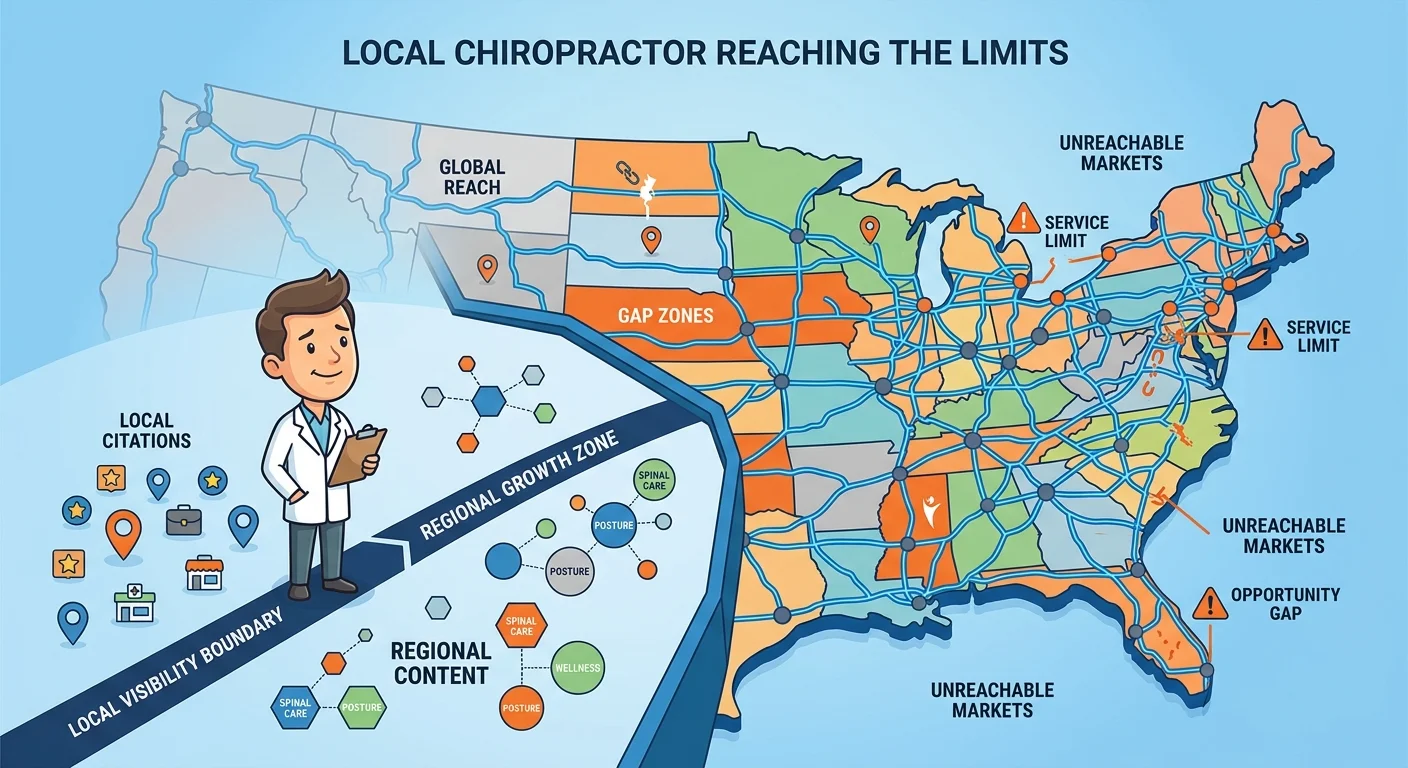
The local ceiling is not a perception problem.
It is not a marketing problem either. It is a structural limit – built into how AI engines read and reward digital authority. That distinction matters. You cannot market your way through a structural wall.
Here’s the thing: most practices have no idea they’ve hit it.
Revenue looks stable. The schedule stays full. But growth has quietly plateaued, referral networks have capped out, and every dollar pushed into regional ad spend returns less than the last. That is the ceiling in action. It is invisible – until you are already pressed against it, wondering why nothing is working.
And AI is not softening that ceiling. It is hardening it.
Gartner projects traditional search engine volume will decline by 25% by 2026, driven by consumers moving to conversational AI platforms for recommendations. Every month that shift accelerates, practices with fragmented, locally-siloed footprints fall further behind the ones whose entity infrastructure AI can actually read. The window to close that gap is not staying open.
What Local Saturation Actually Looks Like
Local saturation looks deceptively healthy from the inside.
The practice is the dominant name in its city. Reviews are strong. Referrals keep the doors open. But every growth lever – more ads, more localized landing pages, more regional content – returns less than the last attempt. The numbers look fine. The ceiling is already there.
That diminishing return is not a creative problem. It is a market-size problem.
There are only so many patients in a defined radius. Once a practice has captured a meaningful share of them, the cost of acquiring the next one climbs sharply. The local market does not get bigger just because the practice gets better at marketing to it.
So the ceiling was always there. What changed is who enforces it.
When discovery lived inside legacy search, a practice could chip away at local saturation with enough volume – more pages, more local keywords, more content. Now AI answer engines have stepped in as the single point of recommendation. Their criteria for naming a practice have nothing to do with how many localized pages it has published. The practices still optimizing for local-only footprints are solving yesterday’s problem with yesterday’s tools. Understanding what a national entity strategy actually requires is the first step toward building something different.
Why Traditional Multi-Location SEO Fails the AI Test
Traditional multi-location expansion had a playbook everyone knew: build a landing page for each city, load the relevant keywords, replicate the structure across markets, wait for the algorithm to move.
That playbook is dead.
AI-driven discovery engines filter out fragmented regional content. They reward cohesive digital structures that present a clear, unified entity profile.
Published analysis on AI content structures confirms this directly – disconnected local subdomains, inconsistent citation data, and isolated content registers as noise, not authority. The engine cannot build a trust signal from a brand that looks like a dozen different businesses depending on the market.
That is the core failure of the old multi-location approach. It was built to fool a keyword-matching algorithm.
AI answer engines do not match keywords. They evaluate entities. An entity that presents inconsistently across markets is not a recognizable entity – it is a collection of fragments the engine has no reason to trust.
The National AI Authority Engine exists precisely because the multi-location model was never built for this environment.
Before a practice can calculate what a national strategy returns, it has to reckon with what it is currently losing. Not to competitors. To the structural invisibility it built – location by location, one disconnected page at a time. That accounting is the starting point. Not the finish line.
| Signal Type | Legacy Search Engine Behavior | AI Answer Engine Behavior | Impact on Local-Only Practices |
|---|---|---|---|
| Discovery Mechanism | Returns a ranked list of options for the user to evaluate and click through | Returns a single recommended entity – one answer, no ranked list | Local-only practices that dominated a list now compete for a single named slot they were not built to win |
| Authority Signal | Reads keyword density, backlink volume, and localized page relevance | Reads Entity Trust – the cohesion, consistency, and reach of a brand’s full digital footprint | Strong local keyword presence provides zero advantage if the entity profile is fragmented or inconsistent |
| Content Structure | Rewards localized landing pages targeting city-specific keyword variations | Deprioritizes fragmented regional content in favor of unified, machine-readable entity profiles | Multi-location landing page strategies built for legacy search register as noise – not authority – to AI engines |
| Geographic Reach | Distributes visibility across many results, allowing local practices to rank within defined radius boundaries | Evaluates brand entity across the full web – not confined to a geographic boundary | Practices optimized for a single market have no entity infrastructure capable of earning cross-regional citations |
| Citation Logic | Aggregates links and mentions to score domain authority within a competitive set | Evaluates Citation Velocity – the rate and consistency of authoritative mentions across the broader web | Low Citation Velocity signals a low-trust entity regardless of local dominance or review volume |
| Competitive Ceiling | Can be chipped away incrementally – more pages, more volume, more spend | Is structural – determined by entity infrastructure quality, not content quantity | Local-only practices hit a hard ceiling the moment AI engines become the primary discovery layer for their category |
Why AI Engines Reward Unified Entity Footprints Over Regional Clusters
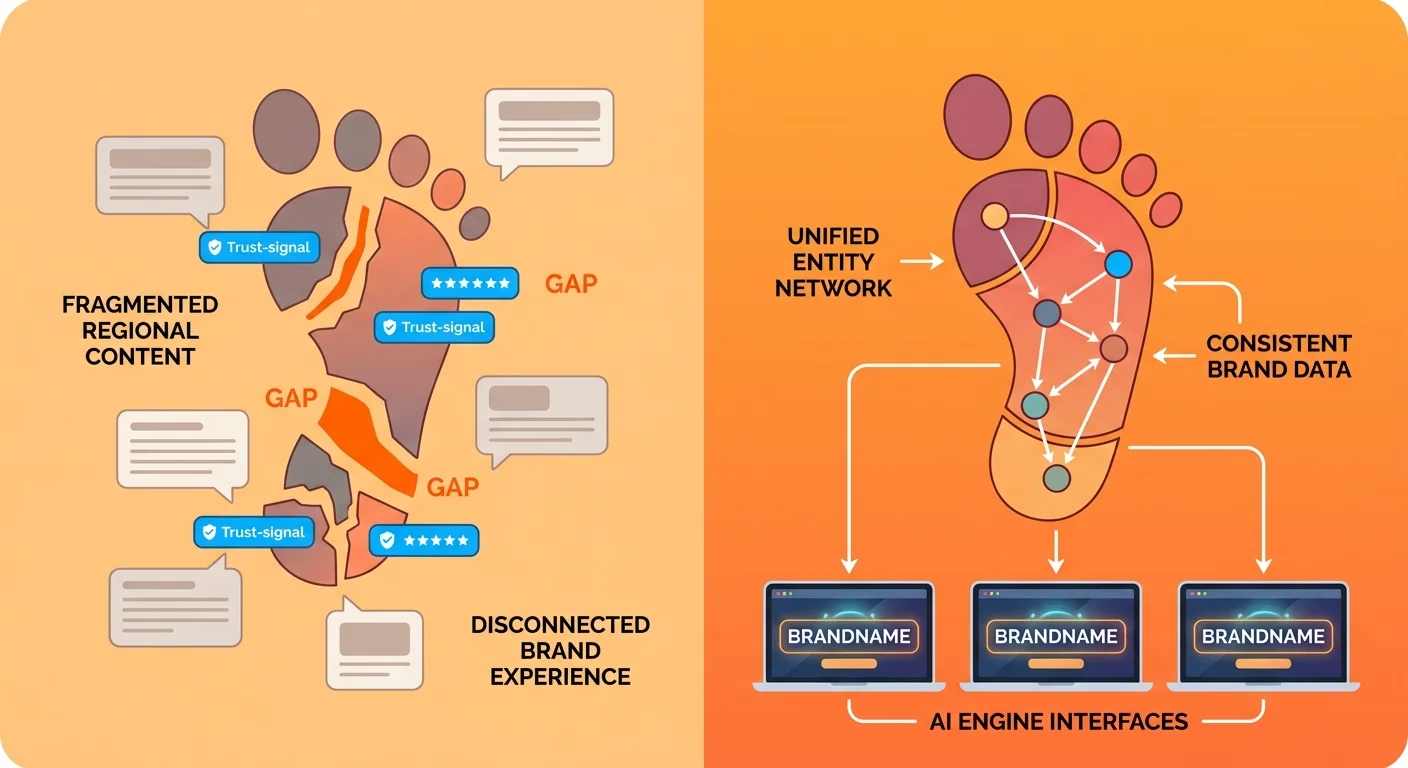
AI engines don’t reward volume. They reward coherence.
The question is never "how many markets am I in?" It’s "does my digital footprint read as one trusted entity – or a collection of strangers?"
AI answer engines make that distinction instantly. And they only cite the ones that pass.
AI-driven discovery engines deprioritize fragmented regional content in favor of cohesive digital structures that present a clear, unified entity profile to the engines doing the evaluating.
That’s not a ranking preference. It’s an architectural filter – and it’s ruthless. Practices with disconnected market-by-market signals aren’t ranked lower. They’re structurally invisible.
How AI Answer Engines Actually Evaluate Brand Authority
Here’s the thing: legacy search ranked pages. AI engines evaluate entities. Those are not variations of the same problem.
When ChatGPT or Gemini processes a recommendation query, it isn’t scanning a keyword index. It’s running a trust audit.
Is this brand consistent across the web? Do independent sources corroborate what this entity claims about itself? Does the citation pattern reflect genuine authority – or a fragmented local presence trying to look bigger than it is?
The practice that passes those tests gets named. The one that fails disappears from the response entirely.
Research on digital ecosystem integration confirms what the logic already demands: when entity data is consolidated and coherent, trust compounds across markets instead of resetting in each one.
That compounding dynamic is the entire difference between an authority asset and an ad campaign. AI engines are trained to detect it – and reward accordingly.
The Entity Trust Gap: What Fragmented Clinics Lose
Every clinic operating with a fragmented footprint is paying an invisible tax.
That tax isn’t measured in wasted ad spend – though that’s real too. It’s measured in every AI recommendation that goes to a competitor because their entity signals are cleaner, more consistent, and more authoritative.
Practices already asking how to scale entity trust without cannibalizing local identity are ahead of the question. The ones still publishing city-specific landing pages are answering a question nobody is asking anymore.
Here’s the thing: this isn’t the engine punishing anyone. The engine is doing exactly what it was built to do – surface the most trustworthy answer for the user asking the question.
A brand that presents as a dozen disconnected local operations gives the engine nothing reliable to cite. No coherent entity signal. No consistent corroboration across independent sources. So it moves on. It cites someone else.
And that someone else compounds.
Who This Path Is Not For
This path is not for every practice. That’s not a soft disclaimer – it’s a hard structural truth.
If the goal is maximum bookings in the next 90 days, a National Entity Strategy is the wrong tool. Full stop.
If the expectation is a contractual guarantee – authority signals converting to new patient volume by a locked date – this is not the right fit. And if the instinct is to replicate national reach by spinning up more disconnected local pages faster, that approach produces exactly the fragmented signal pattern AI engines are built to filter out.
More of the broken thing is still the broken thing.
But for the established practice that has already captured its local market, already proven its clinical model, and is now staring at growth that quietly stalled despite doing everything right – this is the answer.
The local ceiling is not a failure. It’s a signal. The infrastructure was built for a smaller game.
A National Entity Strategy doesn’t patch that infrastructure. It rebuilds it for the environment that actually exists – the one where AI makes the recommendation, the patient follows it, and the practice that invested in entity authority gets named.
| Entity Signal | Fragmented Regional Approach | Unified National Entity Approach | AI Trust Outcome |
|---|---|---|---|
| Business Name Consistency | Practice name, address, and contact data vary across city-specific pages and directory listings – each market presents slightly differently | Business name, address, and contact data are identical across every platform, market, and citation source – one entity, one signal | AI engines confirm the entity as real and trustworthy; inconsistent data is filtered as noise |
| Citation Velocity | Citations accumulate in isolated local clusters – strong in one city, absent or inconsistent in others – producing uneven authority signals | Citations build uniformly across markets, each reinforcing the same central entity rather than competing regional fragments | AI engines detect a coherent citation pattern and treat it as verified authority – fragmented citation clusters trigger no equivalent signal |
| Semantic Density | Content is optimized around city-specific keyword variations – each market has its own disconnected topic cluster with no shared authority spine | Content is structured around a unified topic architecture that signals deep expertise in the specialty regardless of which market is querying | AI engines surface the brand as a subject-matter authority at the specialty level, not just a local provider in one geography |
| Entity Trust Across Borders | Trust signals reset in each new market – the practice is authoritative locally but invisible or unverifiable the moment a patient queries from outside its defined radius | Trust compounds across markets because the underlying entity data is identical and consistently corroborated by independent sources in every region | AI engines cite the brand in multi-market recommendation queries because the entity reads as recognizable and verified – not geographically restricted |
| AI Authority Content Structure | AI Authority articles are published in isolated local silos – structured to rank in one market, carrying no authority transfer to adjacent regions | AI Authority content is built on a unified internal architecture that passes authority signals across the entire entity footprint with every published piece | AI engines treat each new content signal as additive evidence of a single trusted entity rather than isolated local noise |
| Recommendation Eligibility | The practice qualifies as a local recommendation only – AI engines have no reliable basis to name it when a query originates outside its primary market | The practice qualifies as a national recommendation – AI engines can confidently cite it regardless of where the query originates because the entity signal is geographically agnostic | AI engines include the brand in responses across multiple markets simultaneously rather than restricting it to a single local result |
What a National Entity Strategy Actually Builds
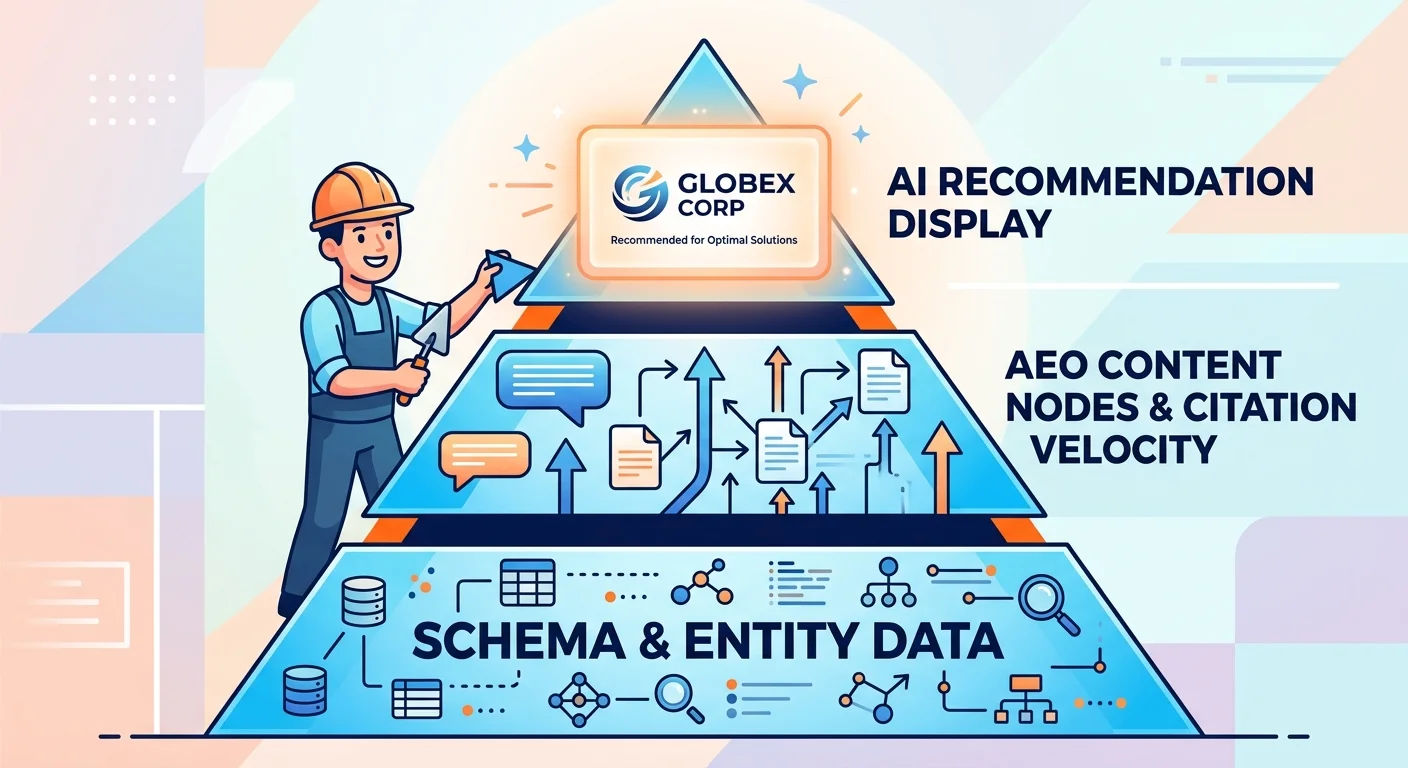
Here’s what a National Entity Strategy actually builds: not an ad campaign, not a cluster of city-specific landing pages. It builds a machine-readable infrastructure that forces AI engines to recognize your brand as one coherent, trustworthy entity – across every market you operate in.
That distinction matters more than most practices realize. The local ceiling exists because the infrastructure beneath the practice was built for a local game. A National Entity Strategy doesn’t extend that infrastructure. It replaces it with one designed for the environment AI engines actually evaluate.
The build happens in three layers: infrastructure, content, and compliance. Each layer compounds the one before it. And each one closes a specific gap that’s currently giving AI engines no reason to trust the practice at scale.
The Infrastructure Layer: Schema, Entity Data, and AI-Readable Architecture
The foundation is schema and entity data. These are the structured, machine-readable signals that tell AI engines exactly who the practice is, what it does, where it operates, and why it deserves to be trusted. Skip this layer and every piece of content the practice publishes is noise. The engine has no anchor point. Authority signals have nowhere to attach.
AI-driven discovery engines filter out fragmented regional content. What they reward is a cohesive digital structure – one clear, unified entity profile they can evaluate and cite with confidence. Consistent NAP signals, unified schema markup, structured entity data: that’s the architecture that transforms a collection of regional pages into a single recognizable brand. And practices wondering whether national scaling applies to them will find the answer here – this infrastructure layer is not reserved for hospital systems. It is the prerequisite for any entity that wants AI to take it seriously.
Here’s the kicker: most practices have never built this layer at all. They have content. They have reviews. They have a presence. But the underlying entity architecture AI engines use to evaluate trustworthiness is either missing, inconsistent, or actively contradicting itself across markets. That is not a content gap. That is a foundation problem.
The Content Layer: Citation Velocity and Semantic Density at Scale
Infrastructure without content is a foundation with no building on it. The content layer is what activates everything beneath it. That’s where Citation Velocity and Semantic Density do their work – not as isolated articles, but as a coordinated signal pattern that tells AI engines the practice holds genuine, deep authority across a defined subject area.
Citation Velocity is the rate at which authoritative sources corroborate the entity’s claims across the web. Semantic Density is the depth of topical coverage that confirms the practice is not a generalist – it’s the recognized authority in its domain. Together, they produce something ad spend never can: every piece of content published reinforces the entity signal rather than starting from zero in a new market.
That compounding dynamic is exactly what the local ceiling destroys. A locally-siloed footprint resets its authority signal every time it enters a new market. A national entity footprint builds across every market at once. The gap in AI recommendation frequency – over months of consistent execution – is not a small edge. It is a structural advantage.
The Compliance Layer: Staying on the Right Side of FTC and SEC Guardrails
Most national-scale conversations stop before compliance ever comes up. That’s a mistake. Under FTC Act Section 5, the FTC requires substantiation for any claims about algorithmic performance or digital authority advantages. Every assertion a practice makes about its AI visibility has to be grounded in verifiable, documented evidence. Not projected outcomes. Not intuition. Proof.
The SEC put a number on it. Investment advisers who made false and misleading statements about their AI capabilities faced $400,000 in combined civil penalties for what regulators called ‘AI-washing.’ The SEC’s enforcement actions make clear that regulators are actively watching how organizations represent their AI infrastructure – and the scrutiny is not limited to financial services. Any brand marketing its AI visibility advantage needs claims that are defensible, documented, and real.
iTech Valet builds this compliance layer into every National Entity Strategy by design. Every authority claim traces to a documented process. Every AI visibility assertion connects to a verifiable methodology. That is not just ethical positioning – it is the architecture of a brand AI engines can cite without contradiction. And it’s exactly what the FTC and SEC now require of any organization marketing itself on the strength of its AI infrastructure.
| Build Layer | Core Components | What It Signals to AI Engines | Without It |
|---|---|---|---|
| Infrastructure (Schema & Entity Data) | Unified NAP signals, structured schema markup, consistent entity data across every platform and directory | A single, coherent brand identity the engine can anchor authority signals to – not a collection of disconnected regional presences | Every content asset published is noise. The engine has no reliable anchor point and no reason to cite the brand over a competitor with cleaner signals. |
| Content (Citation Velocity) | Coordinated AI Authority articles that build a consistent citation pattern across authoritative external sources over time | Genuine, compounding corroboration – independent sources confirming the entity’s authority claims, which is exactly what AI engines are trained to weight | Authority signals reset with every new market entered. The practice looks local even when it operates nationally, and AI engines treat it accordingly. |
| Content (Semantic Density) | Deep topical coverage across a defined subject area, structured to demonstrate domain expertise rather than broad generalist presence | Recognized subject-matter authority – the engine classifies the brand as the credible answer within its domain, not one of several adequate options | The practice reads as a generalist. AI engines surface specialists when a clear specialist exists. Generalist entities lose the recommendation to whoever built deeper topical depth. |
| Compliance Layer | Documented, verifiable methodology behind every authority claim and AI visibility assertion – no projected outcomes, no intuition-based marketing | A defensible, contradiction-free entity profile. AI engines cite brands whose claims are internally consistent and externally corroborated – not brands whose marketing overreaches what their infrastructure supports | Authority claims become liabilities. Regulatory exposure increases. And AI engines – which cross-reference claims against corroborating sources – surface the contradiction and deprioritize the entity. |
Calculating the Return: Authority as a Compounding Asset
Here’s the question most practices never think to ask: what does the infrastructure actually pay back?
Not in clicks. Not in impressions. In equity – the kind that compounds month over month and does not evaporate the moment the invoice stops.
Gartner projects traditional search engine volume will drop by 25% by 2026. Consumers are moving to AI-native discovery. That shift is not waiting for anyone’s budget cycle.
The practices building entity infrastructure now are the ones AI engines will cite when the shift completes. The ones still running regional ad cycles will be paying for visibility in a medium their patients already left.
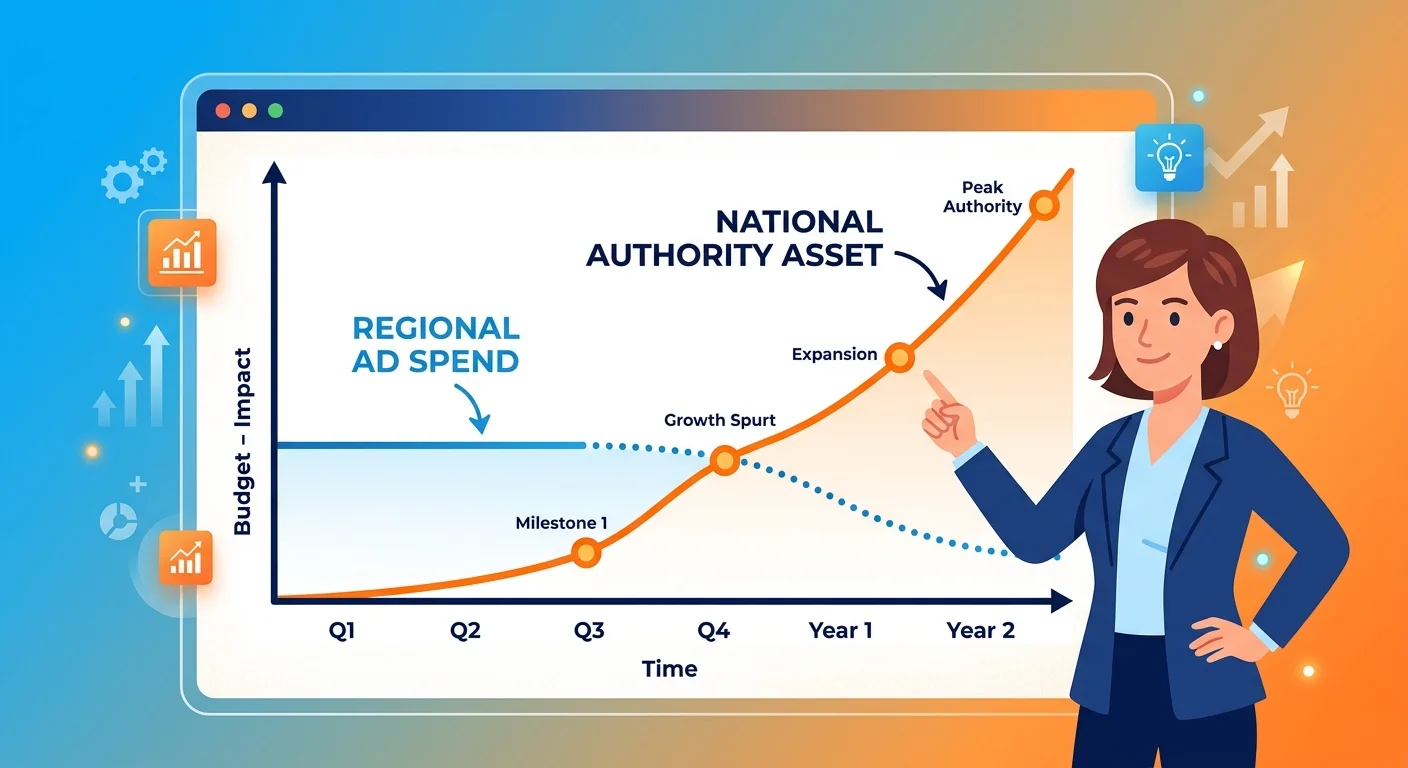
Two curves run in opposite directions. One shows what regional ad spend produces over time. The other shows what an AI authority asset produces.
The gap between them is the return.
The Depreciation Curve: What Regional Ad Spend Actually Costs Over Time
Regional ad spend has one defining characteristic: the moment you stop paying, the visibility disappears. Every dollar buys a window. When the window closes, nothing carries forward.
That is not a flaw in the campaigns. It is the model. Transactional advertising was built for immediate exposure, not lasting authority. For years the trade-off held – exposure was visible, measurable, tied to patient volume.
Then the environment changed.
Patients asking ChatGPT or Gemini for a care recommendation are not seeing ads. They are receiving a verdict. Ads do not build the entity signals that generate those verdicts. McKinsey’s benchmarking on advanced digital infrastructure is direct: compounding operational returns come from accumulated assets – not recurring exposure purchases.
The real cost of regional ad spend is not the budget line.
It is the authority that was never built while the invoices were going out. Every month a practice invested in transactional visibility instead of entity infrastructure is a month a competitor spent compounding the signals AI engines now use to decide whose name to say.
That gap does not close on its own. It widens.
The Compounding Curve: How AI Authority Builds Equity Month Over Month
An authority asset runs on a completely different curve. It does not depreciate. It inverts.
McKinsey’s benchmarking on advanced digital infrastructure makes the case plainly: compounding operational returns come from assets that accumulate, not campaigns that reset. Each month of consistent authority execution – structured entity signals reinforced by coordinated AI Authority content – builds on the month before it.
Citation Velocity increases. Semantic Density deepens. The entity footprint grows more coherent, more corroborated, more recognizable to AI engines across every market the practice operates in.
And it does not reset. That is the structural difference between this and every other visibility investment a practice has made.
This is not theoretical. A single-location clinic that built a national patient funnel without spinning up disconnected regional pages shows exactly how the curve plays out: slow at the foundation, accelerating through content, self-reinforcing once entity signals reach coherence threshold.
A unified national digital ecosystem produces an accelerated trust curve compared to running localized silos. The compounding begins the moment the foundation layer is in place.
Not months later. Immediately.
The Real ROI Question: Positioning Cost Versus Positioning Ownership
The wrong question is: how much does this cost?
The right question is: what is the cost of positioning you do not own?
Regional ad spend produces rented visibility. It exists as long as the invoice is paid. A National Entity Strategy produces owned positioning – authority signals that persist, compound, and widen the gap between the practice and every competitor with each month of consistent execution.
The proven authority asset model is not priced as a monthly expense. It is structured as an infrastructure investment with compounding returns – because that is the only framing that accurately describes what it is.
So the return calculation is not ‘spend X, get Y patients in Z months.’ That is a transactional model applied to a non-transactional asset. It does not fit.
The real question: at what point does the compounding authority curve outpace the cost of the build – and then keep compounding after that?
For practices that have already captured their local market, that inflection point is not a projection. It is the line between staying local and becoming the name AI recommends across every market that matters. For practices still wondering whether national scaling applies to them, the answer lives in that question. The asset either compounds – or it doesn’t. The practices that build it find out. The ones that don’t stay exactly where they are.
| Investment Type | Year 1 Output | Year 2 Output | Year 3 Output | Equity Retained After Stop |
|---|---|---|---|---|
| Regional Ad Spend | Bounded visibility window tied directly to active campaigns | Requires increased spend to maintain same visibility as competition grows | Diminishing returns as AI-native discovery replaces list-based search | Zero – visibility ends when payment stops |
| Local AEO Content (Single Market) | Entity signals established within one geographic footprint | Content compounds within that market but hits a ceiling as local saturation is reached | Authority depth increases but geographic reach remains static – growth stalls at the local ceiling | Partial – entity signals persist but are constrained to a single market’s relevance |
| National Entity Strategy (Infrastructure + Content) | Foundation layer built – entity signals coherent across multiple markets from the start | Citation Velocity accelerates as coordinated AI Authority content reinforces the entity footprint across regions | Semantic Density reaches coherence threshold – AI engines consistently cite the practice across all target markets | High – authority signals are owned infrastructure that compound indefinitely after the build |
| Disconnected Multi-Location Pages (Common Approach) | Fragmented entity signals across regional subdomains with no unified authority architecture | AI engines encounter contradictory entity data – recommendation frequency remains low despite content volume | Authority does not compound because the foundation is fractured – each market effectively starts from zero | Minimal – fragmented signals erode without consistent remediation spend |
Frequently Asked Questions
The ROI logic holds. But logic doesn’t move people – objections do. Here are the questions that actually decide whether a practice acts or stalls.
Answered straight. No hedging.
How does a national entity strategy differ from traditional multi-location SEO?
Traditional multi-location SEO is a keyword-and-landing-page game. Build a city page. Load it with local terms. Wait for a crawler to reward the relevance signal. That is the whole model.
A National Entity Strategy is not that. AI answer engines do not crawl for keyword density – they evaluate entity coherence. Does this brand present a unified, corroborated identity across every market it operates in? Fragmented regional content reads as noise. A single coherent entity footprint reads as authority.
So the difference is not scale. It is architecture. Multi-location SEO builds isolated local assets that reset in every new market. A National Entity Strategy builds one machine-readable entity that AI engines can trust and cite across every geography – without starting over each time.
Why are local-only single-location practices struggling with AI recommendation engines?
AI engines do not reward geographic specificity. They reward entity coherence. A single-location practice typically runs disconnected signals – a local listing here, a thin content footprint there, no unified entity data that tells an AI engine who this brand is beyond one zip code.
That is not a traffic problem. It is a trust problem. When a patient asks ChatGPT or Gemini who to see, the engine synthesizes everything it knows about a brand – citations, corroboration, Semantic Density, Citation Velocity – and names the one it trusts most. A practice with a thin, locally-siloed footprint does not compete in that evaluation.
And the window is closing. Gartner projects traditional search engine volume will decline by 25% by 2026, driven by consumers moving to AI-native discovery. Local-only practices are not just underrepresented in that channel. They are structurally excluded from it.
What is a realistic timeline to see measurable returns from a National AI Authority Engine?
Any agency that hands you a specific timeline is selling you a close, not a strategy. There is no honest number – and you should walk away from anyone who gives you one.
What McKinsey’s benchmarking on advanced digital infrastructure makes clear is that compounding operational returns come from assets that accumulate – not campaigns that reset. The foundation phase builds entity architecture. The content execution phase deepens Semantic Density and accelerates Citation Velocity. The compounding phase is where the curve inverts: the asset starts producing returns that exceed the cost of the build, and it keeps widening after that.
What does not vary is the direction. Every month of consistent execution moves your curve forward. Every month of inaction moves a competitor’s curve forward instead.
Does scaling to a national entity footprint risk diluting local patient trust at individual offices?
Only if it is done wrong. And that is worth saying plainly – because the fear is legitimate.
A poorly executed national strategy produces exactly that risk. Disconnected regional pages. Inconsistent entity signals. A brand AI engines cannot reconcile into a single trusted identity. That does dilute local trust. The entity footprint becomes incoherent – and incoherence is what AI engines filter out.
But a correctly built National Entity Strategy does the opposite. It builds one unified entity that AI engines recognize as the same trusted brand across every geography, while preserving the location-specific signals that route local queries to the right office. Entity coherence and local relevance are not competing forces. They are the same architecture expressed at different scales.
This is an execution question, not a strategy question. Build the entity right, and local trust compounds alongside national authority.
How do AI answer engines like ChatGPT and Gemini evaluate a brand’s entity authority across multiple states?
They evaluate entity coherence – the degree to which every signal about a brand tells the same consistent story across every source the engine can access.
That means schema consistency, citation patterns, content structure, and the alignment between what a brand claims about itself and what independent sources corroborate. ChatGPT and Gemini are not running isolated local searches. They are synthesizing a brand’s entire digital footprint into a single entity profile – then deciding whether that profile is trustworthy enough to cite.
A brand with coherent, corroborated entity signals across multiple states does not get evaluated state by state. It gets recognized as a single authoritative entity. That recognition is what generates multi-market recommendations from a single national infrastructure investment – without winning each market from scratch.
Can a solo practitioner execute a national entity strategy without corporate infrastructure?
Yes. And the assumption that national authority requires corporate infrastructure is exactly backward.
Corporate infrastructure actively works against entity coherence in most cases. Large systems build disconnected regional properties – separate domains, conflicting schema, inconsistent entity signals – that AI engines struggle to reconcile into a single trusted identity. A solo practitioner with a single, well-built entity footprint and a consistent AI Authority content execution model is structurally better positioned than a multi-location system running fragmented digital architecture.
What a solo practitioner needs is not more offices. It is a coherent entity that AI engines recognize as authoritative regardless of geography. That is an infrastructure build, not a headcount build. McKinsey’s benchmarking is direct: compounding operational returns come from assets that accumulate – not from scale for its own sake. The asset is built once. It compounds. Corporate infrastructure is not the prerequisite. Entity coherence is.
The National Ceiling Break: Where This Leaves You
The local ceiling is not a market problem.
It is an infrastructure problem. Infrastructure problems do not fix themselves – they compound in the wrong direction. Every month without the right foundation is a month a competitor spends building theirs.
Gartner projects traditional search engine volume will drop 25% by 2026 – driven entirely by consumers moving to AI-native discovery.
That shift is not waiting for your practice to feel ready. It does not pause while you decide whether national authority is worth the investment.
The practices building coherent national entity footprints right now are the ones AI engines will cite when the shift completes. The ones who wait are not standing still. They are actively funding their competitors’ compounding curve instead of building their own.
Here is where this leaves you.
You have a local ceiling. You have competitors who are either already past it or weeks away from it. And you have a choice: keep investing in transactional visibility that depreciates the moment the invoice stops – or build an authority asset that compounds with every month of consistent execution.
A National Entity Strategy is not a bigger version of what you have been doing. It is a different model entirely. One that turns the entity infrastructure AI engines actually trust into the most durable competitive advantage a practice can build.
ITech Valet builds that infrastructure. The practices that move now will not be the ones trapped behind a ceiling they never knew existed. The ones who wait are already deciding their competitors’ answer for them.
Here’s the question that actually matters: when someone in your market asks an AI engine who to trust – does your name come up? Run the AI Visibility Check and find out in 15 minutes.