
Why Corporate Chains Are Actually Losing the AI Visibility Game

Here’s the thing nobody’s saying out loud: corporate size is a liability in the AI recommendation game. Most independent practices haven’t figured that out yet. That’s the opening.
The industry analysis on digital trust is consistent on this point: verifiable trust decreases friction in entity validation and scales brand reach in ways raw size can’t replicate. Corporate chains have thousands of locations and millions in ad spend. What they don’t have is clarity. And clarity is what AI engines are actually scoring.
When a national healthcare chain deploys the same template across 300 locations, AI engines see 300 nearly identical entities. There’s no reliable way to distinguish one from another. That’s not authority – that’s noise. An independent practice that builds the right national entity strategy can feed AI models structured, specific, schema-rich signals that corporate templates structurally cannot produce. The machine doesn’t reward scale. It rewards verifiability.
Why Template-Driven Infrastructure Fails AI Engines
Template-driven infrastructure was built to solve one problem: visual consistency across locations. It was never built to solve a machine-readability problem. Those aren’t the same problem.
ChatGPT and Gemini don’t browse your pages the way a patient does. They parse structured signals: schema markup, entity relationships, semantic consistency across every mention of your name on the web. When those signals are missing – or when they’re identical across hundreds of locations – the engine can’t confidently verify who you are. An entity it can’t verify is an entity it won’t recommend.
The Local AI Authority Engine is built on exactly this insight. A properly structured independent practice – dense, specific, schema-rich – can out-verify a corporate chain whose infrastructure was optimized for visual consistency, not machine-readability. Organizations actively building this kind of digital trust are 1.6 times more likely to achieve at least 10% annual revenue and EBIT growth. Corporate templates don’t get you there. Intentional entity architecture does.
Here’s the part that stings: template infrastructure doesn’t just fail to differentiate. It actively works against it. Every location shares the same schema patterns, the same content structure, the same generic entity signals. So even when a corporate chain has strong brand recognition with humans, AI engines are left with a pile of indistinct, unverifiable entities. They’d rather name the independent practice that made itself unambiguous than guess which of 300 identical pages is the right one.
| Visibility Factor | Corporate Chain Default | AI Engine Requirement | Result for Chains |
|---|---|---|---|
| Schema Structure | Identical templates deployed across hundreds of locations – schema is copy-pasted, not customized | Distinct, location-specific schema that unambiguously identifies each entity | AI engines can’t differentiate one location from another – none get recommended with confidence |
| Semantic Density | Generic, brand-consistent copy written for human visual appeal and brand guidelines | Deep, specific semantic signals that answer who, what, where, and why for each entity | AI parses indistinct content and finds nothing to anchor a confident recommendation to |
| Entity Verification | Brand recognition built through ad spend, signage, and visual repetition | Machine-readable authority signals verified across multiple external sources | High human recognition doesn’t translate to AI verifiability – the entity remains unconfirmed |
| Citation Velocity | Centralized PR and corporate-level mentions that rarely reference individual locations | Consistent, entity-specific citations that reinforce the same location across authoritative sources | Individual locations accrue no independent citation signals – they remain anonymous to AI engines |
| Geographic Entity Expansion | Location pages built from the same template with only the city name swapped out | Structured, location-specific authority architecture that gives each entity a unique signal footprint | Template swap-outs are transparent to AI – pages register as duplicates, not distinct entities |
| Infrastructure Intent | Built for visual consistency across locations – optimized for the human eye | Built for machine-readability – optimized for how AI engines parse and verify entities | The infrastructure solves the wrong problem entirely, leaving AI engines with nothing to trust |
What Entity Trust Actually Means – and How AI Calculates It
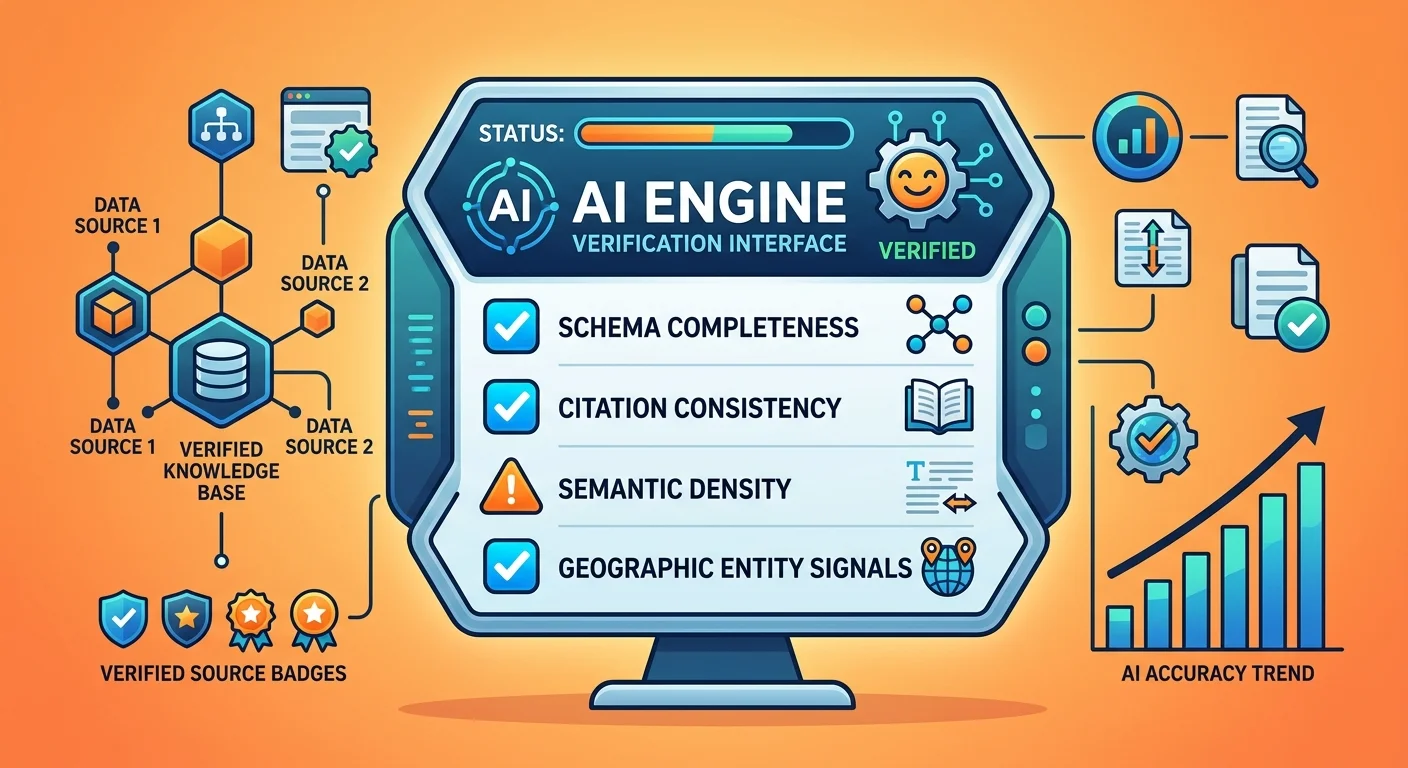
Entity trust isn’t a feeling. It’s a score. And AI engines are calculating it right now – whether you’ve done anything to optimize for it or not.
Here’s what entity trust actually is. It’s the degree to which an AI engine can independently verify that your business is real, specific, and authoritative in its stated category. That verification comes from structured signals – schema markup, semantic consistency, citation patterns, the coherence of your identity across every platform that mentions your name. When those signals are dense and consistent, the machine confirms who you are. When they’re absent or contradictory, it can’t confirm anything. And an entity it can’t verify is an entity it won’t recommend.
That’s the calculation that matters most. When you’re calculating the return on a national entity strategy, entity trust is the foundation everything else builds on. Not your follower count. Not your ad spend. Not how many years you’ve been in practice. The machine is asking one question: can I verify this entity well enough to name it? Your infrastructure either answers that question clearly – or it doesn’t answer it at all.
How AI Engines Measure Entity Trust vs. Brand Size
Brand size tells a human something. It tells an AI engine almost nothing useful.
What AI engines actually measure is verification density – how many independent, structured signals confirm the same coherent identity. A corporate chain with 400 locations still has to pass that test entity by entity. And published research on AI trust architecture shows that corporate entities with complex, multi-layered hierarchies suffer up to a 40% deficit in trust consistency when they deploy systems without clear schema representation. That’s not a branding problem. That’s a structural one. And it doesn’t stop at machine calculations – 79% of US adults express deep concern about how large corporate entities handle their data. The trust gap between a faceless chain and a clearly identified independent practice runs both ways: the machine doubts the chain, and so does the patient.
Here’s the opening that most independent practices don’t realize they have. Build Schema Foundation correctly, layer Semantic Density on top, earn Citation Velocity through consistent authority signals – and you out-verify a corporate competitor whose infrastructure was never designed for machine-readability. The David vs. Goliath framing isn’t a comfort story. It’s structurally accurate. The chain built for human perception. The independent practice that builds for AI verification wins the recommendation. That’s not an upset. That’s the system working exactly as designed.
| Entity Trust Signal | What AI Engines Look For | Corporate Chain Score | Independent Practice Potential |
|---|---|---|---|
| Schema Foundation | Structured markup that clearly identifies the entity – business type, services, location, credentials, and relationships – in machine-readable format | Templates replicate identical schema across hundreds of locations, making each entity structurally indistinct and difficult to verify individually | High – a single-location practice can build precise, specific schema that leaves no ambiguity about who it is, what it does, or where it operates |
| Semantic Density | Consistent, deep topical signals across all content that confirm the entity’s category, expertise, and authority within a defined domain | Content is often centrally produced and distributed uniformly, stripping location-specific semantic depth and producing thin, generic entity signals | High – an independent practice can build rich, specific semantic signals tailored to its exact specialty and market, which AI engines can verify with precision |
| Citation Velocity | The rate at which independent, authoritative sources reference and confirm the entity’s identity consistently across the web | Brand-level citations exist but are rarely tied to specific location entities – the chain is mentioned, but individual locations rarely earn distinct citation authority | High – a focused independent practice can earn location-specific citations that directly reinforce a single, unambiguous entity rather than diluting authority across hundreds |
| Geographic Entity Expansion | The ability to extend verified authority signals into new markets while maintaining coherent, location-specific entity identity in each | Difficult – identical template rollouts in new markets produce new instances of the same indistinct entity pattern, compounding verification ambiguity | High – a practice that has built correctly at the local level can expand entity signals into new geographies with structural specificity that corporate templates can’t replicate |
| Cross-Platform Identity Consistency | Coherent, matching entity data – name, address, category, credentials – across every platform that references the business | Complex organizational hierarchies create frequent inconsistencies between corporate profiles and location-level listings, creating conflicting signals AI engines can’t resolve | High – a single-location or small multi-location practice can maintain tight identity consistency across all platforms, giving AI engines a clear, uncontradicted entity to verify |
| Structured Authority Signals | Explicit, machine-readable declarations of expertise, credentials, and category authority that AI engines can confirm without inference | Authority claims are broad and brand-level – rarely structured in ways that allow AI engines to verify a specific location’s expertise in a specific service category | High – an independent practice can make precise, verifiable authority declarations tied to its exact specialty, making it unambiguous as the recommended entity in its category |
The Architecture of a National AI Authority Strategy
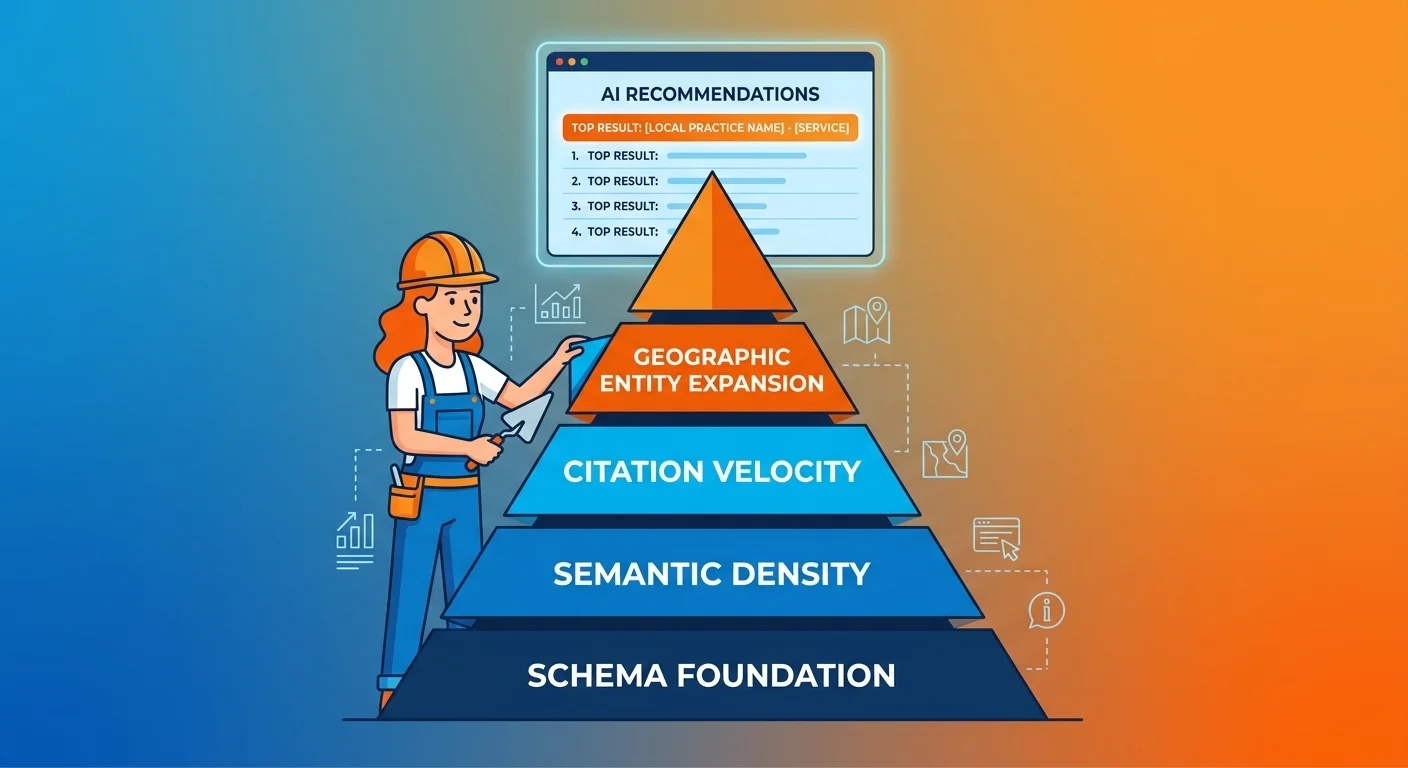
So now the question is: what does building it actually look like?
National AI authority isn’t a content play. It’s an infrastructure play.
And infrastructure has to be built in sequence. Each layer creates the conditions the next layer requires. Skip one, and the whole stack becomes unverifiable – not just weak, unverifiable.
The FTC has been clear on this: you can’t artificially inflate machine-readability signals. The only path to legitimate AI authority is the one built correctly from the ground up.
This isn’t about gaming anything. The FTC explicitly requires that every claim of algorithmic capability be backed by real, empirical evidence – not marketing language.
That standard applies here too. Every layer of the National AI Authority build exists because AI engines require it for verification. The requirement comes from the machine. The build just answers it.
The Four Layers of a National AI Authority Build
Four layers. Not interchangeable. Not optional.
Schema Foundation is where it starts. Machine-readable markup that tells AI engines exactly who you are, what you do, where you do it, and how to verify your identity against external data sources.
Without it, everything you build on top is floating.
And here’s what most practice owners get wrong: they assume their current platform handles this automatically. It almost never does. That assumption is exactly what keeps them invisible while their competitors get named.
Semantic Density builds on top of that foundation. It’s the depth and specificity of content signals that confirm your expertise within your stated category.
This is where what solo practitioners need to know becomes a real competitive edge. Corporate chains push broad, generic content across hundreds of locations. A focused independent practice produces semantically rich, highly specific authority content that AI engines can actually verify.
Corporate templates can’t replicate that depth. They were never built to.
Citation Velocity is the third layer – the rate at which third-party, authoritative sources confirm your entity through consistent mentions, structured citations, and cross-platform signal alignment. Not quantity of mentions. Verified, consistent, structured ones.
Then comes Geographic Entity Expansion: the deliberate process of extending verified entity signals into additional service areas without diluting the core identity that earned the trust in the first place.
That’s the full architecture. Schema Foundation locks your identity. Semantic Density proves your authority. Citation Velocity earns external confirmation. Geographic Entity Expansion scales what’s already verified.
Each layer compounds on the last. None of them work without the ones beneath.
| Layer | Component Name | What It Does for AI Engines | Corporate Chain Weakness |
|---|---|---|---|
| Layer 1 | Schema Foundation | Provides machine-readable markup that identifies the entity’s name, category, location, and credentials – giving AI engines a verifiable starting point before parsing any content | Template platforms auto-generate generic schema across all locations, producing identical markup that AI engines cannot use to distinguish one entity from another |
| Layer 2 | Semantic Density | Builds deep, category-specific content signals that confirm the practice’s expertise within its stated specialty – allowing AI engines to verify authority, not just existence | Centrally produced content is broad and location-agnostic by design, stripping the semantic specificity that AI engines require to assign category authority |
| Layer 3 | Citation Velocity | Generates a consistent stream of third-party, structured citations from authoritative external sources, reinforcing the entity’s identity through independent cross-platform confirmation | Brand recognition with humans does not translate to citation signals AI engines trust – corporate chains often have high consumer visibility but thin verifiable citation infrastructure |
| Layer 4 | Geographic Entity Expansion | Extends verified entity signals into additional service areas by replicating the structured identity architecture – scaling reach without diluting the core identity that earned trust | Multi-location rollouts replicate template structure rather than verified entity architecture, compounding the identity ambiguity problem across every new market entered |
Scaling Without Identity Dilution: The Local-National Balance

Here’s what kills this before it starts.
Most practice owners assume going national means going generic – that the moment you reach beyond your city, you sand off the specific identity patients actually trust. In traditional advertising, that fear is real. But AI authority doesn’t work that way. At all.
Geographic Entity Expansion is built for exactly this problem. It extends verified entity signals into new markets without overwriting the core identity that earned trust at the origin point. Your Schema Foundation stays intact. Your Semantic Density stays specific. What grows is the geographic footprint – and if you’re thinking about how that footprint holds up across state lines, the answer is the same: the machine isn’t asking you to be everything to everyone. It’s asking you to be clearly, verifiably you – in every market you serve.
That’s the actual balance. Not local versus national. Local and national – same verified entity, extended with structural precision.
McKinsey found that organizations actively building digital trust are 1.6 times more likely to hit at least 10% annual revenue and EBIT growth. The practices that skip structure and just go wider end up with the same problem corporate chains have – broad reach, zero verifiability. And real client case studies make this unmistakably clear: the ones that scaled without losing their identity built the foundation before they built the footprint.
Who This Strategy Is Not For
This strategy isn’t for everyone.
That’s not a caveat. It’s a gate.
If you need your schedule flooded in 60 days, stop here. National AI authority builds in layers – Schema Foundation first, Semantic Density on top, Citation Velocity earned over time, Geographic Entity Expansion deployed once the foundation holds. That sequence doesn’t compress into a sprint.
And if your decision framework requires a contractual guarantee of rankings, leads, or revenue before you commit – walk away now. Authority compounds. It doesn’t pay out on a slot machine schedule.
Here’s what most people miss: Pew Research Center data shows 79% of US adults already distrust how large corporate entities handle their data. The independent practice that built transparently and specifically isn’t just winning an algorithm. It’s winning the trust gap corporate chains structurally can’t close.
If you’re planning to reverse-engineer this after one conversation – or if you’re comparing a full National AI Authority Engine to a $500/month retainer on price alone – this isn’t your fit. No hard feelings.
But this is built for the practice owner who’s done watching competitors get named while they stay invisible. The one who understands authority is an asset, not a line item. The one who’s ready to build the infrastructure that makes the machine say their name.
| Practice Profile | Local Identity Risk | National AI Authority Approach | Expected AI Outcome |
|---|---|---|---|
| Single-location independent practice with strong local reputation | Scaling too fast dilutes the specific, locally-verified identity that earned AI trust | Lock Schema Foundation to core location first, then extend Geographic Entity Expansion into adjacent markets using the same verified entity signals | AI engines recommend the practice by name in both origin market and expanded service areas – same entity, wider footprint |
| Solo practitioner entering a second city or state | New market has zero entity verification history – AI has nothing to confirm | Build Semantic Density specific to the new market’s service context before claiming Geographic Entity Expansion; Citation Velocity must precede broad signal distribution | AI engines recognize a verified entity entering a new geography, not an unknown brand making unsubstantiated claims |
| Multi-location independent group practice | Each location competes with the others for entity clarity – inconsistent schema across locations fragments the brand signal | Standardize Schema Foundation across all locations with location-specific Semantic Density layers; every location is a distinct entity node on a unified verified identity | AI engines surface the correct location for each query geography without confusing or cannibalizing sibling locations |
| Corporate chain with national brand recognition | Brand recognition is a human signal – AI engines require structured, machine-readable verification that most corporate templates were never built to provide | Cannot compensate for missing Schema Foundation with ad spend or brand awareness campaigns – the structural deficit requires an infrastructure rebuild, not a marketing push | Without verified entity infrastructure, AI engines default to independently-built practices whose machine-readable signals are clearer and more consistent |
| Practice that built local AI authority and is ready to scale nationally | Abandoning the specific, verified local identity in favor of generic national messaging erases the trust signals that earned AI recommendations | Preserve core Schema Foundation and Semantic Density intact; extend only the geographic layer – the identity that earned trust travels with the infrastructure, not against it | AI engines treat national expansion as a verified entity growing its footprint, not as a new unverified brand entering the market – recommendation consistency holds across all markets |
Frequently Asked Questions
Understanding a strategy and committing to one are two different things. That gap is where the real questions live. Here’s where we answer them straight.
No hedging. No ‘it depends.’ Just answers.
Can a solo practice truly compete with national corporate chains in AI recommendations?
Yes. Not just compete – win.
AI engines don’t score on ad spend. They score on verification density.
A corporate chain with a thousand locations but thin, templated schema is actually harder to verify than a focused independent practice with a tightly built Schema Foundation and specific Semantic Density signals.
The machine doesn’t know your competitor’s logo. It knows whether it can confirm who you are, what you do, and whether external sources agree.
A solo practice that builds the infrastructure correctly isn’t punching above its weight. It’s playing a different game – one where the chain’s size becomes a liability.
What is entity trust and how does AI calculate it for a healthcare brand?
Entity trust is an AI engine’s confidence that it can verify your identity as a real, specific, credible source.
Three signal types drive that confidence: structured schema data, semantic content specificity, and third-party citation consistency.
When ChatGPT or Perplexity encounters your name, it cross-references what your infrastructure says against what external sources confirm. Same name, same category, same service area, consistent credentials – trust accumulates. Conflict or silence – the engine moves to whoever is more verifiable.
Here’s the kicker: Pew Research Center found that 79% of US adults are already skeptical of how large corporate entities handle their data. Transparent, machine-readable identity signals don’t just satisfy an algorithm. They align with what patients already want.
Why does traditional SEO fail to scale trust for multi-location practices?
Traditional SEO was built to rank a page in a list. AI authority is built to earn a named recommendation.
Those aren’t variations of the same goal. They’re different games entirely.
Keyword density, backlink counts, and page authority scores tell a search algorithm where to place you in a ranked list. They tell an answer engine almost nothing. Answer engines need structured schema, semantic specificity, and cross-platform citation consistency – none of which traditional SEO optimizes for.
Multi-location practices that scale traditional SEO just multiply the same unverifiable signals across more pages. More pages. More locations. Same identity fog.
Gartner confirms it: algorithmic validation specifically mitigates identity risks in ways traditional listing strategies don’t. The AI engine can’t verify a keyword-optimized page. It can verify a schema-rich entity.
How do answer engines like ChatGPT and Perplexity handle local vs. national entity validation?
They don’t treat local and national as separate categories. They treat every entity as either verified or unverified.
When someone asks ChatGPT or Perplexity for a recommendation, the engine looks for entities whose schema, content signals, and citation record are coherent and consistent.
So a local practice with a well-built Schema Foundation and strong Semantic Density can be validated at the national level – but only if the Geographic Entity Expansion layer is structured correctly.
The engine isn’t checking your zip code first. It’s checking whether your identity holds up under verification across every market you claim to serve.
What are the structural requirements for building AI-readable authority infrastructure?
Four layers. Built in sequence. No shortcuts.
First, Schema Foundation: the machine-readable markup that declares your identity – who you are, what you do, where you do it, and how external sources can verify it.
Second, Semantic Density: the depth and specificity of authority content that proves expertise within your stated category.
Third, Citation Velocity: the rate at which authoritative third-party sources confirm your entity through consistent mentions and structured signals.
Fourth, Geographic Entity Expansion: the deliberate process of extending those verified signals into new markets without overwriting the core identity.
The FTC is explicit that companies can’t artificially inflate machine-readability signals. Every layer has to be earned through legitimate infrastructure. That’s not a constraint. That’s the competitive moat.
The Verdict: Independent Practices That Build Right Win
Here’s what the chains missed. They built for human perception – big logos, broad reach, names plastered on billboards. AI engines don’t score any of that. They score verification density: how many structured, independent signals confirm a coherent, specific identity. On that dimension, a focused independent practice that builds correctly doesn’t just compete with a corporate chain. It beats one.
That’s the payoff of the entire build. Schema Foundation locks your identity. Semantic Density proves your authority. Citation Velocity earns the external confirmation that makes you trustworthy to the machine. Geographic Entity Expansion scales what’s already verified – without diluting the core identity that earned trust in the first place. McKinsey found that organizations building this kind of layered digital trust are 1.6 times more likely to hit at least 10% annual revenue growth. The chain that outspent you in paid advertising is invisible in the answer engine that replaced it. The practice that built the right infrastructure isn’t.
There’s no version of doing nothing that ends well. AI is already naming someone in your market. Either it’s naming you – because you built the infrastructure that makes verification possible – or it’s naming a competitor who did. That gap compounds every month it goes unaddressed. The practices that build right don’t just catch up to the chains. They create a structural advantage the chains are architecturally unable to close. The machine doesn’t weigh your budget. It weighs your verifiability. And right now, the machine is scoring your market – the only question is whether your infrastructure gives it an answer.
AI is already scoring your market. It’s already naming someone in your category. That someone might be you – or it might be a competitor who moved first. The only way to know is to check. The AI Visibility Check shows you exactly what ChatGPT, Gemini, and Grok say when someone asks who to trust in your space. Fifteen minutes. Real data. No guesswork.