
Why GBP Is a Local Tool – Not a National Authority Signal
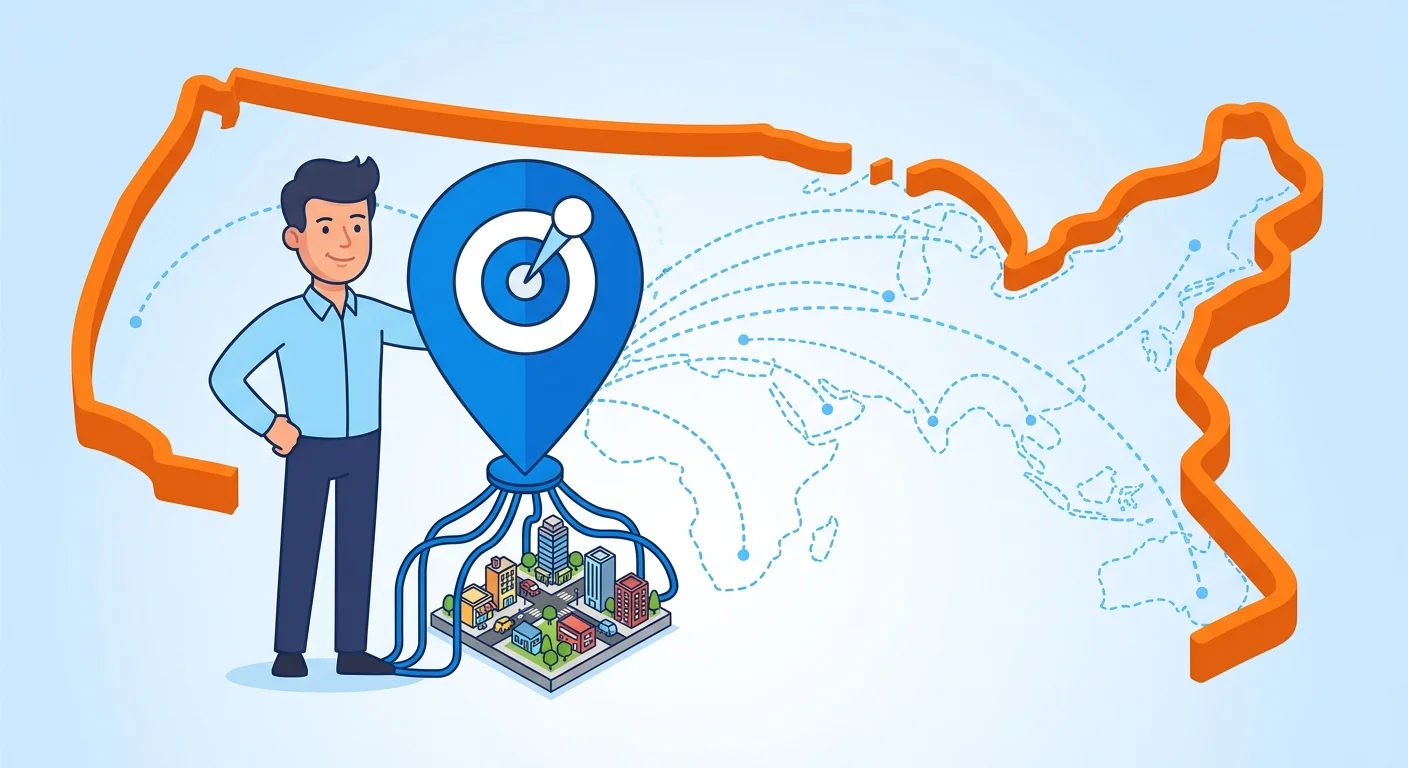
GBP is not an authority signal. It’s an address signal. Those are not variations of the same thing – they are completely different problems requiring completely different solutions.
Ask ChatGPT or Gemini who the top sports medicine specialist in the country is. Your GBP address doesn’t enter that conversation – not even as a secondary signal. AI answer engines aren’t querying a map index. They’re pulling from a semantic trust layer. And GBP signals don’t live there.
Here’s the kicker. Most businesses never see this ceiling coming. They optimize their GBP, collect reviews, update their hours – and call it authority-building. It’s not. That’s footprint-building. And the gap between a local footprint and national AI visibility is exactly where most brands quietly disappear.
What GBP Was Actually Built to Do
GBP was built for one job: helping someone find the nearest option. Not the best option. The nearest one. That distinction matters more now than it ever did.
But that query behavior is collapsing. Gartner projects a 25% drop in traditional search volume by 2026 as users shift to conversational AI that returns one synthesized answer – not a map pack with three pins. GBP was engineered for a world that’s being replaced in real time.
And this isn’t a forecast anymore. 58% of U.S. adults already know what ChatGPT is – and awareness always runs ahead of adoption. The gap between those two numbers is closing fast. Businesses that are building national AI authority right now aren’t being early. They’re being on time.
The Structural Ceiling: Why GBP Signals Don’t Translate to National AI Visibility
So here’s the structural problem. GBP signals are coordinate-bound. They tell AI engines where you are. National AI authority is built on what you are – your topical depth, your semantic relationships, your entity consistency across the entire web. Those aren’t variations of the same signal. They’re two completely different data layers, and no amount of GBP optimization moves you from one to the other.
When an AI engine decides whether to recommend a brand for a national-scope query, it’s not checking a service radius. It’s checking entity trust. Does this brand’s digital infrastructure consistently signal the same identity, the same expertise, the same relationships – regardless of geography? GBP doesn’t answer any of those questions. It was never designed to.
That’s the ceiling. And it’s not a review count problem. It’s not a rankings problem. It’s a structural one – and the businesses still polishing their GBP profile while wondering why AI won’t name them nationally are solving the wrong problem entirely. The Local AI Authority Engine exists precisely because GBP optimization and national AI authority require fundamentally different infrastructure. You can’t optimize your way out of a design mismatch.
| Signal Type | What It Tells AI Engines | Geographic Scope | National Authority Value |
|---|---|---|---|
| Google Business Profile (GBP) | Where you are – address, service radius, map coordinates | Hyper-local (ZIP code and surrounding radius) | Near zero – proximity signals don’t translate to entity trust at national scale |
| Schema Markup (LocalBusiness) | What you offer in a structured, machine-readable format | Local to regional – still anchored to a named location | Low – helps AI parse your services but doesn’t establish topical authority beyond your market |
| Knowledge Graph Entity Node | Who you are – your identity, expertise, and relationships to other trusted entities | National and global – geography-independent | High – this is the layer AI engines query when synthesizing a national recommendation |
| Citation / Directory Listings | That you exist and where – name, address, phone consistency | Local – reinforces geographic footprint | Minimal – confirms existence, doesn’t establish authority or topical depth |
| Semantic Content Clusters (AEO Articles) | What you know – topical depth, expertise signals, entity relationships across the web | National – not bound to any location | Very high – repeated, consistent topical signals build the entity trust AI engines rely on for national recommendations |
| Review Signals (GBP / Third-Party) | How others perceive you locally – volume, recency, sentiment | Local – tied to your registered business location | Low to none – trust signals for human searchers, not the semantic layer AI answer engines read |
Why Proximity-Based Optimization Fails at Scale
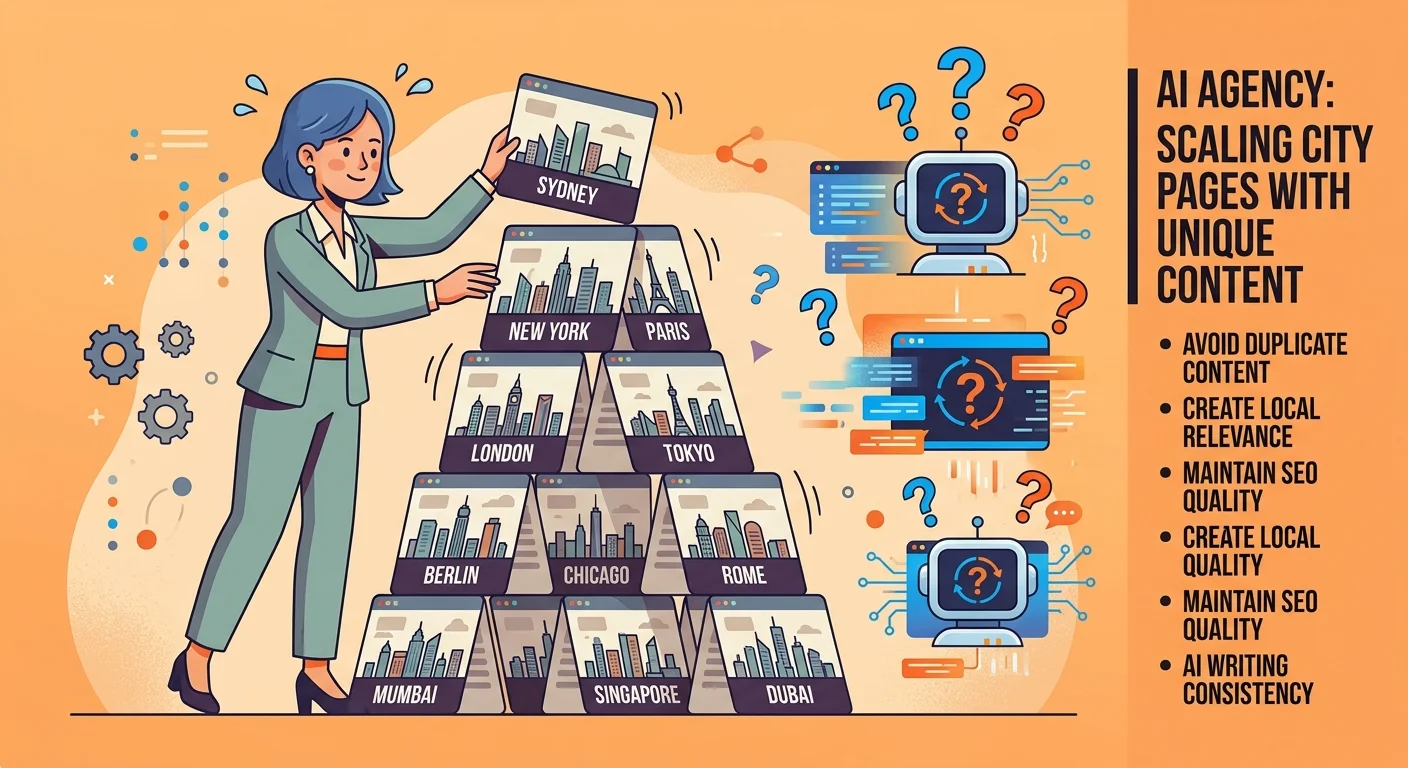
Proximity-based optimization doesn’t scale. That’s not a fixable limitation. It’s a design fact.
When you deploy localized tactics at national scope, you aren’t amplifying authority. You’re fracturing it.
Every new city landing page, every new GBP location, every proximity-keyed signal sends the same message to AI engines: this brand lives here, serves here, exists in relation to this coordinate. That’s not a national entity signal. That’s the opposite of one.
Gartner projects a 25% drop in traditional search volume by 2026. The brands that absorb that shift worst won’t be the ones who ignored AI. They’ll be the ones whose entire infrastructure was built on address-tethered signals.
The ceiling isn’t coming. It’s already here. The only question is whether your infrastructure sits above it or beneath it.
Why Most Agencies Get National Scaling Wrong
Most agencies aren’t getting national scaling wrong because they’re lazy. They’re getting it wrong because they’re running a playbook that used to work – and nobody told them the rules changed.
The default move is replication. Take what worked locally – optimized location pages, proximity signals, geo-tagged content – and multiply it across fifty cities. It feels like scaling.
It isn’t. The 50-City Landing Pages is a Failed Strategy problem isn’t about effort – it’s about entity consistency. Multiply fragmented local signals and you don’t build authority. You dilute it. And diluted entity consistency is exactly what AI engines use to exclude a brand from national recommendations.
Here’s what’s actually happening. When an AI engine evaluates a brand for a national-scope query, it runs a coherence check.
Is this entity’s identity, expertise, and relationship map consistent across the entire web – or is it fractured across dozens of location-specific micro-signals that don’t add up to a single authoritative voice? Fifty city pages fail that check. Every single time.
McKinsey estimates generative AI could create $2.6 trillion to $4.4 trillion in annual value. The brands positioned to capture any of it aren’t the ones with the most location pages.
They’re the ones that built a single, coherent, semantically rich entity that AI systems can recognize, validate, and surface with confidence. That’s a fundamentally different infrastructure problem – one no proximity-based playbook was ever built to solve.
Who This Infrastructure Shift Is Not For
This isn’t for everyone. That’s not a soft landing. It’s a filter.
If you’re a single-location practice with no national ambitions, GBP optimization is still the right call. It does exactly what it was built to do.
The friction only starts when a business tries to use proximity signals to build something proximity signals were never architected to support: national entity trust. That’s not a GBP problem. That’s a scope mismatch.
And if you want something you run through once and call done – walk away now.
Knowledge Graph integration isn’t a campaign. It’s infrastructure. It demands consistent execution, semantic coherence across your entire digital presence, and a complete stop to thinking in coordinates.
Businesses that aren’t ready to commit to that rebuild won’t see the return. Because the return compounds over time – not overnight.
| Proximity-Based Tactic | Why It Fails Nationally | AI Engine Interpretation | Entity Signal Outcome |
|---|---|---|---|
| Google Business Profile optimization | GBP signals are coordinate-bound – they communicate location, not expertise or topical authority | Reads as: ‘This brand exists at this address and serves this radius’ | Geographic footprint signal – invisible to national-scope queries |
| City-specific landing pages (multi-location approach) | Multiplying location pages fragments entity consistency rather than compounding authority | Reads as: ‘This brand is many local businesses, not one national authority’ | Diluted entity coherence – actively weakens national AI recommendation eligibility |
| Proximity-keyed content (geo-tagged, city-modified phrases) | Anchors topical authority to a geographic modifier, preventing AI engines from recognizing broad expertise | Reads as: ‘This brand’s knowledge is local – not transferable to a national query’ | Scoped authority signal – excluded from non-geographic conversational queries |
| Local citation building (directory listings tied to address) | Citations reinforce where a brand is located, not what it knows or what relationships it holds in a semantic graph | Reads as: ‘This brand is verified at a physical location’ – a map-layer signal, not a knowledge layer signal | Address-corroboration only – contributes nothing to Knowledge Graph entity trust |
| Review volume accumulation on GBP | Reviews build social proof for proximity-triggered queries but carry no semantic weight in AI entity evaluation | Reads as: ‘Customers found this business nearby and were satisfied’ – not expertise or authority | Consumer sentiment signal – irrelevant to AI engines resolving national-scope recommendations |
| Service-area expansion in GBP settings | Expanding a service radius inside GBP does not extend entity trust – it only widens the proximity net within the same address-tethered system | Reads as: ‘This brand is willing to travel farther’ – not that it is a nationally recognized authority | Radius expansion signal – zero impact on Knowledge Graph positioning or national AI citations |
What a Knowledge Graph Is and Why AI Engines Depend on It
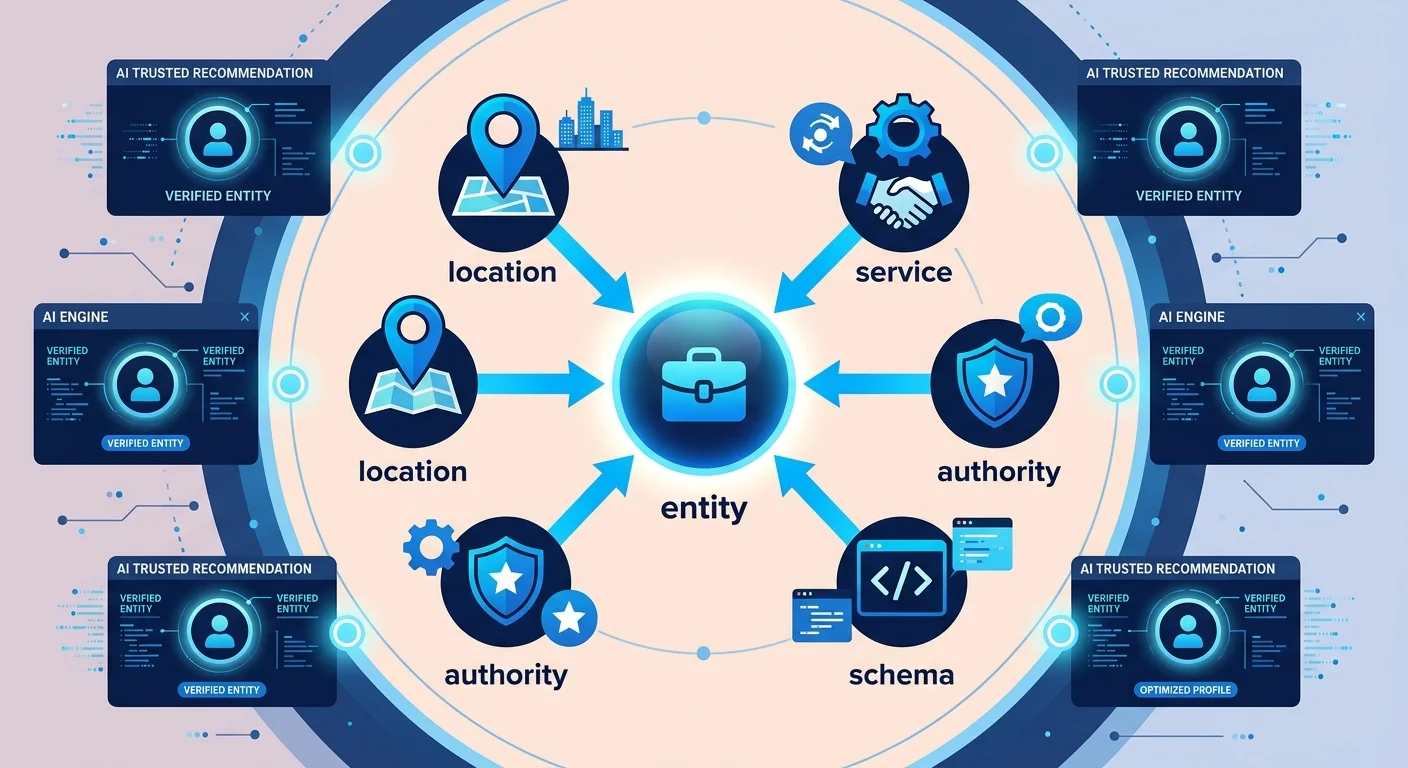
A Knowledge Graph isn’t a ranking signal. It’s a semantic trust map – a structured network of entities, relationships, and verified facts that AI engines use to determine what a brand actually is before they decide whether to recommend it.
That distinction is everything. GBP tells an AI engine where you are. A Knowledge Graph tells it who you are, what you’re authoritative on, and how your identity connects to other trusted entities across the web.
Those aren’t variations of the same thing. They’re operating on completely different layers of the information stack.
Here’s what most business owners miss. When ChatGPT or Gemini generates a recommendation, it’s pulling from a semantic layer that your Google Business Profile never touches.
The brands that get named aren’t the ones with the most reviews. They’re not the ones with the most optimized location listings. They’re the ones whose entity structure is consistent, interconnected, and machine-readable at a level the Knowledge Graph can actually validate.
The RDF Triple: How AI Engines Map Entity Relationships
Here’s how it works. NIH-published research on semantic knowledge systems establishes that Knowledge Graph frameworks use RDF triples – subject, predicate, object – to define nodes and the relationships between them.
Every triple is a declarative statement: this entity is this thing, has this attribute, relates to this other entity. That’s the architecture AI engines read when they’re deciding what to surface. Not a review count. Not a service radius. A structured map of declared facts.
Semantic mapping is the primary data ingestion path. That’s not a technical detail you can outsource to a plugin. The route from your brand’s identity to an AI engine’s recommendation runs directly through whether your entity structure is triple-mapped, schema-reinforced, and coherent across every touchpoint.
Not volume of content. Precision of declared relationships. Those are not the same optimization.
That’s not just an optimization insight – it’s a regulatory one. The FTC’s inquiry into generative AI data pipelines sent compulsory orders to 5 technology companies in January 2024 specifically to investigate how AI systems consolidate and surface institutional data.
Accuracy and entity consistency aren’t best practices anymore. They’re under active federal scrutiny. Brands built on coherent, verifiable entity structures aren’t just winning AI recommendations. They’re already aligned with the accountability standards regulators are demanding from the platforms doing the recommending.
From Local Listing to Knowledge Graph Node: What the Transition Looks Like
A local listing is a coordinate with a label. A Knowledge Graph node is a fully mapped entity with declared relationships, verified attributes, and semantic connections that AI systems can traverse in any direction.
The transition from one to the other isn’t an upgrade. It’s a structural rebuild.
In practice, that transition means replacing proximity-keyed signals with entity schema markup. It means swapping location-specific content for AEO content strategy built for national reach that reinforces topical authority regardless of geography. It means replacing siloed local citations with interconnected nodes that AI engines can validate across the open web.
And every layer has to be consistent with the others. The Knowledge Graph isn’t evaluating effort or volume or proximity. It’s evaluating coherence.
That’s the ZIP code ceiling breaking open.
Once a brand’s entity structure is built at the Knowledge Graph level – not the map-pack level – the geography of a query stops being the deciding factor. AI engines stop asking where you are. They start asking what you are.
And if your infrastructure answers that question clearly, consistently, and with enough semantic depth to validate against other trusted nodes, your brand becomes the answer. Not one of several options. The answer.
| Knowledge Graph Component | What It Defines | Local AEO Equivalent | National AI Authority Role |
|---|---|---|---|
| Entity Node | The brand as a distinct, machine-readable identity – with a name, type, attributes, and relationships declared in structured schema | Business name and category on a GBP listing | The foundational unit AI engines traverse when deciding whether a brand is a trustworthy, citable answer for a national-scope query |
| RDF Triple (Subject-Predicate-Object) | A declarative statement linking two entities through a defined relationship – e.g., this brand is an authority on this topic, which connects to this credentialing body | No direct equivalent – GBP signals proximity, not declared relationships | The building block that allows AI engines to map how a brand’s identity connects to other trusted entities across the open web |
| Semantic Relationship Map | The full network of declared connections between an entity and other verified nodes – topics, organizations, credentials, publications | Geographic proximity to a searcher’s location | Enables AI engines to validate a brand’s authority by traversing its relationship network rather than relying on address-based ranking signals |
| Schema Markup | Structured, machine-readable code that translates a brand’s identity, expertise, and relationships into a format AI engines can ingest and validate | Optional metadata fields on a GBP profile (hours, categories, services) | The primary technical layer that makes entity attributes and relationships legible to the Knowledge Graph – without it, AI engines can’t confirm what a brand actually is |
| Topical Authority Signal | A pattern of semantically consistent content that reinforces a brand’s declared expertise across its entire digital presence | Location-specific content optimized for proximity-based queries | The content layer that tells AI engines a brand’s expertise is real, consistent, and geography-independent – not a local specialty that doesn’t translate at national scale |
| Entity Coherence | The degree to which a brand’s identity, attributes, and relationships are consistent across every touchpoint the AI engine can read | Consistent NAP (name, address, phone) across local citation sources | The overarching signal that determines whether a brand is surfaced as a single authoritative voice or fragmented into conflicting micro-signals that AI engines can’t confidently resolve |
Schema Markup Requirements for a National AI Entity
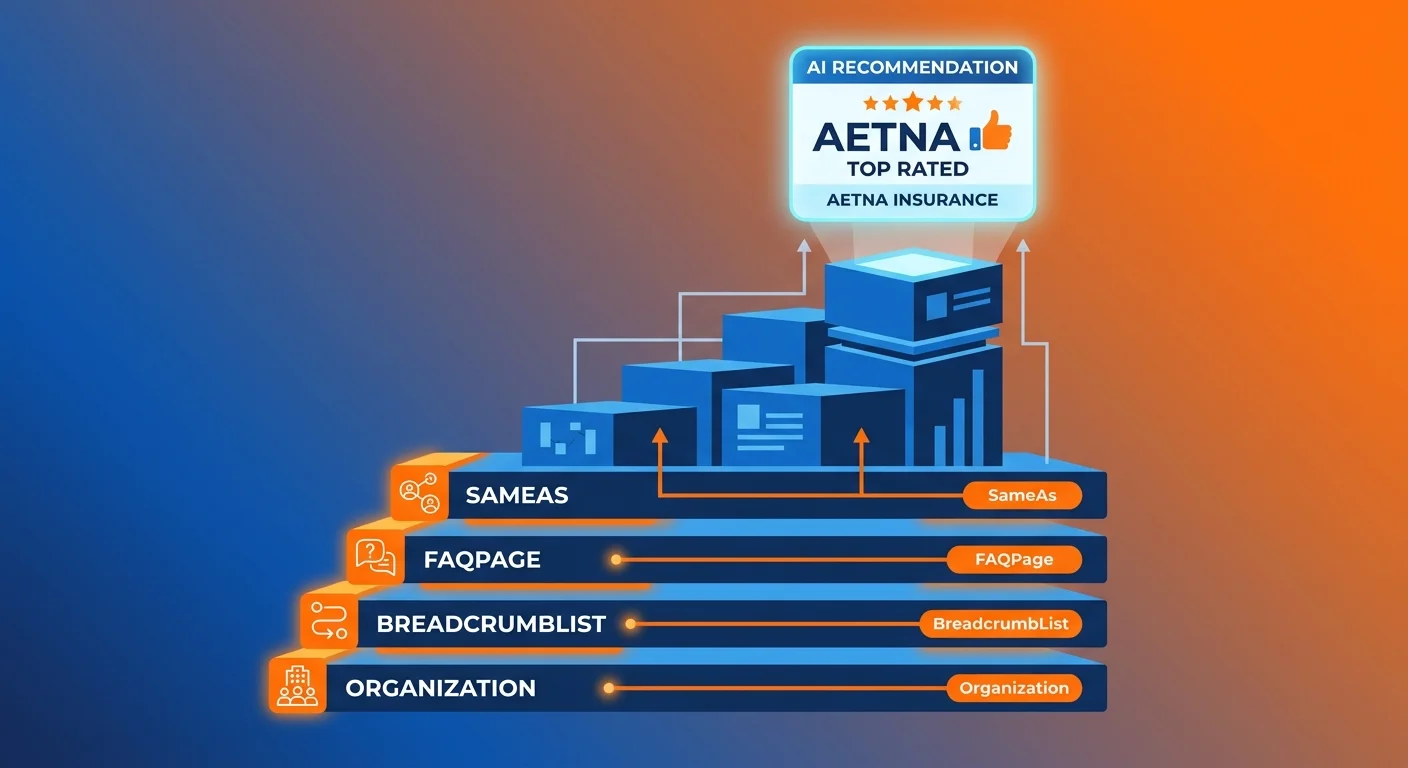
Knowing how the Knowledge Graph works doesn’t build you into it. That takes a specific technical layer most businesses have never touched – and most agencies have never built.
Schema markup is the machine-readable translation layer. It converts your brand’s identity, expertise, and relationships into structured signals AI engines can actually ingest.
Without it, your entity doesn’t exist in the semantic layer the Knowledge Graph reads. You’re not invisible because AI rejected you. You’re invisible because you never gave it the structured data it needs to recognize you in the first place.
That’s not a content problem. It’s an infrastructure one.
Knowledge Graph frameworks use RDF triples – subject, predicate, object – to define entities and the relationships between them. Schema markup is how your brand plugs into that structure.
Think of it as a declaration layer. You declare what you are. AI engines read it, validate it against other trusted nodes, and decide whether you’re surfaceable.
And for a national AI entity, those requirements are fundamentally different from anything a localized GBP profile was ever designed to produce.
The Core Schema Types That Establish National Entity Trust
Three schema types do the heavy lifting for national entity trust: Organization, WebSite, and BreadcrumbList. Each one answers a different question the Knowledge Graph is already asking about your brand.
Organization schema declares who you are – your legal name, your service area, your founding date, your social profiles, and your sameAs relationships. Those sameAs connections are what matter most. They’re the RDF-style semantic links that map your entity to other trusted nodes across the open web.
Without them, your brand exists as an isolated coordinate. Not an interconnected entity the Knowledge Graph can validate.
WebSite schema reinforces the connection between your brand’s identity and its digital home – making that relationship machine-readable at the root level. BreadcrumbList schema signals your internal authority hierarchy, showing AI engines how your topical expertise is organized and where the weight sits.
But here’s where most brands blow it. Schema isn’t a one-time deployment. Semantic mapping is the primary data ingestion path – which means every schema declaration has to stay consistent with every other entity signal across your entire digital presence.
If your Organization schema declares one service area while your content signals another, that incoherence registers as an entity ambiguity flag. AI engines don’t resolve ambiguity in your favor. They route around it.
The work of decoupling your brand identity from geographic anchors has to happen at the schema layer first – because that’s where AI engines look before they look anywhere else.
FTC Compliance and Machine-Readable Entity Disclosure
Here’s what most agencies won’t tell you: the accuracy of your schema markup isn’t just a performance question. It’s a legal one.
The FTC advertising guidelines establish that online businesses are bound by Truth in Advertising principles – and that disclosures must be clear and conspicuous in both machine-readable and human-readable contexts. Section 5 of the FTC Act covers online businesses directly.
That means the entity data you declare in your schema – your service claims, your geographic scope, your professional credentials – has to be accurate and verifiable.
Not just for AI performance. For legal compliance.
This is where the infrastructure rebuild and the compliance layer meet.
A national AI entity isn’t just one that AI engines trust – it’s one that regulators can audit. Schema-reinforced entity structures that are accurate, consistent, and machine-readable aren’t optional at national scope. That’s the standard.
Brands treating schema as a marketing layer instead of a structural compliance requirement are building on ground that won’t hold. Not in AI recommendations. Not under regulatory scrutiny.
| Schema Type | What It Declares to AI Engines | National Authority Function | Implementation Priority |
|---|---|---|---|
| Organization | Declares legal name, founding date, service area, social profiles, and sameAs relationships to connected trusted entities | Anchors brand identity in the Knowledge Graph as a distinct, named entity with verified attributes – not a location coordinate | Critical – deploy first; all other schema layers reference this identity node |
| WebSite | Declares the authoritative relationship between brand identity and its primary digital domain | Makes the brand-to-domain connection machine-readable at the root level so AI engines can validate ownership and scope | High – must be consistent with Organization schema declarations |
| BreadcrumbList | Communicates internal content hierarchy and topical authority structure across the digital presence | Signals to AI engines how expertise is organized, where authority weight sits, and which topics the brand owns at depth | High – reinforces topical credibility signals across the full entity structure |
| FAQPage | Declares structured question-and-answer content as a direct source of semantic topic signals | Positions brand responses as AI-extractable answer nodes, increasing the likelihood of direct citation in conversational outputs | Standard – deploy on all AEO content; ensures answer-layer content is machine-readable |
| BlogPosting / Article | Declares authorship, publication date, topical category, and entity relationships for individual content pieces | Builds semantic density around topical authority over time – each declared piece reinforces the brand’s expertise map in the Knowledge Graph | Standard – consistent deployment across all published AEO content |
| sameAs Links (within Organization) | Declares cross-platform entity equivalence by linking brand identity to verified profiles on institutional directories, social platforms, and authority sources | Eliminates entity ambiguity by creating RDF-style semantic connections the Knowledge Graph can traverse and validate across the open web | Critical – the more coherent and complete the sameAs network, the stronger the entity trust signal |
The AEO Content Infrastructure That Powers National Entity Signals
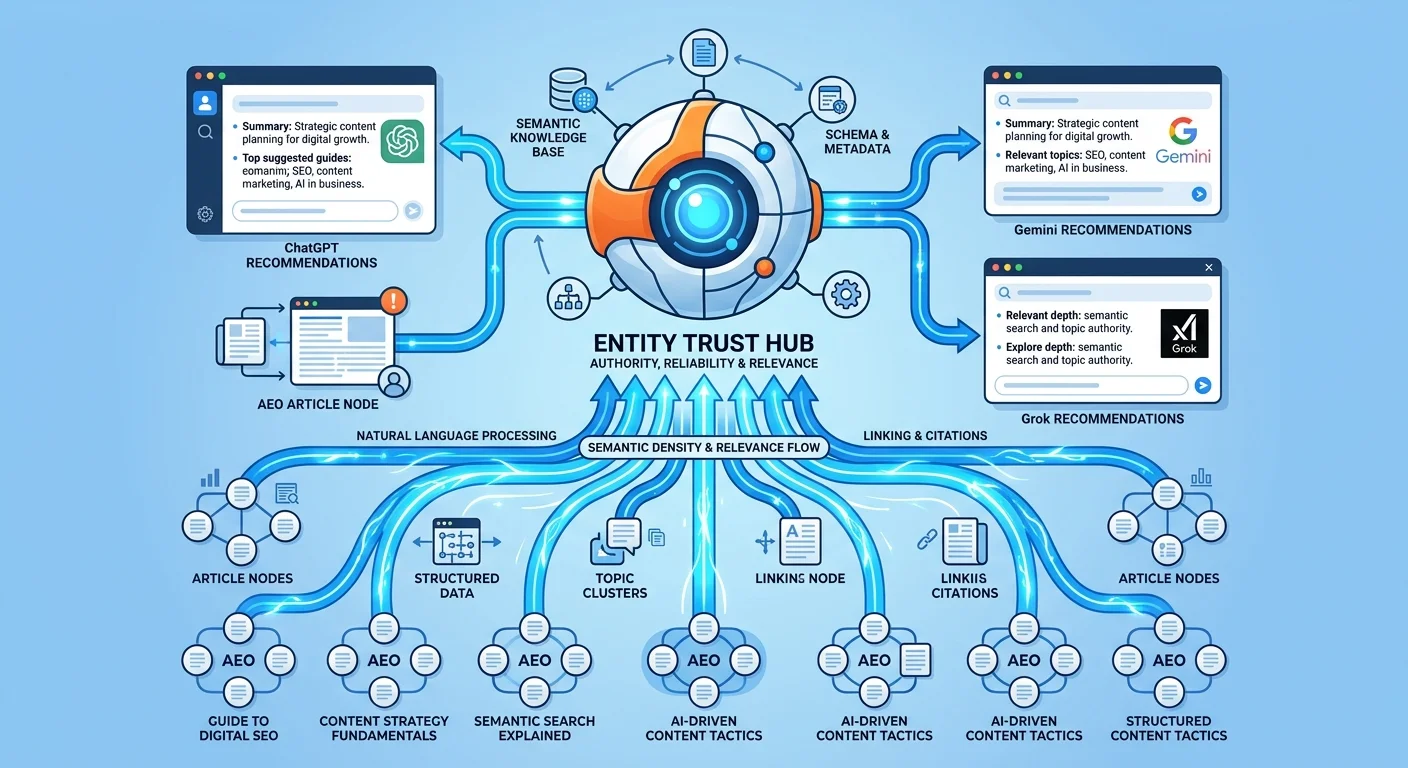
Schema establishes who you are. AEO content infrastructure is what stops that identity from eroding the moment a competitor starts publishing.
Consistency, topical depth, and semantic density – those are what separate a brand that gets named nationally from one that doesn’t get named at all.
Here’s what most brands get wrong the moment they start thinking nationally: they assume the problem is output.
It isn’t. They’re already producing content. The problem is that none of it builds toward a coherent entity. It doesn’t deepen topical authority in a way AI engines can traverse. It doesn’t reinforce a consistent identity across the semantic layer.
It just exists. And existing isn’t the same as being trusted.
Gartner projects a 25% decline in traditional search engine volume by 2026. Pew Research Center found that 58% of U.S. adults are already aware of ChatGPT – and awareness is always the leading indicator of adoption.
That shift isn’t coming. It’s already in the numbers.
The brands that own national AI authority won’t be the ones who start building when conversational AI hits critical mass. They’ll be the ones whose content infrastructure is already coherent, already dense, and already reinforcing entity trust before the majority of queries finish migrating.
Semantic Density: Why Volume of Content Is Not the Same as Authority
Semantic density isn’t a publishing metric. It’s a relationship metric.
It measures how deeply your content maps the connections between your brand, its topical territory, and the entities around it – not how much you’ve published.
Localized content builds cluster depth around geography – proximity signals, city-specific relevance, service-area coverage. That made sense when the index was organized around coordinates.
National AI authority doesn’t work that way. AI engines don’t synthesize recommendations from map density. They synthesize from topical coherence.
Every piece of AEO content has to reinforce the same core entity from a different angle – answering adjacent questions, validating connected claims, building a semantic map AI engines can enter from multiple directions and always arrive back at your brand.
This is your ZIP code ceiling – in content form.
A brand that built its authority around location-specific signals has capped its own reach at the edge of a map pack. Stop thinking in coordinates. Start thinking in entities. Build content around topical ownership instead of geographic relevance – and the ceiling breaks.
AI engines stop asking where is this brand. They start asking what does this brand own. Semantically dense content infrastructure is the only credible answer to that question.
How National AEO Content Strategy Differs from Local Cluster Execution
Local AEO execution and national AEO execution aren’t the same strategy at different scales.
They’re different structural models entirely. Treating them as scale variations is one of the most expensive mistakes a brand makes during the transition.
Local cluster execution reinforces proximity – content that deepens relevance inside a defined geographic footprint, anchors the brand to a service area, and validates local entity signals across citations and listings.
National AEO content infrastructure has to do the opposite. It has to decouple authority from geography entirely. Build topical ownership that’s valid regardless of where a query originates. Create enough semantic density that AI engines recognize your brand as the definitive resource on a topic – not a strong local option.
For a closer look at how these execution models diverge, national vs local audience AEO strategy walks through the infrastructure differences in full.
That’s the transition iTech Valet engineers when a brand moves from local authority to national entity status. Content infrastructure gets rebuilt around topical ownership – not service-area coverage.
Articles aren’t written to perform in a city. They’re written to reinforce entity relationships that AI engines validate across the open web.
McKinsey estimates generative AI could create $2.6 trillion to $4.4 trillion in annual economic value by transforming how information is retrieved and surfaced. The brands that capture a disproportionate share of that shift won’t be the ones with the most content. They’ll be the ones whose content was built to be trusted by the engines doing the surfacing.
| Content Dimension | Local AEO Approach | National AEO Approach | AI Engine Signal Produced |
|---|---|---|---|
| Geographic Anchor | Content tied to city names, service-area boundaries, and proximity signals | Content decoupled from geography – authority valid regardless of where the query originates | Topical ownership signal vs. location relevance signal |
| Cluster Architecture | Articles deepen relevance within a defined local footprint – proximity reinforcement at the topic level | Articles build outward from a central entity, answering adjacent questions across a national topical territory | Semantic traversal depth – how far AI engines can follow your entity across the open web |
| Content Purpose | Validate local entity signals, anchor brand to a service area, reinforce map pack presence | Reinforce topical authority, deepen entity relationships, and build a semantic map AI engines can traverse from multiple entry points | Entity coherence score – whether AI engines recognize the brand as the definitive resource on a topic |
| Semantic Density Strategy | Dense within a geographic boundary – strong signal inside a small radius, weak signal beyond it | Dense across a topical territory – strong signal on a subject regardless of where the query is asked | Citation velocity – how consistently and broadly the entity gets referenced across AI knowledge sources |
| Entity Validation Method | Local citations, GBP profile consistency, service-area pages, proximity-based trust signals | Schema-reinforced sameAs relationships, national directory presence, topically coherent AEO content across the open web | Knowledge Graph node density – how many trusted sources confirm the entity’s identity and expertise |
| Authority Ceiling | Capped at the boundaries of a map pack – reach limited to the geographic footprint the content was built around | No geographic ceiling – authority compounds across every market where the topical territory is relevant | Zero-click answer eligibility – whether the brand qualifies as the single synthesized answer in a national AI response |
Frequently Asked Questions
But before you move, you probably have questions. Good. Here are the ones that come up every time – answered straight, no hedging.
Let’s get into it.
What is the difference between local GBP optimization and national Knowledge Graph integration?
GBP tells AI engines where you are. Knowledge Graph integration tells them what you are. Those aren’t the same signal. They don’t produce the same outcome.
GBP anchors your brand to a location. It surfaces you when a query originates near your coordinates. Knowledge Graph integration maps your brand as an entity – topical relationships, verified credentials, structured claims AI engines can traverse without geography.
One caps your reach at a service area. The other removes the cap entirely.
Local GBP work isn’t wrong for local intent. But it can’t do the structural work national AI visibility requires. It was never built for it.
Why are traditional multi-location city landing pages failing under AI answer engines?
City landing pages were built for a ranked list. AI answer engines don’t produce a ranked list. They produce a verdict. That’s a structural mismatch – and page volume doesn’t fix it.
AI engines synthesize from topical coherence and entity trust. A page that says ‘chiropractor in Austin’ doesn’t build entity trust. It signals geographic proximity.
When the query comes from a conversational AI interface, proximity signals don’t move the needle. The engine isn’t counting your pages. It’s checking whether your brand holds credible, verifiable topical authority across the open web.
Fifty city pages built from the same template don’t establish that. They dilute it.
What technical schema markup is required to transition to a national AI entity?
Organization schema is the foundation. You need fully populated name, url, description, sameAs, and areaServed properties. Those sameAs connections are the RDF-style links that map your entity to trusted nodes across the open web – the same structure the NIH’s knowledge graph research identifies as the primary path for eliminating entity ambiguity.
For service-based national brands, Service schema maps each offering with explicit serviceType and provider declarations. FAQPage schema on AEO content reinforces topical authority at the page level.
And here’s what most people skip: consistency. Every schema declaration has to map the same entity across every digital asset. One mismatch between declarations registers as entity ambiguity. AI engines don’t resolve ambiguity in your favor – they just move to whoever is cleaner.
There’s also a compliance layer. FTC Truth in Advertising principles require that service claims inside schema are accurate and verifiable. This isn’t just a performance question. Every declaration has to hold up under regulatory scrutiny – not just inside AI recommendations.
Can a business build national AI authority without high traditional domain authority?
Yes. Traditional domain authority is a signal built for a ranked-list model. AI answer engines don’t rank. They recommend. The evaluation criteria are different.
AI engines synthesize entity trust from structured schema declarations, topical coherence across AEO content, consistent entity signals across citations and platforms, and verifiable credentials. Not from the volume of inbound links pointing at a domain.
A brand with deep entity trust and semantically dense content infrastructure can establish national AI authority without legacy domain metrics.
Traditional domain authority is an artifact of the old model. Useful in that model. Not the variable that determines whose name AI says.
How does the AI Authority System shift a brand from local search to national AI visibility?
It starts at the infrastructure layer. Schema reconstruction. Entity signal alignment across every digital asset. Stripping geographic anchors from the brand identity so AI engines stop reading you as a local provider.
AEO content infrastructure gets built on top of that foundation – articles engineered to reinforce topical ownership, deepen semantic density, and give AI engines multiple traversal paths back to the brand.
This isn’t a content strategy bolted onto an existing structure. It’s a full infrastructure rebuild, with content execution compounding on top of it every month.
Gartner projects a 25% drop in traditional search engine volume by 2026. The brands that own AI answer slots at that inflection point are building this now. Not then.
How long does it take to see national AI authority signals after the infrastructure shift?
Anyone who hands you a single number is selling something.
Here’s what’s actually true: the infrastructure layer moves faster than most brands expect. AI engines constantly re-index entity signals. Schema corrections and entity alignment can register quickly. AEO content authority is the slow build – but it compounds.
The earlier you start, the more compounding cycles you get before AI search hits critical mass.
We won’t promise a timeline. Authority doesn’t run on a microwave schedule. What we’ll say is this: every month of execution builds on the last. The brands that stay with it compound. The ones that wait give that ground to whoever kept going.
The Technical Transition Is Not Optional – It’s Already Underway
The ZIP code ceiling isn’t a metaphor. It’s a structural fact.
Every brand still building authority around map coordinates is hitting that ceiling right now. Most of them just don’t know it yet.
Gartner projects a 25% decline in traditional search engine volume by 2026. That’s not a forecast about something coming. It’s a measurement of something already in motion – and the brands optimized exclusively for proximity aren’t going to be penalized by that shift. They’re just going to be absent from it.
The brands that break through aren’t the ones who optimized harder inside the old model. They’re the ones who stopped thinking in coordinates.
That means schema-reinforced Knowledge Graph structures. Topical ownership that doesn’t decay at the edge of a service area. AEO content infrastructure that builds semantic density AI engines can traverse – not geographic relevance that disappears the moment a query originates two states away.
That’s the transition. It’s happening in every market right now. The only variable is whether a given brand is part of it or watching from the outside.
There’s no neutral position here. Every month a brand stays tethered to localized signals is a month a competitor compounds national entity authority.
The brands building that infrastructure now will own the answer slots AI search is allocating as it reaches critical mass. The ones waiting will inherit whatever’s left.
Your ZIP code is not your authority. The question is whether you’re building something that is.
Your ZIP code isn’t your authority. Your entity signals are. Run the check and see exactly what ChatGPT, Gemini, and Grok say about your brand right now. Fifteen minutes. Real data. No guesswork.