
Why Your Answer Engine Optimization Project Has an Expiration Date
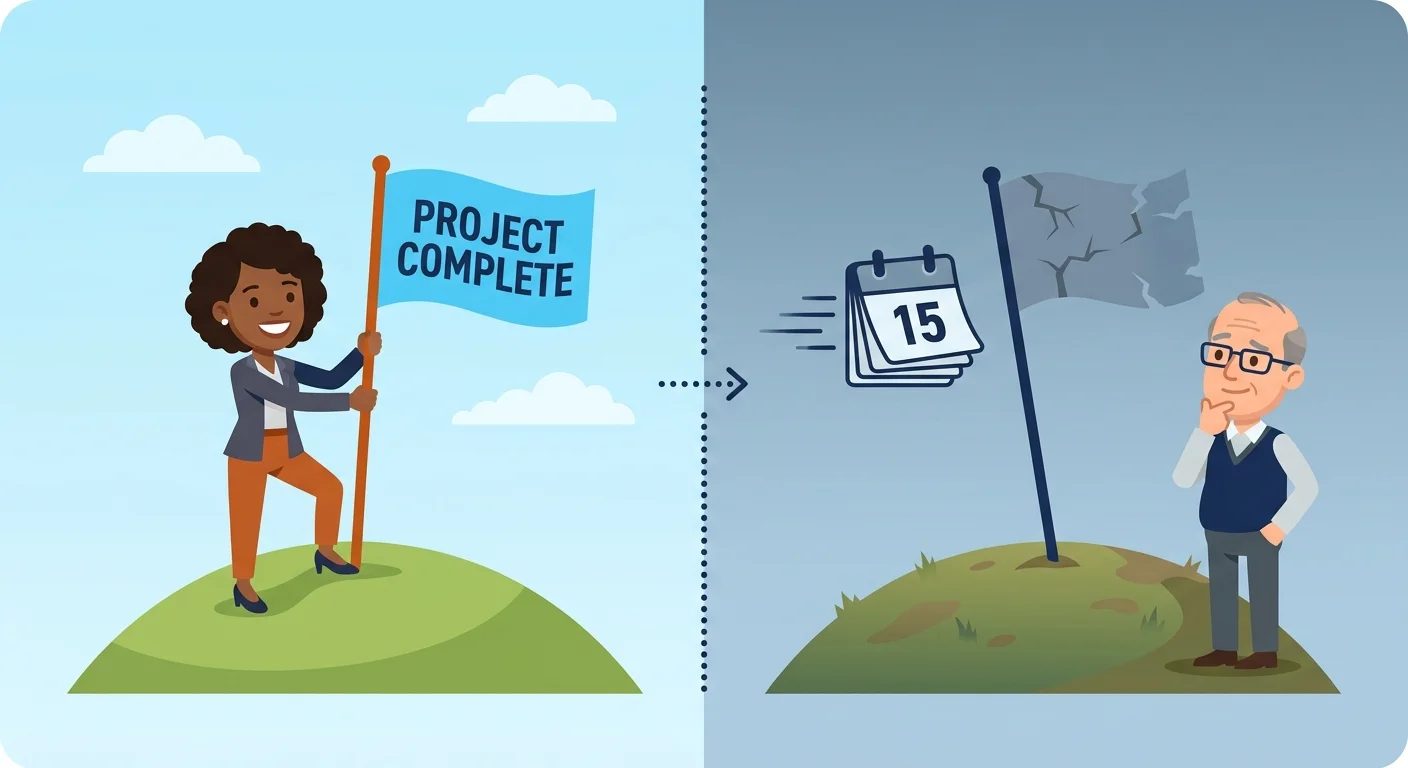
Here's the shift that makes an expiration date inevitable. Search stopped being a list of links to dig through. Now it's a synthesized answer handed straight to the reader, and that one change breaks the logic a one-time project was built on.
So one big push can't keep up with a moving target. It freezes your signals the day the work wraps, then the whole system keeps changing without you.
That's why one-time, project-based traditional search optimization gives you a static snapshot, not a living presence. Sure, the snapshot's accurate the day you build it. But it starts decaying the second the AI environment shifts again, and it always shifts again.
Knowing what actually holds ground here starts with knowing what a durable position even looks like, which is the subject of what a defensive authority moat strategy actually requires. Look at it this way: a wall built once can still be climbed. A moat only works if something keeps refilling it.
The Hidden Cost of Treating Machine-Readable Authority as a One-Time Deliverable

So what does that decay actually cost you once you stop reinforcing your presence? The bill shows up first inside the language models themselves, not on any page a person can see.
Here's the mechanism most one-time projects never see coming. Update an entity's information once and walk away, and the systems writing AI answers don't just leave that old signal sitting there in peace.
They try to reconcile it against everything newer your competitors keep publishing. That reconciliation is where a static signal starts bleeding out, and it happens inside the model, invisibly, long before a reader spots a single change.
| Failure Mechanism | What It Does To Existing Knowledge | Why a One-Time Fix Cannot Solve It |
|---|---|---|
| Catastrophic Forgetting During Model Updates | Newer competitor information absorbed during retraining overwrites the model's internal representation of an entity's still-accurate facts. | A single reinforcement pass cannot inoculate a fact against every future retraining cycle. Only sustained, repeated reinforcement keeps the original signal from being edited out. |
| Conflicting Source Reconciliation | Outdated directory listings, stale bios, and copied errors compete with the correct entity information for the model's trust, sometimes outnumbering it. | Fixing the record once does not stop other sources from continuing to publish or copy the outdated version. The correction has to be repeated as often as the errors are. |
| Static Structured Data Decay | Schema and entity markup submitted once are treated as a stable filing entry, while the surrounding AI environment keeps re-evaluating and re-weighting every entity it knows about. | A one-time submission freezes at the moment it was built. It cannot re-weight itself against new competitor signals the way a continuously maintained feed can. |
Why 'Set It and Forget It' Structured Data Fails Language Models
Structured data gets treated like a form you fill out once and file. But language models don't store facts the way a filing cabinet stores paper.
They update through something closer to editing than archiving, and editing has a documented failure mode. Existing model editing methods teach a model new facts just fine, yet the same process makes those models catastrophically forget older, still-accurate knowledge about the same entity, a mechanism confirmed on the arXiv preprint server.
This isn't some hypothetical stuck in a lab. It's the exact failure a one-time structured data project kicks off the moment nobody comes back to reinforce it.
So your original, correctly submitted facts can get quietly painted over inside the model as newer competitor information gets absorbed. Nothing about that structured data was wrong. It just stopped being reinforced, and reinforcement is what decides whether a fact survives the next round of retraining.
Why Conflicting Signals Confuse the Engines Reading Your Business
Now picture what happens when two sources describe the same entity differently. This is where conflicting signals pile on as a second problem, stacked right on top of the forgotten knowledge.
AI systems pull entity information from a pile of sources at once, and those sources don't always agree, some even copying each other's details without checking. A data fusion approach exists specifically to find the true values across a large number of conflicting sources, including cases where some are just copying others instead of independently confirming the facts, as detailed on the arXiv preprint server.
So that outdated directory listing, that old bio, that stale scrap of structured data isn't sitting there harmlessly. It's actively fighting the correct version for the model's trust, and copied errors can outnumber the truth.
This is exactly why citation velocity, not citation existence, decides what survives that reconciliation. A deeper look at why AI search recommendations decay without continuous citation velocity shows how that erosion compounds when nobody keeps the signal current. Put plainly: one accurate mention made once gets outvoted by a dozen inconsistent mentions made continuously.
How AI Engines Actually Decide Who Gets Cited
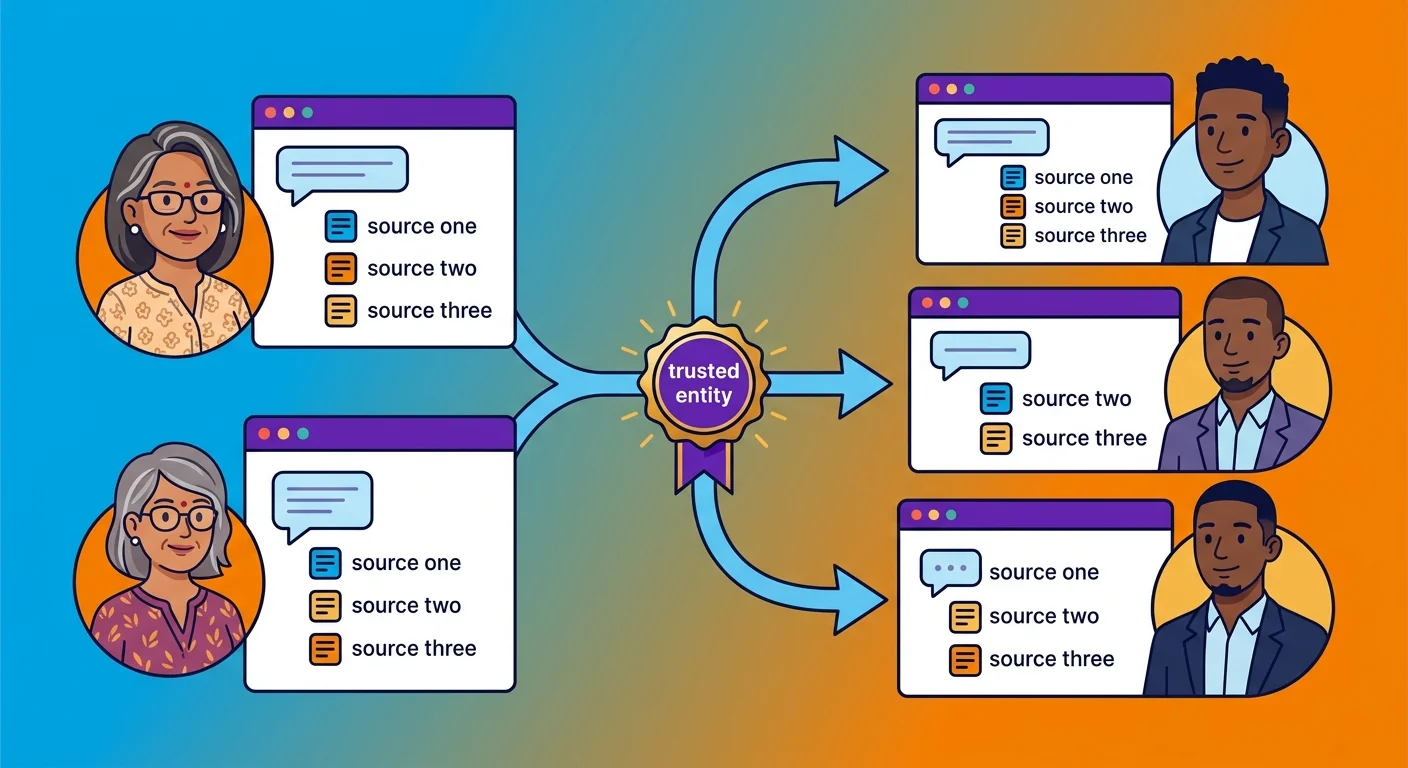
So how does an AI engine actually pick who gets cited once all that reconciling settles down? Here's the thing: it rarely lands on one winner at all.
Google AI Overviews in March 2025 show the pattern loud and clear. According to Pew Research Center data, 88% of AI summaries cited three or more sources. Only 1% leaned on a single source.
That means chasing one dominant citation is a broken game before you even start. Being one of several trusted sources beats being the only name nobody else backs up.
| Signal Type | What It Measures | Effect On Citation Odds |
|---|---|---|
| Source Multiplicity | Whether an AI-generated answer draws on a single source or corroborates across several | 88% of AI summaries cited three or more sources, making single-source visibility a weak position |
| Single-Source Reliance | How rarely an AI answer is willing to stand behind just one citation | Only 1% cited a single source, so being the lone source rarely secures inclusion |
| Brand Mention Frequency | Whether an entity is the brand most consistently named within its category | The most mentioned brand was cited at least once 69.9% of the time, linking frequency to citation |
| Domain Authority Alone | Whether raw domain strength predicts becoming the most-cited source | The most cited domain was rarely the most mentioned brand, showing authority alone does not decide citation |
The Difference Between Being Mentioned and Being Cited
Here's the distinction most entities blow right past. Getting mentioned by an AI engine and getting cited by one are two different events, and treating them as the same thing is exactly why static signals stall out.
A mention is the model recalling a name it saw somewhere. A citation is the model pointing a reader at a specific, current, verifiable source behind that name.
This gap bites hardest for entities fighting it out in tight local categories, where a mention without a citation does nothing to lock in the recommendation. The full stakes are laid out in what happens when AI engines can only recommend one clinic per query, and the mechanics reach way past clinics.
Why Domain Authority Alone Won't Get You Quoted by an AI Engine
Now the harder truth. A high-authority domain doesn't automatically make you the entity an AI engine quotes.
Across ChatGPT answers in 1,094 US categories, the most mentioned brand in a category got cited at least once 69.9% of the time. But the most cited domain was rarely the most mentioned brand at all, according to published industry reporting.
That split is the whole case against leaning on domain authority alone. A domain can carry serious weight across the web and still miss the specific, current, well-reinforced signal an AI engine needs to quote it by name.
This Isn't for Businesses Chasing a Quick Placement in the Classic Ten Blue Links

So who does this actually shut out? Businesses chasing a project with a finish line, a box checked, a promise that the work is done.
Look, that instinct makes sense if all you want is a temporary snapshot. But a static snapshot is exactly what decays the second competitors keep publishing and the AI environment shifts again.
Here's the thing: real authority in the age of AI isn't a project you finish. It's a system you run without stopping. If you want the opposite — a one-and-done placement, not an ongoing lexical presence like the one in building a zero-click lexical moat around a local brand — this isn't your fit.
What Continuous Reinforcement Actually Looks Like in Practice

So what does the ongoing work actually look like once an entity clears the qualification question? Less like a launch. More like a maintenance discipline that never fully clocks out.
Answer Engine Optimization isn't traditional search optimization wearing a new name tag. Its whole job is making an entity's expertise machine-readable and citable — a completely different goal from chasing a steady spot in the classic ten blue links.
That difference shapes how every bit of the work gets built from here. A ranking goal tolerates long gaps between updates. A citation goal doesn't, because the systems doing the citing never stop re-evaluating.
| Stage | One-Time Project Approach | Continuous Reinforcement Approach | Outcome Over Time |
|---|---|---|---|
| Structured Data | Submitted once, then left untouched | Checked and corrected on a recurring basis as facts and competitors change | Facts stay trusted instead of getting overwritten during model updates |
| Content Publishing | A fixed batch of pages produced for the initial launch | Sustained, ongoing publishing that answers questions as they shift | The entity keeps showing up as the surrounding conversation evolves |
| Entity Mentions | Assumed accurate after the first round of outreach | Actively monitored across third-party sources for inconsistencies | Conflicting mentions get corrected before they outweigh the truth |
| Citation Presence | Secured once and treated as permanent | Reinforced continuously across the sources AI systems actually draw from | Citation survives repeated reconciliation instead of fading out |
| Project Timeline | Ends the day deliverables are marked complete | Has no end date and treats the finished project as a starting position | Authority compounds instead of decaying the moment work stops |
The Recurring Activities That Keep an Entity's Authority Current
Here's what that constant re-evaluation demands. An entity's structured data has to get checked and corrected on a recurring rhythm — not submitted once and left to grow old.
New content has to keep landing on a steady cadence, answering the questions an audience is actually asking as those questions move. Stopping is what turns an accurate signal into a stale one.
Entity mentions across third-party sources need active watching, because the inconsistencies nobody corrects are exactly what fight the accurate version for a model's trust. And citations have to get reinforced across the sources an AI system actually pulls from — not built once and assumed permanent.
None of these come with a finish line stapled to them. Each one is a recurring function, run on a rhythm, built to keep an entity's presence current inside systems that never quit updating themselves.
Where a One-Time Project Stops and Ongoing Reinforcement Begins
Now here's where the line actually falls. A one-time project ends the day the deliverables get marked done: pages published, data submitted, citations locked at that one moment in time.
Ongoing reinforcement starts at that exact spot and never sets an end date. It treats the finished project as a starting position, not a done outcome.
Look, real authority in the age of AI was never something a business finishes building. It's something a business keeps running — the same way a moat only holds water if you keep refilling it.
Frequently Asked Questions
Here's where the leftover questions tend to live. Not in the big argument, but in the specific mechanics readers still want pinned down.
How is Answer Engine Optimization (AEO) different from the traditional search optimization I'm used to?
Traditional search optimization chases a stable spot in the classic ten blue links. Answer Engine Optimization wants something else entirely. Its job is making an entity's expertise machine-readable and citable inside AI-generated answers.
Why do the results from a one-time traditional search optimization project seem to fade away over time?
Because a one-time project stops the day the deliverables get marked done. Nothing keeps reinforcing the entity's facts after that. So newer, more current signals from elsewhere quietly outweigh it.
What specific activities are involved in continuous AI authority reinforcement?
It means fixing structured data on a recurring rhythm, publishing new content on a steady cadence, watching third-party mentions for inconsistencies, and reinforcing citations across the sources AI systems actually pull from. Not one of these has a finish line.
If my site has strong keyword position tracking, isn't that enough to show up in AI answers?
No. A brand can be mentioned all over a category without being the domain an AI engine actually cites. Those two signals drift apart more often than most people assume.
How do AI search engines like Google's AI Overviews decide which sources to cite in their answers?
They pull from a spread of sources instead of settling on one. So being one of several corroborating voices beats being the single loudest one nobody else backs up.
Can a business be mentioned by name in AI answers without ever being cited as a source?
Yes, and that gap is the whole problem. A mention is the model recalling a name. A citation points a reader to a current, verifiable source behind it — and only one of those locks in the recommendation.
Where This Leaves You
So where does all this leave an entity trying to hold ground inside AI-generated answers? Not at a finish line. The reconciliation, the copied errors, the citation gap, the domain-authority trap — none of it settles itself once and stays settled.
Here's the position worth stating flat out. A Defensive Authority Moat isn't a feature you bolt onto a static site. It's the discipline of refilling the moat on a rhythm nobody else is matching, and that discipline is the whole difference between a mention and a citation.
Look, a business can keep treating this like a project with deliverables and a closing date. Or it can start running the system that keeps the moat full while everyone else's wall gets climbed. See what continuous reinforcement looks like against your own entity by starting with an AI visibility check.