
When a Content Fix Can't Reach the Real Problem

So how do you tell a content gap from an architecture gap? Every clinic hits this fork eventually: is the problem what the site says, or how the site is built?
Here's the thing. Most practices reach for content work first, on the assumption that more content equals more visibility. That assumption falls apart once answers replace links as the way people find a practice.
What Counts as Architecture Versus What Counts as Content
Content is the words on a page: service descriptions, blog posts, patient-facing explanations. Architecture is the system underneath those words — the markup, the templates, the internal linking, the technical scaffolding a crawler reads before it ever reaches a sentence.
A practice can publish strong, accurate content and still sit on architecture that no automated system can parse. When that happens, the content is wasted effort, not a wasted idea. The infrastructure beneath it decides whether any of it gets read.
The Diagnostic Question Every Clinic Should Ask First
Alright, quick reality check: does the site struggle to say enough, or does it struggle to be understood at all? The first is a content gap. The second is a foundation gap, and no pile of new writing closes it.
If the architecture already supports structured data, clean parsing, and coherent internal linking, the fix is additive. That is the lighter path, and it covers how new articles can be added without a full rebuild. If the architecture itself cannot carry that weight, content is the wrong tool for the problem being solved.
Why Adding More Articles Fails on a Broken Foundation
Adding more keyword-targeted articles to a site that already struggles with crawlability treats a foundation problem as if it were a content gap. The volume goes up. The citation rate does not move, because the limitation was never about how much the practice had written.
The Mechanism Behind Rented Attention Strategies
Let's keep it real: publishing on a schedule without fixing the architecture underneath is renting attention. It borrows visibility one article at a time instead of building a structure generative AI can parse and trust, so the attention dies the day the publishing stops. Meanwhile, what postponing a site rebuild really costs a clinic keeps growing every month the foundation goes untouched.
What This Practice Costs in Measurable Terms
Here's the kicker: the cost shows up as effort poured into pages a crawler can't fully read. Structured data stays unsupported, internal links keep scattering topical authority, and every new article hits the same technical ceiling as the last one. Output goes up while citation eligibility stays flat.
What Generative Engines Actually Require From a Page
Content fixes assume the page can already be read. Eligibility is decided before that.
| Eligibility Factor | What It Involves | Why It Matters for Citation |
|---|---|---|
| Indexability | Standard inclusion in search results with an eligible snippet | A page absent from the index cannot surface as a supporting link, regardless of how authoritative its content reads |
| Clean Semantic Structure | Headings, tables, and lists that machines can parse without ambiguity | Generative engines extract definitions, comparisons, and procedural steps directly from structure; tangled markup hides those answers even when the words are correct |
| Coherent Internal Linking | A linking system that routes topical authority toward the pages meant to carry it | When links scatter authority instead of reinforcing it, a crawler struggles to map which page is the practice's actual answer on a given topic |
| Structured Data Support | A content management system flexible enough to carry markup that labels entities, services, and facts explicitly | Explicit markup removes guesswork for automated systems deciding what a page is actually about |
| Stable Technical Performance | Consistent load behavior and crawl access that doesn't degrade under automated requests | A page a crawler cannot reliably reach or render is a page that cannot be evaluated for citation at all |
Indexing and Snippet Eligibility as the Baseline Requirement
Now… this part matters: the eligibility bar is narrower than most rebuilds assume, because a page simply has to be indexed and eligible to show in standard search with a snippet. Per Google's documentation, Google's guidance states that a page must be indexed and eligible to be shown in Google Search with a snippet to be eligible as a supporting link in AI Overviews or AI Mode, with no additional technical requirements beyond the standard Search ones. That's the exact check behind how to tell if a site already meets AEO requirements.
How Query Fan-Out Changes What Counts as a Supporting Page
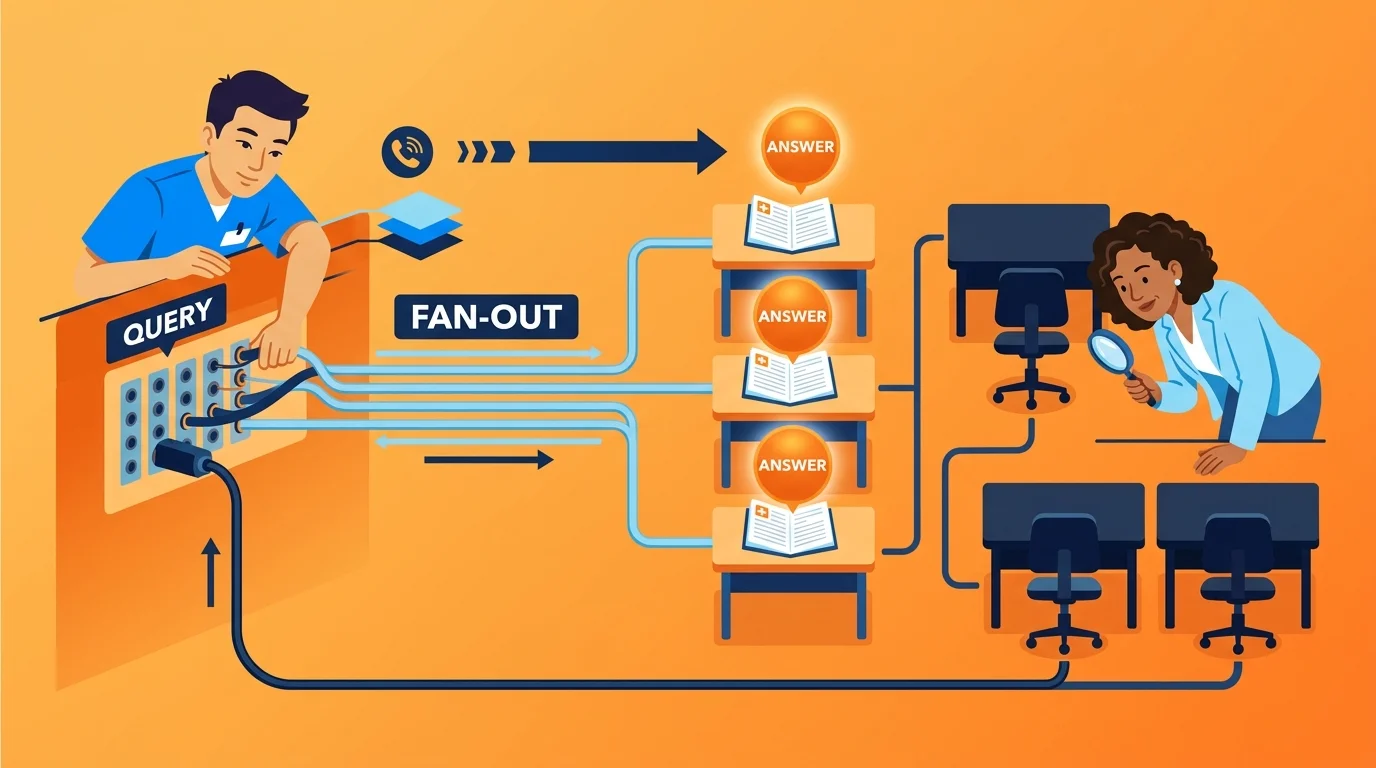
Query fan-out changes what a system is even hunting for. Both AI Overviews and AI Mode may use a query fan-out technique, firing off multiple related searches across subtopics and data sources to build a response and surface a wider set of supporting links than a classic web search. So one page no longer fights for one query, because now it fights across every subtopic the fan-out spins up.
Where Thin Architecture Breaks Under a Fan-Out Query
Thin architecture cannot answer multiple subtopic searches from one page. According to Google's documentation, AI Overviews and AI Mode may use a query fan-out technique, issuing multiple related searches across subtopics and data sources, to build a response and surface a wider set of supporting links than a classic web search. Rank-tracking reports measure one query against one position. Fan-out retrieval measures a page against many related searches at once. Our AI Authority System services are built around that modular requirement, not around chasing a single keyword.
Why a Clinic's Own Listings Can Contradict Its Own Website
The same fragmentation shows up off the page, not just on it. Rank-tracking reports and crawlability audits assume a clinic's identity is stable. That assumption breaks once an AI system pulls business data from directories, knowledge graphs, and citation sources that were never synchronized with each other.
| Data Source | What Can Drift | Downstream Effect |
|---|---|---|
| Directory listings (business name, address, phone) | Hours, service descriptions, and practice name formatting across commercial databases | An AI system cross-referencing sources finds conflicting basics and treats the clinic's identity as unverified |
| Knowledge graph entries | Category labels, service taxonomy, and which locations or providers are linked under the same entity | Fragmented entity records split topical authority that a rebuilt site would otherwise consolidate |
| Citation sources feeding generative AI | Which version of a clinic's name, specialty, or location gets pulled into a generated answer | Generative AI defaults to whichever record looks most structurally trustworthy, not necessarily the most current one |
| The clinic's own website | Nothing, if the architecture is sound — it becomes the fixed reference point | A well-built site gives automated systems a clean record to reconcile conflicting outside data against |
Where Entity Data Drifts Across the Web
Entity data drifts because no central authority forces agreement between commercial listing databases. Research by Hoehner & Schootman (Journal of Urban Health, 2010) found only 32% of business listings matched between two commercial databases in the St. Louis study area, though the agreement may vary by business type. A near match-rate that low means listings from different databases often disagree. A rebuilt site cannot force outside directories into agreement. What it can do is stand as the most structurally trustworthy single source, so automated systems have a clean record to reconcile the rest against.
How Internal Architecture Maps a Clinic's Topical Authority

Internal linking is the map that tells a crawler which pages matter and why they connect. Authority you own compounds through that structure. Attention you rent by publishing alone dies the day the publishing stops.
| Page Trait | Low-Influence Pattern | High-Influence Pattern |
|---|---|---|
| Link selection method | Expert-assisted patchwork linking, weaker authority redistribution | Automatic selection, stronger authority redistribution |
| Semantic coherence cost | Lower authority yield paired with tighter topical coherence | Higher authority yield paired with larger semantic coherence costs |
| Page length and structure | Short, single-purpose pages with no modular breakdown | Longer, more modular pages aligned with the generated answer |
| Extractable content genres | Pages lacking definitions, numerical facts, comparisons, or procedural steps | Pages built around extractable evidence genres such as definitions, numerical facts, comparisons, and procedural steps |
Why Automatic Link Structures Outperform Manual Patchwork
Look, the machine wins this one. In one WordLift/Kalicube-linked test on one site, a simulated crawl of Kalicube's site inside the WebKnoGraph system, automatic link selection beat expert-assisted patchwork on authority redistribution, with higher authority yield, though it paid a bigger price in semantic coherence.
What Separates a High-Influence Page From a Forgotten One
Some pages get cited over and over while others never get touched, no matter how accurate they are. Research by Zhang, He & Yao found high-influence pages may be longer, more modular, and more likely to contain extractable evidence such as definitions, numerical facts, comparisons, and procedural steps; those traits are linked to, not proven to cause, that influence. So being correct is table stakes, because a page also has to be structured enough for a retrieval system to pull from cleanly.
Building the Evidence Genres AI Systems Extract
Definitions, numerical facts, comparisons, and procedural steps are the genres a retrieval system pulls from a page. A page without those genres has nothing extractable, no matter how accurate its prose is. Rebuilding architecture means building pages that carry those genres natively, not bolting them on after the fact.
Sequencing a Rebuild Without Losing Ground You Already Hold
A rebuild does not require discarding what already ranks. The sequence starts with mapping which pages already hold topical weight. According to Gjorgjevska et al. (WordLift/Kalicube), in one test on one site, automatic link selection may generally produce stronger authority redistribution than expert-assisted selection, though with larger semantic coherence costs. That finding carries a laboratory limitation, so automatic restructuring is a starting signal, not a finished answer. The practical sequence preserves those pages' existing signals while rebuilding the links around them.
Frequently Asked Questions
The structural case is made. What follows are the direct questions that come next, once a clinic recognizes its own site in the diagnostic above.
What is the difference between a website redesign and a website rebuild?
A redesign changes the look of existing pages. A rebuild changes the underlying architecture those pages run on — the part generative AI actually parses.
How long does a typical clinic website rebuild take?
No fixed timeline holds across every clinic. It hinges on how much existing architecture survives versus how much gets restructured.
Will rebuilding my clinic's website negatively impact my current search rankings?
A rebuild done against the existing eligibility bar preserves what already works while fixing what blocks parsing. The risk sits with leaving broken architecture in place, not with correcting it.
Can my existing blog posts and patient testimonials be moved to the new website?
Yes, and they should be. Existing articles and testimonials carry topical weight worth keeping. The sequence maps which pages hold it before rebuilding links and structure around them.
Is a website rebuild a one-time cost, or are there ongoing maintenance fees?
The rebuild itself is a structural project, not a subscription. Ongoing AI Authority article creation to keep the new foundation populated is a separate, ongoing decision.
How does a site rebuild specifically help with visibility in AI-powered search results?
Generative AI systems query across subtopics rather than a single keyword, and cite pages built with extractable structure. A rebuilt architecture is what makes a page eligible to be pulled into that answer at all.
The Bottom Line
Content is the paint. Architecture is the foundation. And generative AI doesn't cite a fresh coat of paint, because it cites a structure that can actually hold the weight of its own claims.
So call a rebuild what it really is: a structural realignment with how generative AI discovers, validates and presents information. No pile of new writing stands in for that work, however good the writing is. Sound fair?
The diagnostic question answers itself once you inspect the foundation instead of the paint. If your pages still can't be parsed, validated or confidently cited, the next move isn't another article. It's an honest look at what's underneath, and that's exactly where an AI Visibility Check starts. The recommended path is a full rebuild onto the iTech Valet Authority Platform, built for AI visibility, with a design update and iTech Valet handling everything. Where a practice must keep its current website, iTech Valet reworks it instead and rewrites the sales copy on what is already there. Each practice is looked at case by case.