
What Separates Standalone AEO Content From a Full Authority Rebuild
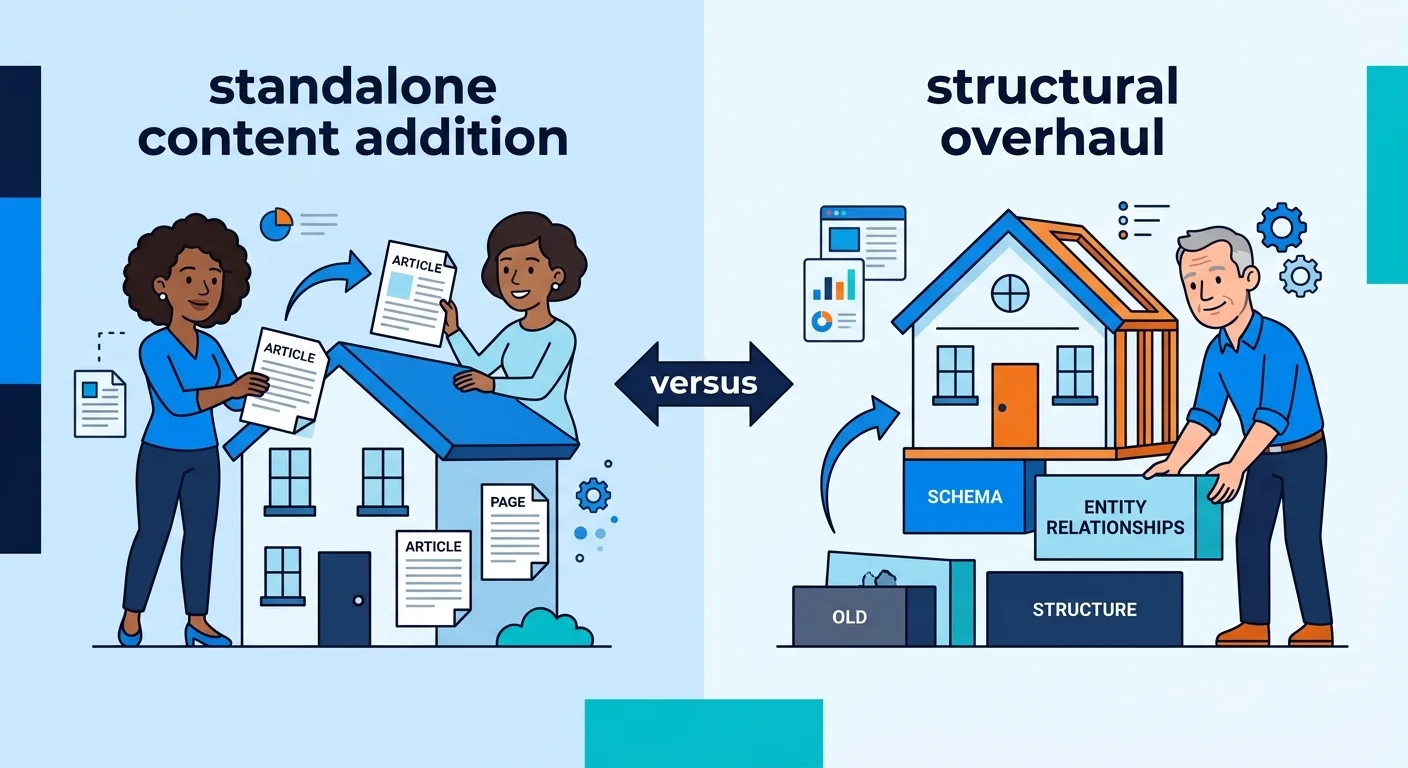
AI-powered search rewrote the rules of online visibility, and that's exactly why so many businesses default to a false choice. They think they're picking between two competing strategies. They're really diagnosing one machine.
Here's the vocabulary you need before any diagnosis makes sense. Standalone AEO content refers to the strategy of creating and publishing highly structured, intent-focused articles and assets on an existing website without major technical changes. It works on top of whatever foundation already exists — it doesn't touch that foundation.
A full authority infrastructure rebuild is a different animal. You're redesigning the site's technical foundation itself, its structure, schema, and entity relationships, so AI engines read it natively. This isn't content sitting on top of a system, it's the system getting rebuilt underneath.
So the real question was never content versus infrastructure. It's whether your local presence already has clean boundaries an AI engine can parse, or whether those boundaries are the thing breaking everything downstream. We've mapped out exactly where those boundaries typically fail for local service businesses, and that diagnosis tells you which path you're actually standing on.
Where Standalone Content Actually Works
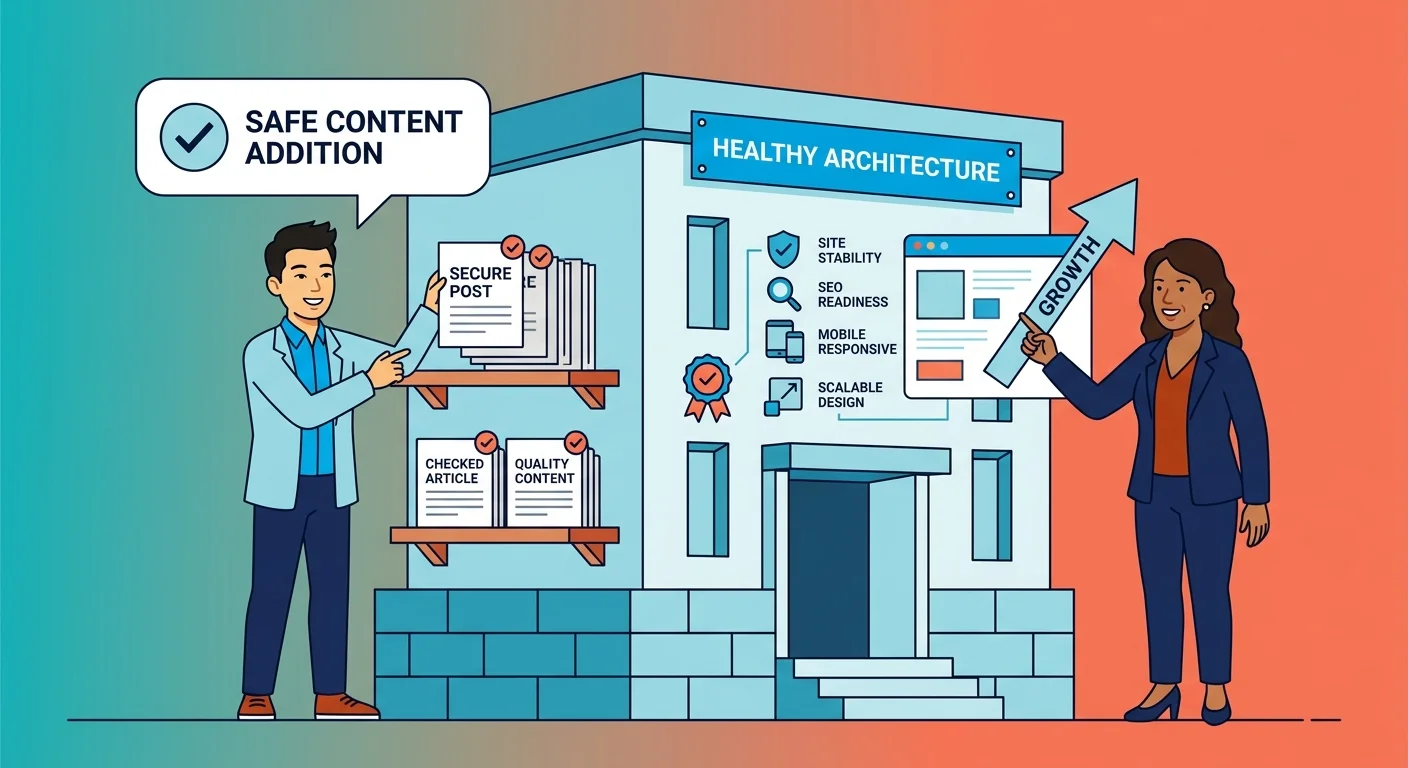
Standalone content earns its keep in fewer situations than most businesses think.
And it's got nothing to do with writing quality. A brilliant article on a site with broken entity signals still lands nowhere, because the machine reading it can't tell what it's even looking at.
So the real test was never the content calendar. It's whether the foundation under that calendar already speaks a language AI engines trust.
| Site Condition | Content-Only Viability | Why It Holds |
|---|---|---|
| Structured data already validates without errors | High — new articles compound existing trust | AI engines can already parse entity relationships, so fresh content simply adds depth to a system that reads correctly |
| Internal linking already routes authority to the right pages | High — content extends a working architecture | Semantic overlap between anchor text and destination is already coherent, so new assets reinforce that map instead of fighting it |
| Entity signals are inconsistent or contradictory across pages | Low — content cannot resolve confusion it did not create | No amount of well-written prose corrects what the underlying schema and entity relationships fail to establish |
| Site structure actively blocks machine comprehension | Low — a full authority infrastructure rebuild is required first | Content sits on top of the foundation; it never reaches down to fix the structure underneath it |
| Foundation is sound but topical coverage is thin | High — this is exactly the gap standalone content is built to close | The site already speaks a language AI engines trust, so the only missing piece is depth on the specific questions the audience is asking |
The Conditions That Make Content-Only a Sound Move
Content-only work makes sense when the structured data already validates, the entity relationships already hang together, and the internal linking already routes authority where it should go. In that world, new articles aren't propping up a shaky system. They're feeding one that already works, and each new asset stacks on the ones before it.
That's a narrow window. Most businesses assume they're standing in it without ever checking, and that's exactly the gap we've documented in why conventional writing approaches quietly disappear from AI answer results — the prose reads fine to a human, but the machine underneath never registers it as an answer.
What Content Alone Can Realistically Deliver
When the conditions line up, standalone content really can move the needle. It builds topical depth, answers the exact questions a business's audience is asking, and hands AI engines fresh, well-structured material to cite.
But it can't fix what it doesn't touch. Content sitting on top of a broken foundation is still content sitting on top of a broken foundation — it doesn't reach down and repair the schema, the entity relationships, or the structural signals underneath. That's a whole different job.
Where Standalone Content Hits a Ceiling

So where's the actual ceiling? It's the exact point where the site's own architecture stops cooperating with the words written on top of it.
Here's the piece nobody checks. Across the internal links audited on 1,700 websites, 28% of anchors carried zero semantic connection to their target page, and another 63% showed only low-to-moderate similarity — a pattern laid out in published research data on how sites really wire their internal signals. That's not a content problem. That's a wiring problem, and no article ever fixed wiring.
We've built a companion breakdown on drawing precise entity lines around what a single local service page actually covers, because that boundary work is what decides whether new content lands clean or gets swallowed by ambiguity that's already baked into the site.
Why Publishing Great Content on Broken Architecture Fails
Publishing on broken architecture doesn't just underperform. It burns the writing.
Think about what a schema tag is actually for. It tells a machine exactly what kind of entity it's staring at, so the machine can trust the content sitting right next to it.
Across production websites audited in April 2026, 49% had schema that was technically there but functionally dead — shipped, but not qualifying for rich results and not feeding AI-search citations, per that same published research data. That's not a missing piece. That's a piece that looks finished and isn't, which is worse, because nobody hunts for a problem that already looks solved.
Drop a great article into that mess and it never gets a fair reading. The machine parsing the page still can't confirm the entity, still can't validate the relationships around it, still can't hand over the trust the content earned. The writing did its job. The architecture never did.
What a Full Authority Infrastructure Rebuild Actually Changes
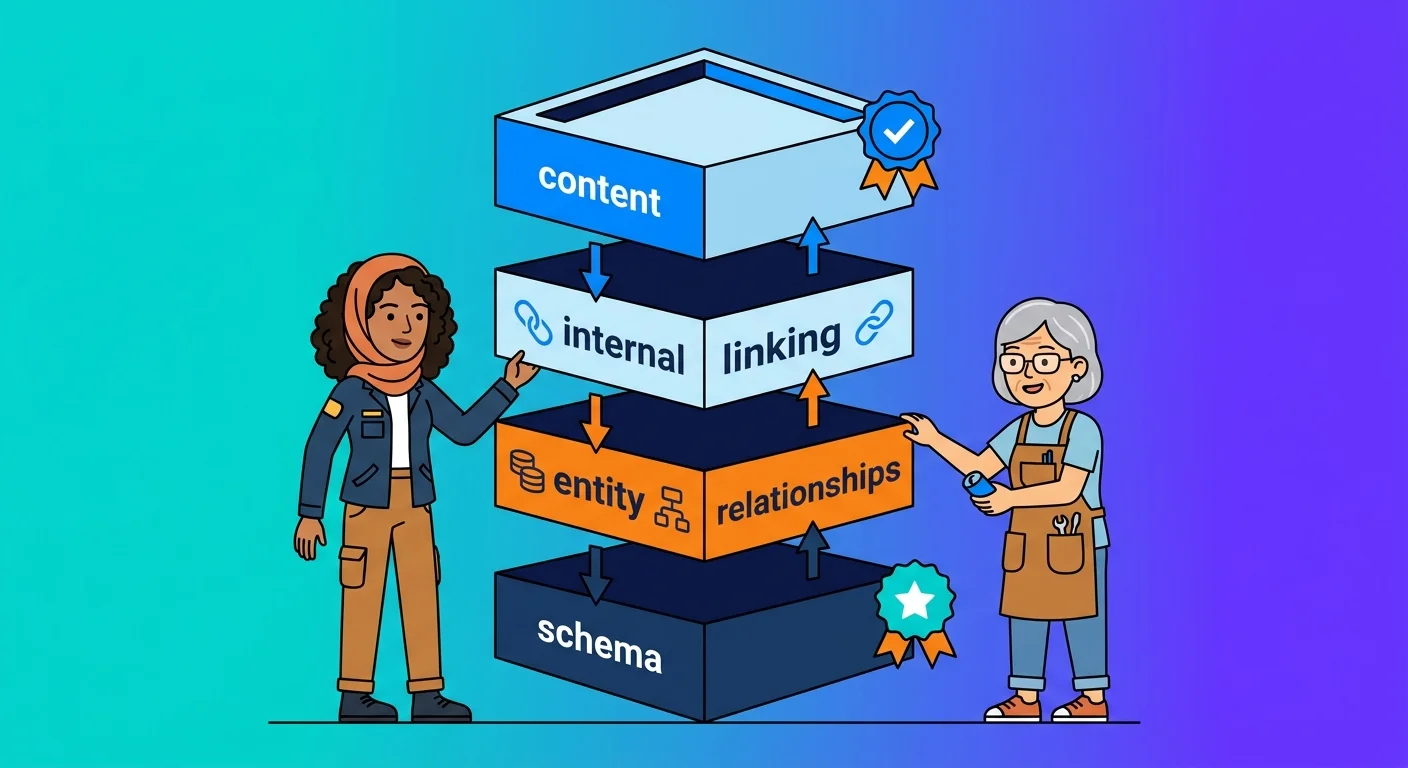
So what does the fix actually look like? A full authority infrastructure rebuild repairs the machinery underneath the words, not the words themselves. And it starts with the same question that broke everything in the first place: can a machine tell what entity it's looking at, and can it trust the relationships around it?
Schema gets rebuilt so it actually validates, instead of just sitting there on the page. Entity relationships get mapped so an AI engine can trace how one page connects to the next, rather than reading each page like an island.
Internal linking gets restructured around semantic relevance, not habit. That's the piece most site owners never think to question, and it's exactly what we walk through in how clinics can earn AI citations without a full platform migration — the fix doesn't always mean tearing out the CMS underneath it.
| Structural Layer | What Gets Rebuilt | AI-Readability Impact |
|---|---|---|
| Structure | How pages relate to each other across the site, replacing ad hoc linking with a deliberate map of authority flow | An AI engine can trace which pages support which claims instead of treating each page as an isolated document |
| Schema | Markup rebuilt so it actually validates against its type, not just present in the code without qualifying for anything | The machine can confirm what kind of entity and content it is looking at, rather than guessing from surrounding text |
| Entity Relationships | Explicit connections between the business, the people behind it, the services it offers, and the places it serves | AI engines can trust that the entity is real, coherent, and consistently described everywhere it appears |
| Internal Linking Architecture | Links reorganized around genuine semantic relevance instead of habit, navigation convenience, or historical accident | Anchor text and destination finally agree with each other, so authority actually transfers instead of leaking |
The Structural Layers an Infrastructure Rebuild Touches
A rebuild touches four layers, and each one exists to answer a different machine-readable question. Structure answers what this page is in relation to the rest of the site. Schema answers what type of entity is sitting on the page, and entity relationships answer how this business connects to the people, places, and services named around it.
None of those layers work in isolation. A rebuild treats them as one connected system, because that's how AI engines actually parse a site — not page by page, but as a web of declared relationships. Get one layer wrong and the others inherit the damage.
Here's the return this kind of foundational work generates when it's paired with real content strategy. Businesses that build foundational content marketing authority around genuine thought leadership see an average yearly ROI of $984,000, according to published research, and that return typically doubles or triples moving from year 1 to year 3. That's not a content number or an infrastructure number — it's what happens when both subsystems finally run in sync.
Who Should Not Start With a Full Rebuild
Not every business needs this. A full rebuild is a serious undertaking, and starting there when it isn't warranted burns both time and budget. If a site's structured data already validates and its entity relationships already read clean, a rebuild solves a problem that doesn't exist.
This isn't for businesses chasing a quick placing in the classic ten blue links with zero interest in what's actually broken underneath. And it isn't for anyone hoping a technical overhaul makes up for having nothing worth saying. A rebuild fixes the machine — it doesn't write the content that runs on top of it, and that's still a separate job, done well.
Diagnosing Which Path Your Website Needs First

So how do you figure out which path is actually yours? Don't start by picking a strategy. Start by reading the signals your site is already throwing off.
And this isn't guesswork. It's a checklist of specific, observable signals — and most business owners have never looked at a single one.
| Diagnostic Signal | What It Indicates | Recommended First Move |
|---|---|---|
| Anchor text semantic alignment | Whether internal linking routes authority correctly or scatters it on habit-driven boilerplate | Audit anchor text against target page topics before publishing another article |
| Low-to-moderate anchor similarity across the site | A wiring problem content alone cannot repair, since most linking already falls short of clean semantic routing | Restructure internal linking around semantic relevance before adding new pages |
| Foundational rebuild paired with genuine thought leadership content | Both subsystems running in sync, which is where the strongest return shows up over time | Sequence infrastructure repair first, then layer content strategy on top of it |
| Return trajectory from year one through year three | Foundational authority work compounds rather than staying flat, unlike recurring content spend alone | Commit to the rebuild sequence when the diagnosis points to broken architecture |
Reading Your Site's Existing Signals Before You Choose
Start with your schema. Does it actually validate, or does it just sit there looking finished?
Then look at your internal linking. Does the anchor text between your pages describe what those pages are actually about, or is it habit-driven boilerplate that tells a machine nothing?
That second question carries more weight than most site owners realize. We already walked through how common weak anchor-target alignment really is across business websites — and if your own linking's never been checked against that pattern, you're probably standing closer to the infrastructure side of this call than the content side.
Sequencing Content and Infrastructure Work Together
Once you know which side you're on, sequencing gets simple. Infrastructure work always comes first when the diagnosis says the foundation is broken.
That's not a preference. It's a mechanical fact — content dropped onto a rebuild-in-progress just gets rebuilt around later, which burns the writing twice instead of once.
But when the diagnosis comes back clean, the sequence flips. Content goes first, right away, because the machine underneath is already primed to trust it — and that's the exact spot where the foundational ROI we referenced earlier starts compounding instead of stalling.
Frequently Asked Questions
You've read the diagnosis. Here's where the real doubts still hang around.
How long does it take to see AEO results from content alone versus a full infrastructure rebuild?
Content moves faster when the foundation already validates. A rebuild takes longer, because it's fixing machinery, not just adding pages.
Can standalone AEO content overcome a technically flawed website?
No. Standalone content can't repair schema, entity relationships, or internal linking. It just sits on top of whatever's already broken underneath.
What are the typical budget differences between a content-focused AEO project and a full site authority rebuild?
Content work is an ongoing, per-article spend. A rebuild is a bigger one-time commitment, because it touches the machinery underneath, not just the pages.
What specific technical elements are considered part of an authority infrastructure rebuild for AEO?
Schema that actually validates, entity relationships that a machine can trace, and internal linking built around semantic relevance instead of habit. Those three layers are the machinery content sits on top of.
Is it better to publish AEO content on an old site first or wait for the new infrastructure to be complete?
Never publish on architecture you already know is broken. Content built on a rebuild-in-progress just gets rebuilt around later, burning the writing twice.
Does adding more keyword-targeted articles fix a schema markup problem?
No. More articles can't validate broken schema — that's a structural fix, not a content one. The two problems live in different subsystems.
Where This Leaves You
An authority engine runs on two subsystems: content and code. Split them into a false choice, and the whole machine stalls no matter which half you fund. That's the trap this debate keeps setting.
There's no universal verdict here. Some sites need content first. Others need the machinery underneath rebuilt before a single new article earns its keep.
What matters is diagnosing which side you're standing on before you spend a dollar guessing. The iTech Valet AI Authority System exists to make that call concrete instead of theoretical — sequencing content and infrastructure as one build, not two competing budgets. If you want to know exactly where your own site's boundaries sit, start with a diagnostic conversation about your specific setup.