
How AI Answer Engines Actually Read Your Content
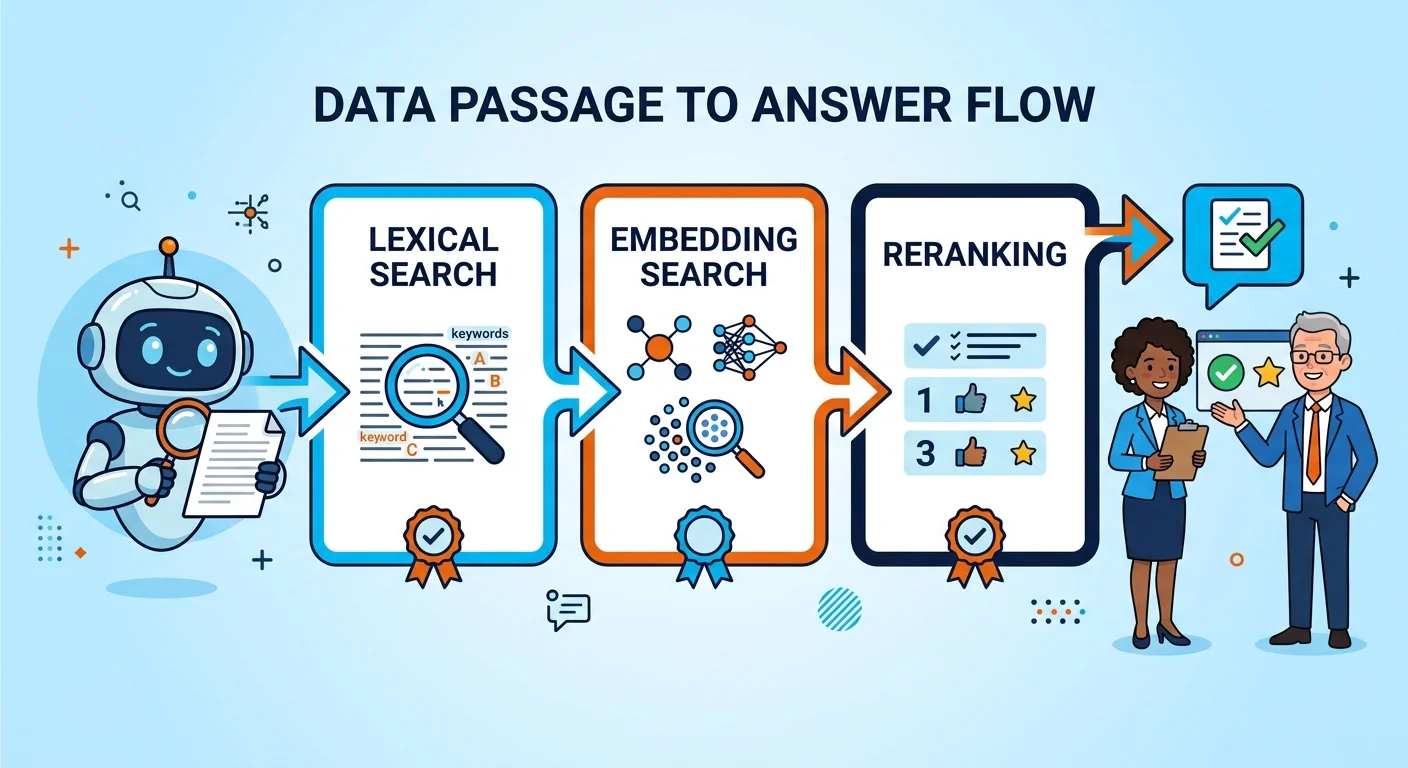
Retrieval kicks off the second a query lands. Before an answer engine writes a single word, it has to go find the passages that'll feed the facts into that answer.
And that finding step? It's mechanical, not interpretive. It scores passages for relevance and evidence, then hands the survivors to a generation step that only synthesizes what retrieval already picked.
So copy that reads beautifully to a person but never gets picked in that first pass never even reaches the generation step. That's exactly why a standalone AEO content boundary beats a diffuse page, because a page with fuzzy entity boundaries is a lot harder for retrieval to score cleanly.
Retrieval Before Generation
Here's the thing: modern retrieval pipelines don't lean on one search method. They mix lexical search, which matches literal terms, with neural embedding-based search, which matches meaning.
Systems built for the TREC 2025 RAG track were told, flat out, to design pipelines that combine retrieval and generation while ensuring transparency and factual grounding, per the National Institute of Standards and Technology. That grounding rule is the whole point. A system judged on transparency has zero reason to reward a passage it can't verify.
Why Reranking Punishes Ambiguity
Once lexical and embedding search return their candidates, a reranking stage decides which passages actually earn a spot in the final answer. And reranking rewards precision.
A vague sentence gives a reranker nothing solid to grab onto. An answer engine isn't a smarter search box waiting to be persuaded. It's a knowledge synthesizer built to value verifiable facts over compelling narratives, and ambiguity just doesn't survive that filter.
Why Persuasion-First Writing Breaks Down Here
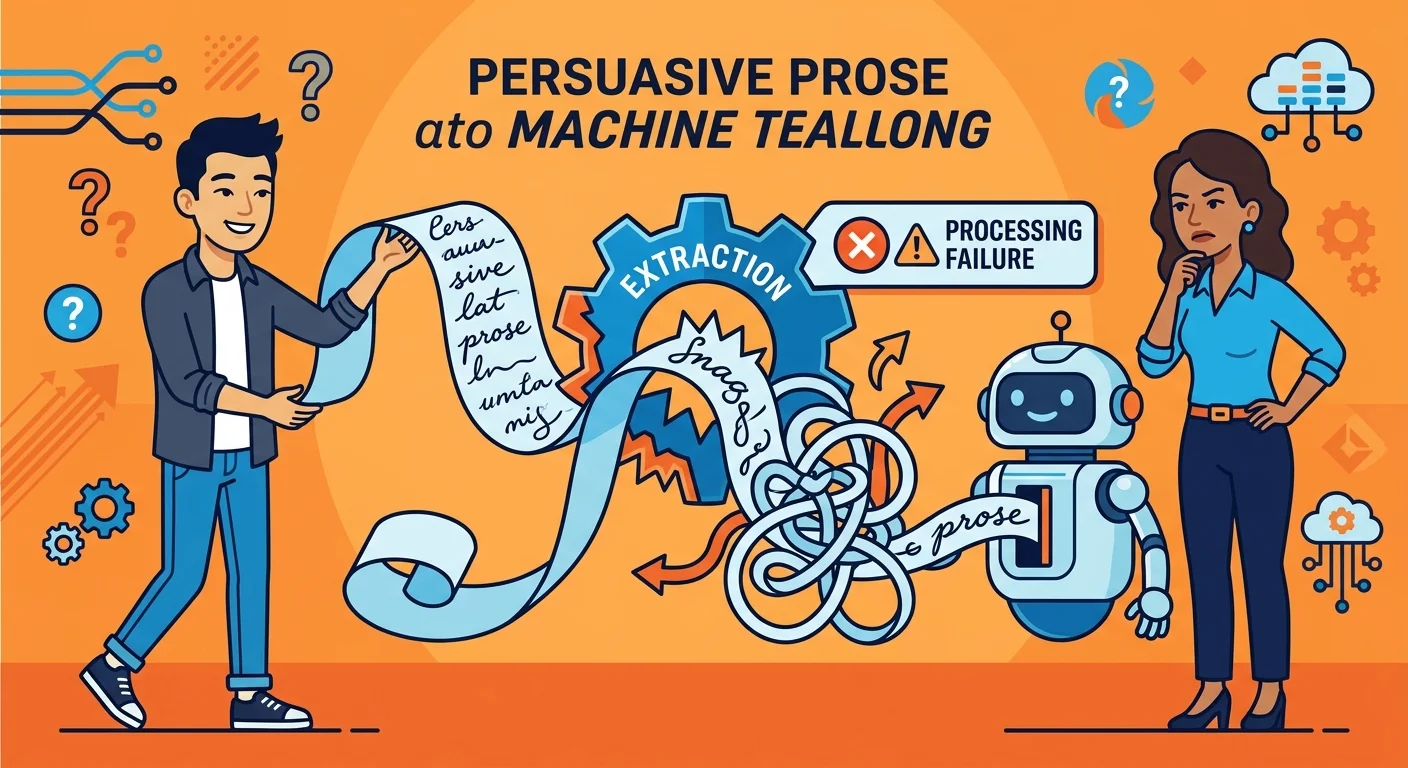
Persuasion-first writing is built to do one job: walk a human skimmer from a headline down to a decision. It leans on tension, rhythm, and an emotional payoff to hold your attention long enough to move you.
But that script gets no second life as a data asset. The second retrieval scores a passage for evidence, everything that made the script persuasive is exactly what makes it useless.
And this is where most standard copywriting quietly falls apart. It was never built to survive extraction, because extraction was never the job it got hired for.
| Writing Element | Human Reader Effect | Machine Extraction Effect |
|---|---|---|
| Ambiguity | Invites the reader to infer meaning, creating intrigue or a sense of nuance | Leaves no clear claim for a reranker to score, so the passage is passed over |
| Emotional Language | Builds trust or urgency by appealing to feeling rather than stating fact | Buries the underlying claim beneath sentiment a retrieval system cannot verify |
| Narrative Flow | Rewards patience with a satisfying build toward a payoff | Delays the plain statement of fact past the point extraction is scanning for |
| Figurative Phrasing | Makes a point memorable through comparison or imagery | Fails to map cleanly onto a named entity or an unambiguous statement |
The Narrative Flow Method and Its Failure Mechanism
Narrative flow works by holding back, then delivering. A person tolerates a paragraph that builds toward a point instead of just stating it up front. Some even enjoy it.
A retrieval system has zero patience for that. It's not reading start to finish. It's scanning for a passage that states a claim cleanly enough to score and cite.
That mismatch is why the edges of your content matter as much as the sentences inside it. Getting those edges right is the whole subject of how entity boundaries get mapped inside local service content, and a page that blurs where one topic stops and the next starts hands retrieval nothing firm to isolate.
Ambiguity, Emotion, and Extraction Friction
Emotional language just makes it worse. A sentence built to make you feel reassured or excited usually buries the actual claim under the feeling.
Traditional copy leans on ambiguity, emotion, and narrative flow. Those three habits jam up AI extraction, because writing solely to move a person is a dead product now. Content has to work as a data asset, and a sentence that only performs emotionally doesn't survive that test.
Where Entities Replace Keywords in the Evaluation
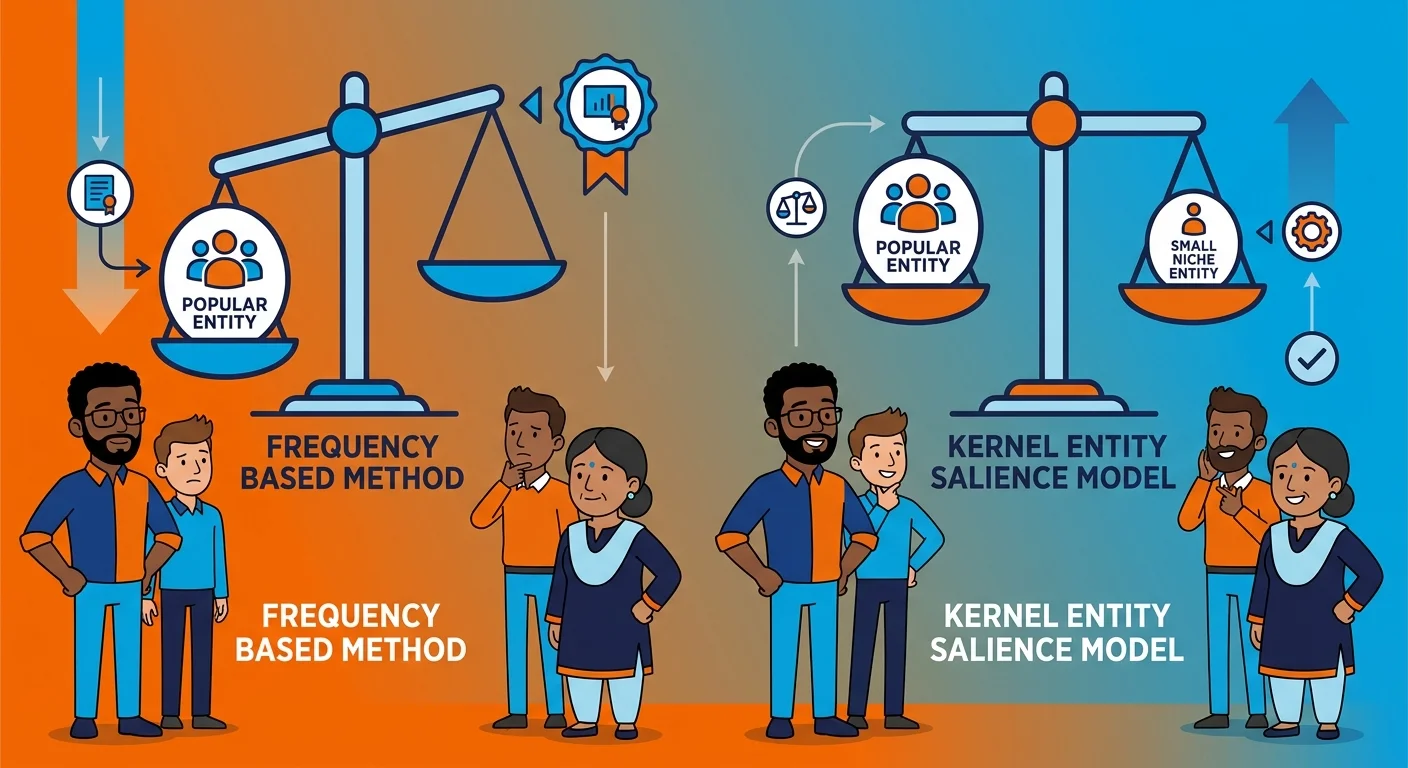
Retrieval finds the passages. Evaluation decides which entity inside them actually earns the citation. And that second step is where keyword density quietly loses every bit of its old authority.
A keyword is just a string of characters. An entity is a distinct, identifiable thing a system can verify, cross-reference, and weigh against everything it already knows. Answer engines score the second one, not the first.
This is the shift that makes the script-versus-data-asset split impossible to dodge. A persuasion script can repeat a phrase until it feels emphasized to a person, but repetition doesn't make an entity any more real to a machine. You see it clearest in the choice between patching one page and rebuilding the wider content system, where the entity a page centers on has to be unambiguous long before volume ever enters the conversation.
| Evaluation Method | What It Measures | Bias Introduced | Outcome for Rare Topics |
|---|---|---|---|
| Frequency-Based Scoring | How often a term or phrase appears across a page | Heavily biased toward the most popular entities | Rare topics score poorly because their vocabulary appears too infrequently to register |
| Feature-Based Scoring | Surface signals like placement, formatting, and term prominence | Heavily biased toward the most popular entities | Rare or specific subjects are treated as less important regardless of accuracy |
| Kernel Entity Salience Modeling | Salience of an entity independent of how often it is mentioned | Balanced treatment across popular and rare entities | Rare topics retain accurate salience instead of being discounted for lack of frequency |
| Entity Recognition (General Shift) | Whether content centers on a distinct, verifiable entity rather than a repeated string | Removes repetition as a meaningful advantage | Rare topics compete on entity clarity instead of on how often a keyword was repeated |
Why Keyword Density Stopped Being the Signal
Keyword density used to work as a stand-in for relevance. A page that repeated a term often enough told older systems that term was its subject.
Entity recognition swapped that stand-in for something closer to verification. That move from keyword matching to entity recognition is the biggest change in how content gets discovered and valued in two decades, and it stripped repetition of any real meaning as a signal.
How Rare and Common Topics Get Weighed Differently
Not every entity carries the same weight, and that's where salience modeling comes in. A rare, specific entity and a common, widely-discussed one don't get scored by the same lazy popularity math.
The Kernel Entity Salience Model hit a better balance between popular and rare entities when predicting salience, according to published research data. Frequency-based and feature-based methods stayed heavily biased toward whatever was already popular. That bias is exactly the failure mode standard copywriting inherits when it treats every term it mentions as equally important.
What Structured Data Does That Prose Alone Cannot
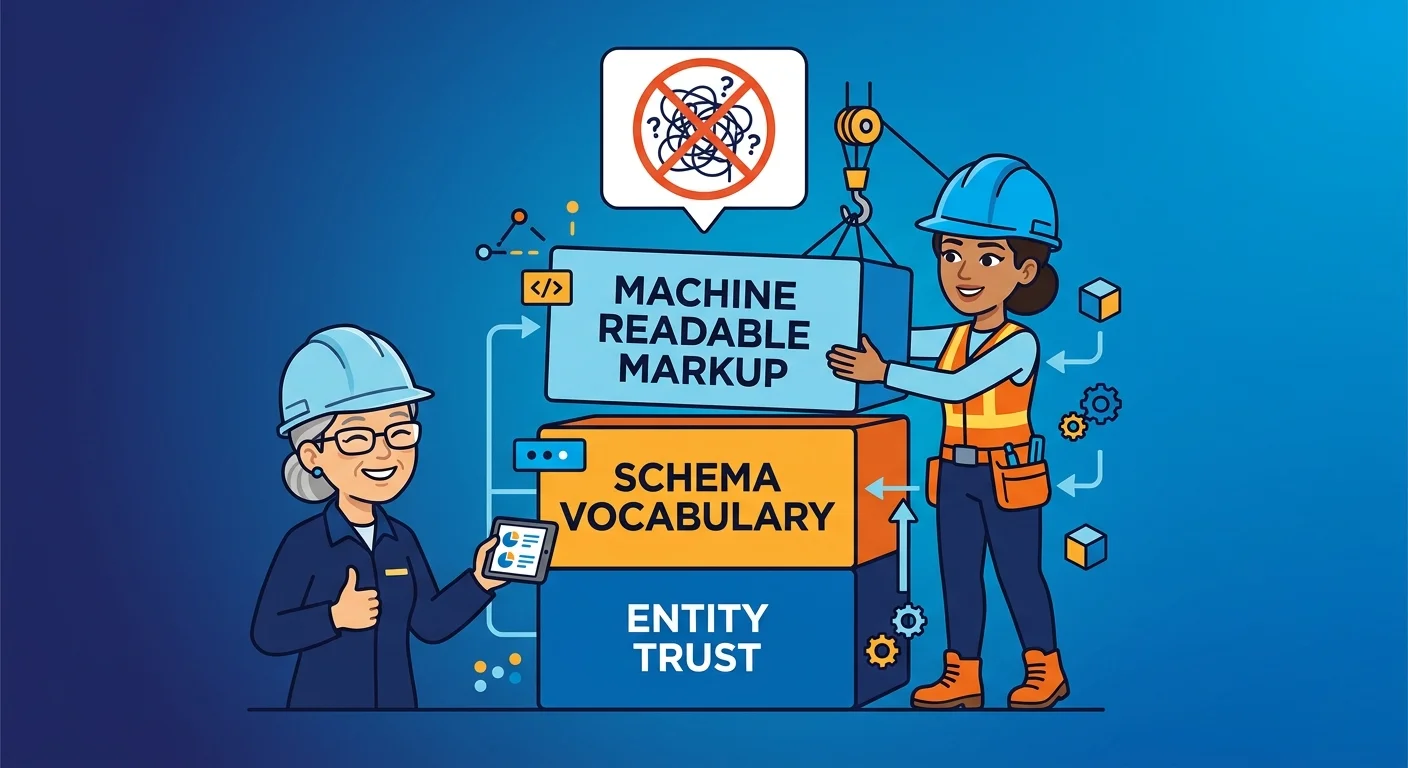
Naming an entity in a sentence isn't the same as declaring it to a machine. Prose can gesture at a subject, but it rarely states what that subject is, what category it belongs to, or how it relates to everything around it in a form a system can parse without inference.
That gap is exactly why the split between structured entity boundaries and raw word count matters so much. It's the whole subject of why answer engines weigh structured entity boundaries over sheer content volume, and it lands right here: a page can be long, well-written, and still leave its own subject undeclared.
Structured markup closes that gap. It takes the entity a sentence only implies and states it flat out, in a format built to be read by a retrieval system instead of guessed at by one.
The Schema Layer Machines Actually Trust
Schema.org exists for exactly this. It hands site owners a shared vocabulary to mark up a page so its entities get stated outright, not implied.
That vocabulary is organized as a collection of schemas, each one built to mark up a page in a shape the major answer engines can parse for semantic search. A retrieval system reading that markup doesn't have to guess what the page is about. Schema.org markup states it directly, in the same structured form every time, and that's what makes the entity trustworthy enough to cite.
That consistency is the whole advantage. A schema field either holds the entity or it doesn't. No tone to misread, no ambiguity to untangle, a structural fact confirmed by the schema documentation held in PubMed Central.
Why Figurative Language and Tone Confuse the Model
Prose gives you none of that certainty, and figurative language is where the gap opens up fastest. A model can score a sentence's literal probability without ever grasping what the metaphor inside it was doing.
And that failure is documented, not theoretical. Current language models don't make effective use of metaphorical context when reading figurative language, leaning instead on the raw predicted probability of an interpretation, a limitation detailed in findings hosted on the arXiv preprint server. So a phrase written to feel persuasive to a person can read as pure noise to the very system deciding whether to cite it.
Who This Content Approach Is Not Built For

Not every business needs this diagnosis. Some are building the persuasion script on purpose, and for a narrow slice of use cases, that's a fair call.
So here's where we draw the line. This section names who this approach isn't built for, and why the script-versus-data-asset split just doesn't apply to them.
The Business Still Chasing Persuasive Copy Alone
Some businesses aren't trying to get cited by a retrieval system at all. Think of a one-time landing page built to close a single campaign, read once and tossed. There's no second life to protect.
And if a business genuinely wants a persuasion script and nothing more, this isn't the approach for them. That's a legitimate, narrow choice, not a mistake.
But most businesses say they only want persuasion while quietly expecting to be found. That contradiction is the real problem, not the writing style. A script can't double as a data asset just because you want both from one document.
Auditing a Page for Machine Readability

Everything up to here was diagnosis. This part is the test, run on one page at a time.
A machine-readability audit asks two questions, and they're separate. Does the page answer cleanly on its own? And does it declare its entities in a form a retrieval system can parse without guessing?
Both matter, because the market that rewards them keeps getting bigger. Nearly half of Google searches now end without a click, with the zero-click rate hitting 46.96% across searches measured from October 2024 through December 2025, a pattern published research data confirms. A page fighting to be the source behind that answer has to pass both tests, not just one.
| Audit Step | What You Check | Pass Signal |
|---|---|---|
| Isolation Test | Read one paragraph alone, with no headline or surrounding sentences for context | The paragraph still states a complete, verifiable claim on its own |
| Entity Declaration Check | Whether the page's primary subject is stated in structured markup rather than only implied by the surrounding prose | Schema fields name the entity directly, with no inference required |
| Pronoun and Specificity Scan | Whether the prose leans on vague pronouns and generic phrases instead of named, specific entities | Sentences name the subject directly instead of pointing back to something said earlier |
| Narrative Dependency Check | Whether a claim only makes sense next to the sentence before or after it | The claim reads as complete without needing the paragraph around it |
| Structure Versus Script Verdict | Whether the page passes both the isolation test and the entity declaration check together | The page functions as a data asset rather than a script wearing the shape of an answer |
Checking Whether a Page Answers Without Its Surrounding Copy
Pull one paragraph off the page. Read it alone, with no headline over it and nothing before or after it for context.
Does it still state a complete, verifiable claim? If it only makes sense next to the sentence before it, that paragraph was written as a script, not a data asset, and it won't survive extraction.
Checking Whether Entities and Markup Are Actually Present
Now dig into the page's source for structured markup. Confirm its primary entity is declared in schema fields, not just implied by the prose around it.
Then read the prose itself for named, specific entities instead of vague pronouns and generic phrases. Pass both checks and you've got a data asset. Fail either one and it's still a script wearing the shape of an answer.
Frequently Asked Questions
All those distinctions raise real questions, fast. Here are the ones we hear most, answered straight.
What is the core difference between copywriting for humans and for AI answer engines?
Writing for humans persuades. It leans on narrative, tone, and feeling to move a person. Writing for answer engines does the opposite: it states entity-declared facts a machine can pull without inferring a thing.
How does structured data like schema help AI understand my content better?
Schema declares your entities flat out instead of burying them in prose. A retrieval system reads that declaration directly, with nothing left to guess.
Do keywords and meta descriptions still matter for Answer Engine Optimization?
Keywords still tell a system your topic, sure. But density itself barely counts anymore. What matters is whether the page names a clear, verifiable entity, not how many times a term repeats.
Can good storytelling and persuasive language actually hurt my visibility in AI answers?
Yes. Emotional language and narrative flow bury the actual claim under feeling. That friction makes the passage harder for a system to extract and cite cleanly.
What is entity salience and why is it more important than keyword density now?
Entity salience is how strongly a system weighs one entity against everything else on the page. It beats density because answer engines score verified importance, not repetition.
How can I audit my existing content to see if it is optimized for answer engines?
Pull one paragraph and read it alone. Does it stand up with no context around it? Then check your source markup and confirm it actually declares the page's primary entity in schema fields.
The Bottom Line
Every page is one of two products: a persuasion script for a human, or a data asset built to be extracted, verified, and cited by a machine. Standard copywriting was built for the first and never retooled for the second.
That's not a style problem. It's a category error. A script tuned for feeling can't also serve as the unambiguous, entity-declared record a retrieval system needs before it'll trust the page enough to cite it.
So the real choice isn't whether to write well. It's which product to build. If you want to be the verified source an answer engine reaches for, the content has to be architected as a data asset from the first sentence, not patched into one after the fact. See what your current pages actually are with an AI visibility check.