
How AI Engines Actually Decide Who Gets Named Nationally
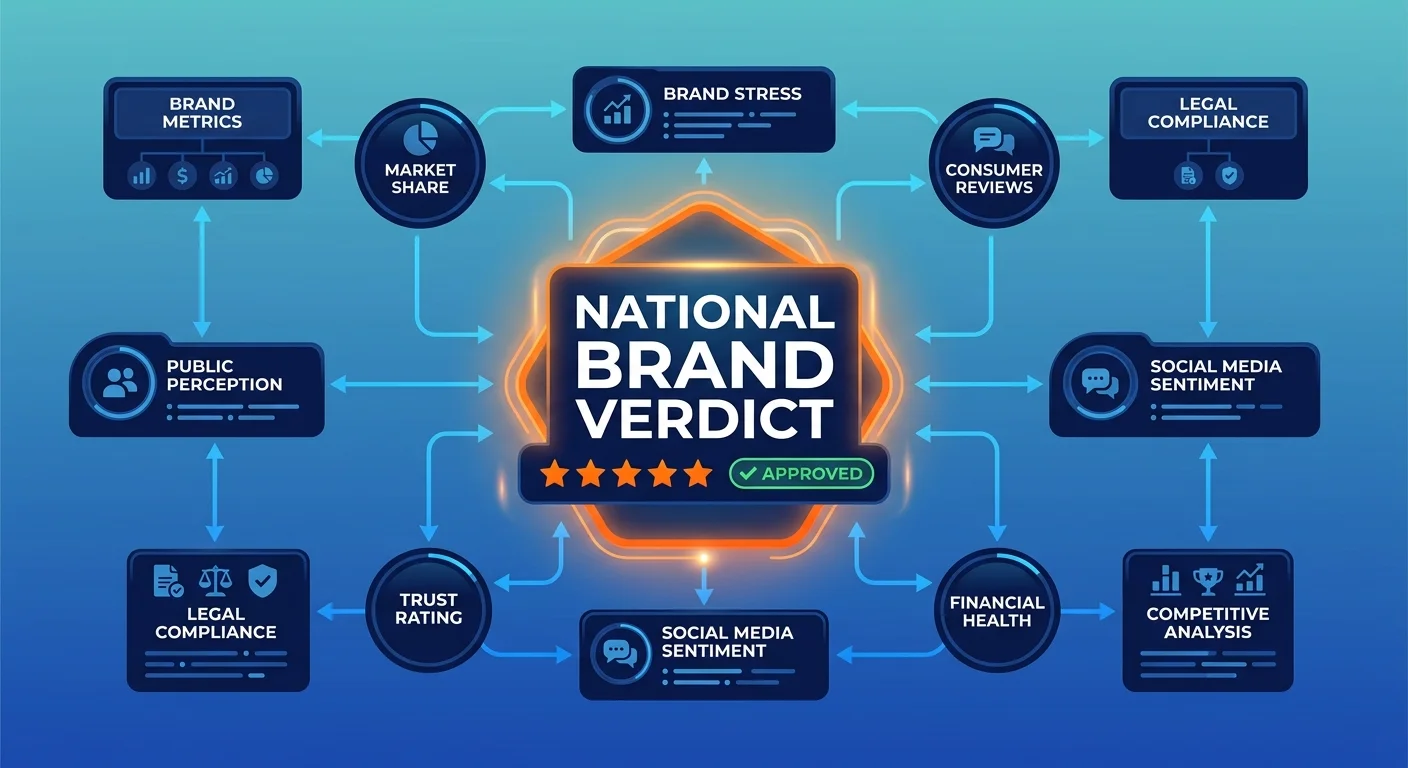
Here’s what AI engines are actually measuring.
Not proximity. Not keyword frequency. Not page count.
Modern search engines stopped returning ranked lists. They produce a single definitive recommendation.
That shift is architectural – not cosmetic. The engine isn’t asking which pages are relevant. It’s asking which entity it trusts enough to name.
That distinction changes everything.
Trust gets computed through structured schema mapping and semantic graph verification – not geographic breadth. One deeply structured, machine-readable entity node beats fifty fragmented doorway pages. Every time.
From Keyword Rankings to Entity Verdicts
The old search model handed authority to whoever showed up most often for the right keywords. The new model hands the verdict to whoever AI can most reliably resolve as a coherent, trustworthy entity.
Those aren’t variations of the same game.
Gartner named AI TRiSM – Trust, Risk, and Security Management – as a dominant technology imperative. The mandate is explicit: enforce strict entity boundaries and eliminate the hallucination risk that comes from conflicting, fragmented data signals.
Enterprise AI platforms are building toward that standard right now.
So here’s what that means for a national brand running 50 geo-pages. Inconsistent entity data spread across dozens of city templates isn’t just ineffective. It actively degrades the AI’s ability to resolve a clean answer about who you are.
Keyword rankings are a legacy metric. The AI engine isn’t counting how many times your brand appears across city-specific pages.
It’s reading your entity – structured schema, consistent NAP signals, authoritative content architecture – and deciding whether that entity earns the verdict. Brands building national entity authority for the first time are often shocked by how little their existing page count matters. A published analysis of how AI synthesizes entity trust at national scale breaks down exactly how those mechanics work.
Why the Old Local Pack Logic Doesn’t Scale
The local pack logic was built for a different era.
Google’s local algorithm rewarded geographic specificity. More hyper-local signals meant more surface area in local results. Fifty city pages felt like a rational scaling move – because inside that model, it was. The math made sense.
But AI verdict engines don’t reward surface area. They reward depth, coherence, and entity integrity.
Fifty boilerplate geo-pages with swapped city names don’t multiply authority – they dilute it. The Technical Shift from Local Answer Engine Optimization to National AI Authority isn’t a trend to watch. It’s the operating reality right now.
Brands still running local pack logic at national scale aren’t standing still. They’re building toward invisible.
| Signal Type | Traditional Local SEO Weight | National AI Engine Weight | What It Measures |
|---|---|---|---|
| Keyword Density | High – more keyword matches meant more visibility | Negligible – AI engines parse meaning, not frequency | Whether a page stuffs target terms or builds semantic coherence |
| Geographic Coverage (Page Count) | High – more city pages meant more local surface area | Counterproductive – diluted entity signals reduce trust resolution | How coherent and consolidated the brand’s entity node is across markets |
| Structured Schema Markup | Low – optional enhancement for rich snippets | Critical – primary machine-readable signal for entity verification | Whether AI can parse who the brand is, what it does, and where it operates without ambiguity |
| NAP Consistency (Name, Address, Phone) | Moderate – mattered for local pack ranking | High – inconsistent NAP data across pages degrades entity resolution | Whether the brand presents as a single trustworthy entity or a fragmented cluster of signals |
| Content Originality Across Locations | Low – boilerplate duplication was acceptable | High – duplicate geo-page content signals low authority to AI verdict engines | Whether the entity demonstrates genuine depth or template-scaled noise |
| Semantic Authority Architecture | Low – internal linking and topical depth were secondary | Dominant – AI evaluates the coherence of the full content infrastructure, not individual pages | Whether the brand’s content signals form a unified, resolvable knowledge graph |
The Anatomy of a 50-City Landing Page Strategy
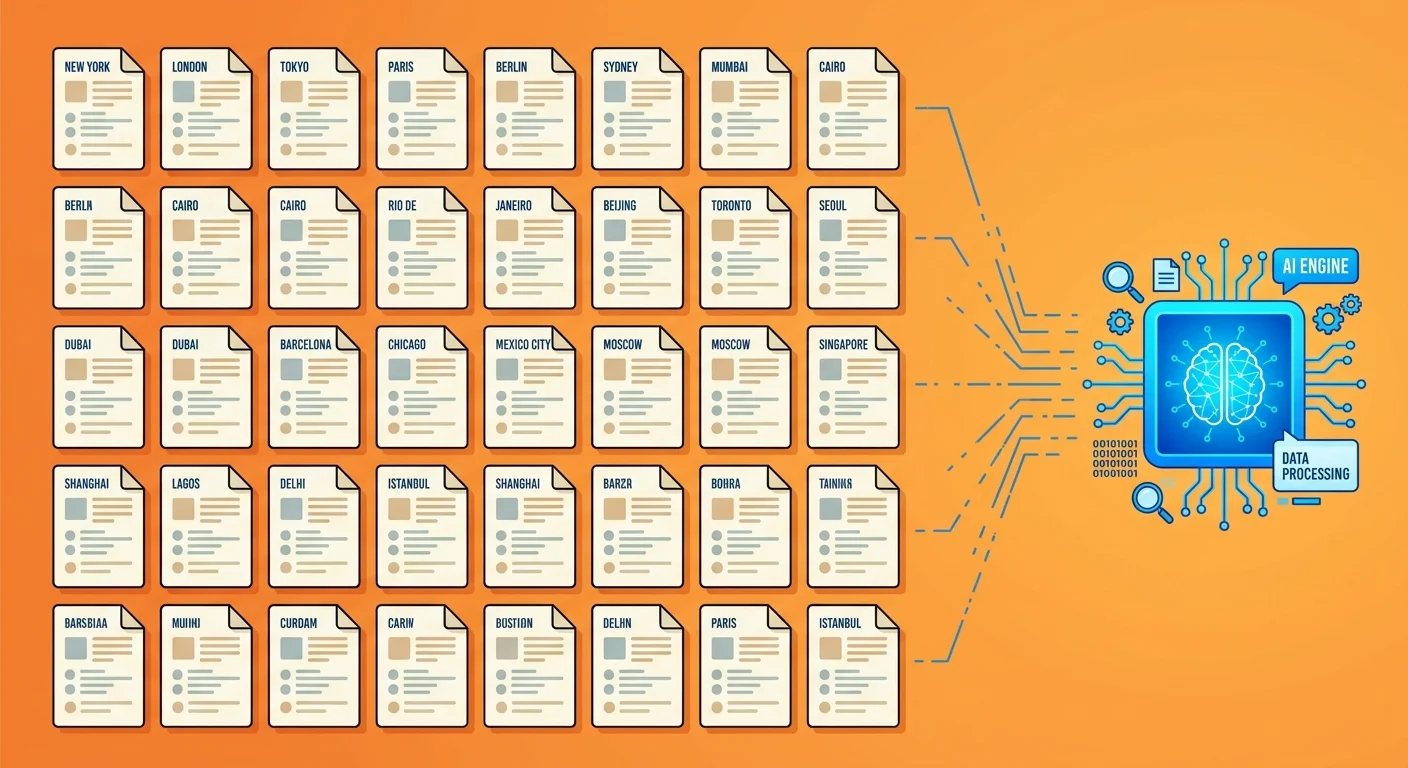
Here’s what the 50-city strategy actually looks like in practice: one page template, duplicated dozens of times, with the city name swapped out.
That’s it. That’s the whole playbook.
Maybe a local landmark gets dropped in. Maybe a zip code. Everything else is identical boilerplate, market to market.
Agencies call this geographic coverage.
What it actually produces is semantic fragmentation. Boilerplate geo-pages don’t establish the semantic density national AI platforms need to build a confident recommendation. They produce recommendation invisibility – and they do it at scale.
So instead of one coherent, deeply structured entity node, a brand running this approach gives AI fifty diluted signals pointing in fifty different directions.
The engine can’t build a clean verdict from that.
It moves on to whoever gave it something it could actually read.
What These Pages Actually Look Like
And the anatomy is almost always identical.
A headline with the city name inserted. A paragraph about serving customers in that metro. A service list with the location dropped in. A generic call to action.
Repeat for every target market.
And the content is not just similar – it is functionally identical in every signal AI engines use to measure entity trust.
The schema is the same. The structured data is the same. The semantic relationship between the brand and the content is indistinguishable from page to page.
That is not scaling authority. That is replicating noise across markets.
Trust is built on centralized, unified digital infrastructure – not geographic breadth.
Fifty pages with swapped city names don’t produce fifty trust signals. They produce one fragmented, unresolvable entity that AI cannot confidently name as the answer to anything.
Why Traditional SEO Agencies Still Sell This Playbook
Here’s the honest answer for why agencies still sell this: it worked.
Keyword targeting, geographic duplication, local citation clusters – these were legitimate tactics in the era of ranked lists. An entire industry built its pricing models, its service packages, and its pitch decks around them.
But the era of ranked lists is over.
The agencies that built their value around it haven’t caught up – or won’t admit it. So they keep repackaging the same geo-page template under new names: "local SEO expansion," "market penetration content," "city-specific landing pages." They’re billing it as AI readiness.
It isn’t.
And the FTC has made the stakes explicit: claims about AI performance and localized reach must be backed by verifiable, objective evidence.
Agencies selling geo-sliced doorway pages as a national AI strategy aren’t just selling an ineffective tactic. They’re selling implied promises that carry direct legal exposure under Section 5 of the FTC Act.
That’s the corner the old playbook has backed itself into.
| Page Element | Typical 50-City Template Execution | What AI Engines Register | Trust Impact |
|---|---|---|---|
| Headline / Page Title | City name inserted into a templated H1 (e.g., ‘[Service] in [City]’) | Repeated semantic pattern across dozens of pages – no unique entity signal | Dilutes brand identity; AI reads duplication, not authority |
| Body Copy | Boilerplate service description with city name swapped and a local landmark added | Near-identical content structure flagged as low-semantic-density filler | Fails to build the semantic depth AI platforms require to resolve a trusted entity |
| Structured Schema / Schema Markup | Same schema block copied from the master template, location field swapped | Inconsistent or conflicting entity signals across the page cluster | Degrades AI’s ability to resolve a single, coherent brand entity |
| Internal Linking Structure | Generic links back to the homepage or a master services page – no unique content hierarchy | Shallow semantic graph with no distinct topical authority per page | No entity depth for AI to traverse; the brand resolves as thin, not authoritative |
| Call to Action | Identical CTA block across all city pages – copy-pasted without variation | Zero differentiation signal; AI sees a replication pattern, not a brand voice | Reinforces the noise profile; AI cannot distinguish this page from any other in the cluster |
| NAP / Contact Data | City-specific phone number or address inserted – often inconsistent with centralized entity data | Conflicting entity data points that contradict the brand’s unified identity | Actively undermines entity trust; AI cannot confirm which signal is canonical |
Why Geo-Cloned Pages Are a Spam Signal to AI Search Engines
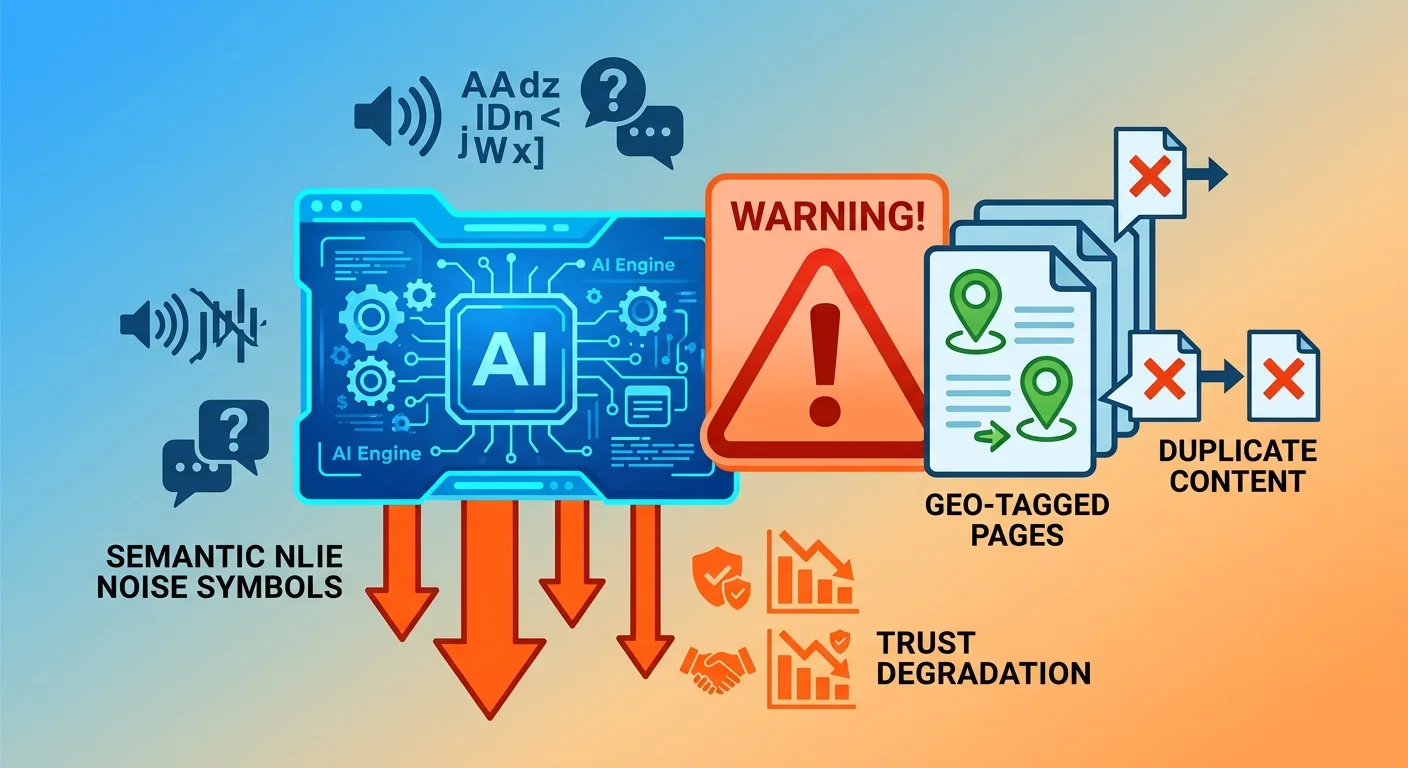
Geo-cloned pages aren’t just ineffective. They’re read as a spam pattern by the exact systems that determine national AI recommendations.
AI engines are built to detect redundancy. Fifty pages sharing the same schema signature, the same content architecture, the same semantic relationship to a brand – that doesn’t register as fifty trust signals.
It registers as one fragmented, unresolvable entity trying to game geographic coverage.
Boilerplate doorway pages don’t establish the semantic density national AI platforms require. That failure isn’t a ranking drop in the old-school sense.
It’s worse.
The engine can’t build a coherent verdict from the noise – so it names someone else. You’re not penalized. You’re invisible.
And the mechanism gets worse the more pages you add.
Every geo-cloned page drops another contradictory data point into the entity graph. The AI’s ability to resolve a clean, authoritative signal doesn’t improve – it degrades.
The result isn’t broad national presence. It’s a brand AI can’t confidently name as the answer to anything.
The Semantic Density Problem
Semantic density is the difference between an entity AI trusts and an entity AI ignores.
It’s the depth, consistency, and structural coherence of everything surrounding a brand – schema markup, entity relationships, content architecture, unified NAP data. All of it working as one coherent signal.
One deeply structured entity node produces high semantic density. Fifty boilerplate city pages produce near zero.
Here’s the thing – when national brands make the shift from local targeting to national content architecture, the semantic density gap becomes immediately obvious.
Local geo-pages produce identical schema, identical content signals, identical entity relationships across every market. That isn’t depth.
That’s replication. And AI engines treat replication as noise, not authority.
Trust gets calculated on centralized, unified infrastructure signals. Not geographic breadth.
Consolidate your entity signals into one machine-readable Authority Infrastructure – AI has everything it needs to resolve a clean verdict. Scatter those same signals across fifty diluted doorway pages – AI has nothing it can use.
That’s the whole equation.
Who This Approach Is Actively Repelling
Look – this approach actively repels the kind of brand iTech Valet builds national authority for.
If your growth plan is built on geographic page duplication – if "national scaling" means adding fifty city pages and calling it done – this isn’t the right system for you.
That model produces invisibility. Not authority.
But if you’re a national brand that’s already burned budget on geo-cloned page strategies and come away with nothing – no AI recommendations, no measurable authority, no differentiation from the noise – you already know the problem firsthand.
The question isn’t whether the strategy failed. That part’s settled.
The question is whether you’re ready to build something AI can actually read and trust.
The Regulatory and Trust Risk Nobody Mentions
Here’s the part almost no agency tells its clients. The SEC’s risk evaluation of AI model accuracy makes the structural problem explicit: excessive clustering around poorly verified information nodes degrades accuracy inside AI systems.
Fifty geo-pages pointing at the same unverified entity are exactly that kind of cluster.
The AI can’t resolve a reliable answer. And the agency that built those pages hasn’t created geographic advantage – it’s created a systemic trust failure with real exposure under Section 5 of the FTC Act.
The FTC goes further. Firms making claims about AI performance and localized reach must possess objective, scientific evidence to back those claims.
Agencies selling geo-sliced doorway pages as national AI visibility are selling implied localization promises they can’t substantiate.
Exaggerated or fake localization claims are a direct violation of Section 5 of the FTC Act. That’s not a technicality. That’s a liability.
So the 50-city landing page strategy isn’t just a failed tactic. It’s a legally exposed one.
The brand running it is invisible to AI. The agency selling it is making claims it can’t verify. And the entire architecture moves in the exact opposite direction of what centralized verification requires to establish national system trust.
That’s not a gap to optimize around. That’s a foundation to tear out and rebuild.
| Spam Signal Type | How It Manifests in 50-City Builds | AI Engine Response | Authority Outcome |
|---|---|---|---|
| Schema Replication | Identical structured data markup copied across all 50 pages – same entity relationships, same property values, same organizational signals with only the city name swapped | Detects duplicate schema signatures; treats pages as a single fragmented entity rather than distinct authoritative nodes | Zero semantic differentiation across markets – AI cannot resolve a confident, unique verdict for any location |
| Boilerplate Content Architecture | Same headline structure, same service list, same call-to-action pattern reproduced across every city variant with surface-level local insertions | Flags near-identical content blocks as low-trust replication; deprioritizes the entire domain’s entity signal in national recommendation pools | Semantic density collapses – each duplicate page erodes rather than builds the brand’s overall authority score |
| Entity Signal Fragmentation | Brand signals scattered across 50 separate URLs instead of consolidated into a single, deeply structured entity node – NAP data, canonical references, and topical authority all diluted | Cannot resolve a clean, coherent entity graph; treats the brand as ambiguous rather than authoritative at the national level | Systemic recommendation invisibility – AI engines name competitors whose entity signals are unified and machine-readable |
| Geographic Keyword Clustering | City-name keyword insertion in H1s, meta descriptions, and body copy across dozens of pages – no substantive content differentiation supporting those geographic claims | Reads geographic keyword clustering as a manipulation pattern; deprioritizes geo-targeted content that lacks underlying topical authority and structured evidence | Brand is filtered out of AI-generated local and national recommendation sets despite broad surface-level geographic coverage |
| Unverified Localization Claims | Implied local presence and service authority across 50 markets with no structured data, verified citations, or authoritative content infrastructure to substantiate those claims | Cross-references entity claims against centralized verification signals; absence of corroborating structured data renders localization claims unresolvable | Authority Infrastructure reads as empty to AI engines – brand fails entity trust thresholds required for national AI recommendations |
| Internal Link Dilution | Link equity and topical authority dispersed across 50 thin pages rather than concentrated into a unified content hierarchy that reinforces a single entity node | Internal linking architecture signals low topical coherence; AI cannot identify a primary authoritative source within the domain to anchor a national recommendation | The brand’s strongest content signals are buried under structural noise – compounding invisibility instead of compounding authority |
What National AI Authority Actually Requires
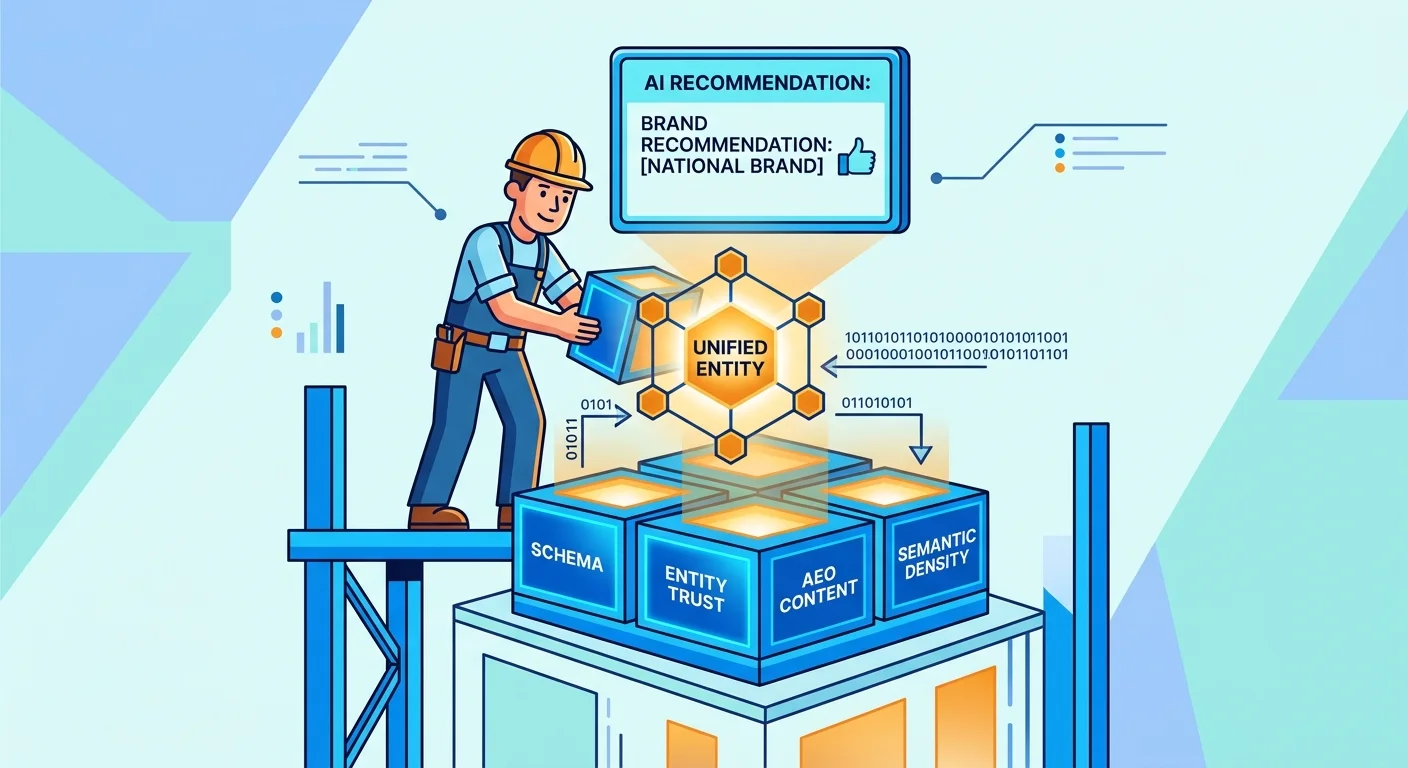
So what does the right architecture look like?
Not fifty diluted signals pointing in fifty directions. One unified entity node – deeply structured, machine-readable, coherent enough that AI engines resolve a clean verdict without hesitation.
That’s the whole shift.
AI doesn’t scan your geographic footprint. It evaluates the structural coherence of your entity.
The depth of your schema. The consistency of your content signals. The authority relationships surrounding your brand. That’s what gets synthesized into a national recommendation – not how many city pages you’ve published.
Gartner identified systematic entity validation as a dominant technological imperative. That’s not a prediction. It’s already the operating standard AI platforms are enforcing right now.
Generative AI needs one thing to produce a national recommendation: a unified, semantically structured entity it can read at scale.
Not fifty fragmented local templates stitched together at volume. One foundation. Built to enterprise-grade consistency.
Everything else builds from there.
The Four Pillars of a Unified National Entity Node
Start with schema architecture.
Every page in a national authority system carries structured markup that tells AI engines exactly who the entity is, what it does, and how it connects to every other element of the brand.
Not generic schema dropped in as an afterthought. Purpose-built, entity-specific markup that functions as a machine-readable identity document.
- Schema architecture – purpose-built structured markup that tells AI exactly who the entity is and how every element of the brand connects
- Semantic density – the depth and consistency of meaning surrounding the brand across every piece of content
- Unified entity data – one name, one address, one phone number, one authoritative signal across every platform AI queries
- AI Authority content architecture – a structured library of topically coherent content that reinforces entity relationships and demonstrates subject-matter authority at scale
Here’s the thing – the four pillars are not independent. They compound.
Strong schema makes semantic density more legible. Unified entity data makes content authority more credible. Brands working through how to scale entity trust without fragmenting identity figure this out fast: each pillar reinforces the others.
The result is one coherent entity node AI can resolve with confidence. Not fifty diluted doorway pages it can’t read.
How the Proprietary Two-AI Validation System Builds This
iTech Valet builds national authority through a Proprietary Two-AI Validation System.
Gemini researches. Claude writes. Gemini validates. Claude refines. Every claim sourced. Every entity signal verified before a single piece of content publishes.
That’s not a workflow. That’s a quality standard the geo-page template model cannot touch.
The system rebuilds Authority Infrastructure from the foundation up.
Schema designed for AI extraction. Entity relationships mapped and structured. AI Authority articles that compound month over month – deepening semantic density, reinforcing the brand’s national authority signal.
The Local AI Authority Engine services are built on exactly this model. Not geographic duplication. Structured entity depth.
But the output isn’t just content.
It’s a single, unified entity node that AI engines can read, trust, and name. Structured schema mapping – not local keyword density – is how query processing works now. A brand built to that standard looks entirely different to an AI engine than fifty boilerplate city pages ever could.
One gets named. The other gets ignored. That’s where this math resolves.
| Infrastructure Component | 50-City Page Approach | Unified Entity Node Approach | AI Trust Signal Produced |
|---|---|---|---|
| Schema Architecture | Generic local business markup duplicated across fifty city pages with identical entity signals | Purpose-built, entity-specific structured markup functioning as a machine-readable identity document for a single authoritative brand node | AI can resolve a clean, unambiguous verdict about who the entity is and what it represents |
| Semantic Density | Boilerplate content replicated with city name substitutions – near-zero unique meaning per page | Deep, topically coherent content architecture that reinforces entity relationships and subject-matter authority across every signal | High semantic coherence that AI engines can read as genuine expertise, not geographic noise |
| NAP and Entity Data | Fragmented local citations pointing to fifty variations of the same brand – contradictory data points across platforms | One name, one address, one phone number, one authoritative signal consistent across every platform AI queries during verdict construction | Unified entity resolution – AI builds one confident answer instead of fifty unresolvable fragments |
| Content Authority | Geo-targeted landing pages with interchangeable body copy – no compounding topical depth, no differentiation signal | Structured AI Authority content that compounds month over month, deepening semantic density and reinforcing national authority relationships | Demonstrated subject-matter authority at scale – the kind AI engines use to select a recommended entity over competing noise |
| Entity Relationships | Isolated city pages with no meaningful internal authority architecture connecting brand signals | Mapped and structured entity relationships across schema, content, and external citations – a coherent knowledge graph surrounding one brand | Interconnected authority signals that allow AI to trace the brand’s credibility across multiple verification points simultaneously |
| AI Recommendation Outcome | Systemic recommendation invisibility – the engine cannot build a coherent verdict from diluted, duplicated signals | A single, unified entity node that AI engines can read, trust, and name as the definitive national answer | One brand gets named. Fifty doorway pages get ignored. |
Frequently Asked Questions
The strategic case is made. But here’s where national brands actually get stuck – not in theory, but in the specific questions that surface the moment a rebuild is on the table.
So let’s answer them directly. No hedging. No ‘it depends.’ The architecture either works or it doesn’t – and these answers reflect exactly how it works.
Why are 50-city landing page strategies failing under generative AI search?
Because generative AI doesn’t produce a ranked list. It produces a verdict.
The 50-city model was built for a search architecture that no longer governs recommendations. Boilerplate geo-pages produce identical content signals, identical schema, and identical entity relationships across every market. That isn’t geographic reach – that’s signal fragmentation.
AI engines treat fragmented signals as noise. Not authority. The strategy didn’t gradually decline. It already failed.
How do AI engines evaluate national entity trust versus localized directory citations?
AI engines aren’t counting citations. They’re resolving entity coherence.
A national brand with a consolidated, machine-readable Authority Infrastructure gives an AI engine one clear, structured answer to evaluate. A brand with fifty localized directory citations spread across boilerplate city pages gives it fifty contradictory signals to sort through.
Trust is built on centralized, unified infrastructure – not directory volume. Structural depth is what AI reads. Directory breadth is what AI ignores.
What is the difference between optimizing for Google’s traditional local pack and building national AI authority?
Google’s traditional local pack rewards proximity signals – NAP consistency, geographic relevance, review volume. That model was built for a list.
National AI authority is built for a verdict. Query processing in generative AI relies on structured schema mapping, not local keyword density. Those aren’t variations of the same optimization problem – they’re completely different games.
Local pack tactics optimize for position on a list that AI is already replacing. National AI authority builds the single entity node that AI names when the list is gone.
Why does duplicate geo-targeted boilerplate content trigger spam filters in AI-era search?
AI engines surface authoritative, differentiated signals. Duplicate content – regardless of the geo-swap in the headline – reads as replication, not depth. And replication is exactly what spam filters are built to catch.
Gartner identified systematic entity validation as a dominant 2024 technology imperative. That means AI systems are actively enforcing strict entity boundaries and filtering out model hallucination at the infrastructure level.
Fifty pages saying the same thing across fifty markets don’t pass that validation. They fail it – automatically, every time.
How does a unified knowledge graph replace the 50-city landing page model for national brands?
A unified knowledge graph replaces fifty diluted doorway pages with one structured entity node that AI can actually read.
Instead of scattering signals across fifty markets, the brand consolidates schema, entity data, content architecture, and authority relationships into a single coherent infrastructure. That’s what generative AI requires to produce a national recommendation. Not geographic breadth. Structural depth.
The knowledge graph gives the AI engine one clean answer to resolve. Fifty boilerplate city pages give it one verdict – fifty reasons to be ignored.
Can a national brand still rank locally while building national AI authority?
Yes. And the key is understanding that local visibility and national AI authority aren’t competing objectives – not when the underlying infrastructure is built correctly.
A consolidated entity node with strong schema, unified NAP data, and deep semantic density surfaces in local queries because the entity signals are coherent. Not because a geo-page was created to chase a city keyword. The FTC is explicit: localization claims must be backed by objective, scientific evidence – not manufactured through page duplication.
An Authority Infrastructure built to that standard produces genuine local relevance as a byproduct of national entity trust. That’s not a workaround. That’s how the system is supposed to work.
The Verdict on Geo-Cloned Pages
Here’s the verdict.
Fifty geo-cloned pages don’t build national authority. They build national noise.
AI engines aren’t counting your city pages. They’re reading structural coherence – one entity node with signals that resolve cleanly into one trusted answer. Scatter those signals across fifty boilerplate pages and you’ve handed the engine exactly nothing it can work with.
And that contrast is the whole argument.
One unified entity node – deeply structured, machine-readable, verified – looks like a trusted answer. Fifty diluted doorway pages look like a brand the engine can’t resolve.
No partial credit. No geographic workaround. No amount of city pages closes that gap.
So you’ve already run the geo-page playbook. You’ve got the city pages. You’re still invisible.
More pages won’t fix that – because the problem was never coverage. It was coherence.
The brands AI names aren’t the ones with the widest geographic footprint. They’re the ones that gave the engine one signal it could trust – one consolidated, machine-readable authority node it resolved without guessing.
ITech Valet builds to that standard. Not fifty pages pointing at fifty markets. One entity, built right, trusted at scale.
Stop adding pages. Start building authority. Because when you run the math all the way out, there’s only one verdict, fifty reasons to be ignored.
You’ve seen the math. Fifty geo-cloned pages produce one verdict, fifty reasons to be ignored – and the only way out is to know exactly where your entity stands right now. Run the check.