
Why Your Old Content Scorecard Just Stopped Telling the Truth
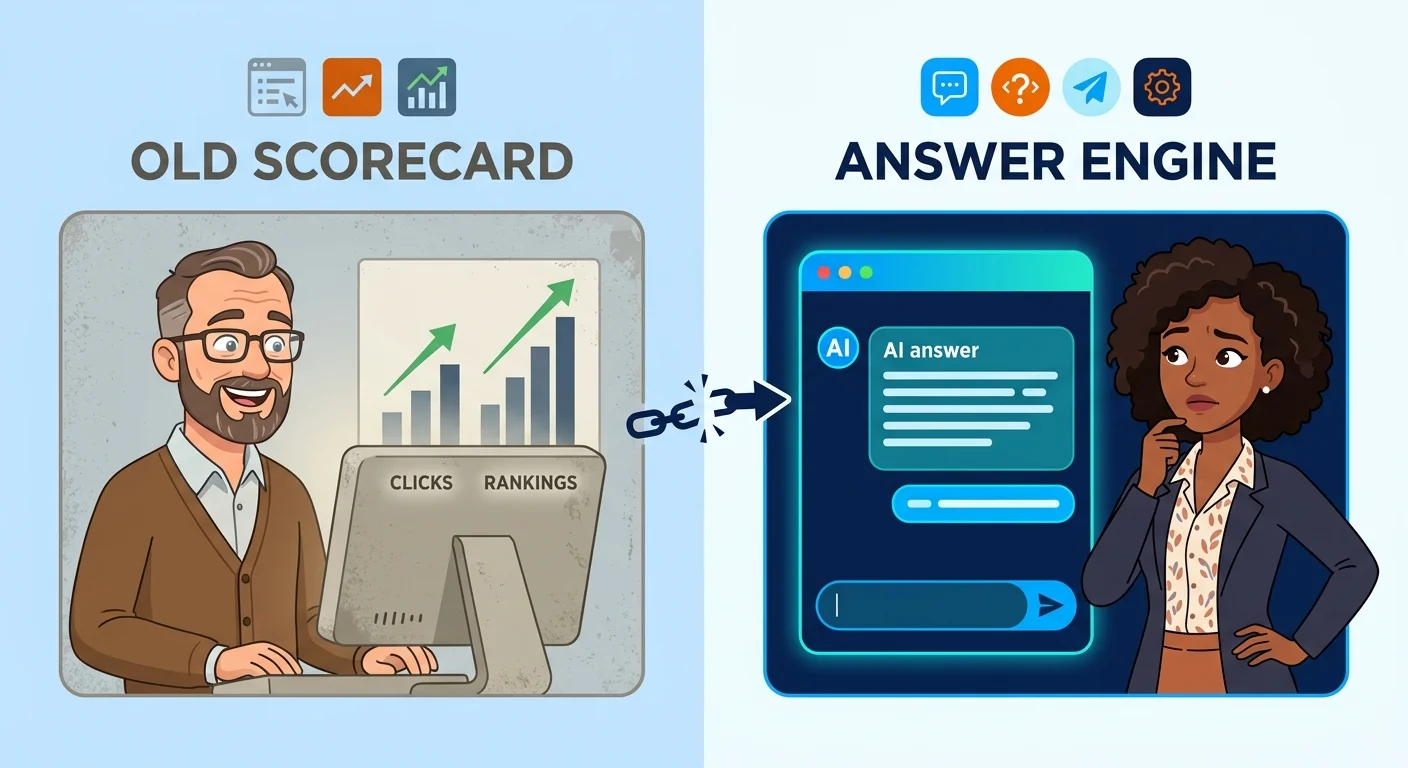
Rankings, impressions, click-through rates. That used to be the whole scorecard, right next to your classic ten blue links placements and a site visits report pulled straight off the dashboard.
Here's the thing: those metrics defined a decade of traditional search optimization success. And they're going irrelevant fast in the age of conversational AI, because a generated answer never produces a click for your page to claim credit for.
Look at what's actually happening at the query level. Across Google searches between October 2024 and December 2025, nearly half, 46.96%, ended without a single click, according to published research data.
That's not a dip. It's a structural shift in how an answer reaches a person, and a scorecard built entirely around clicks can't even see it happening.
| Old Metric | What It Measured | Why It Breaks in Conversational Search |
|---|---|---|
| Keyword position tracking | Where a page sat inside a list of ten blue links for a given search term. | A conversational search engine doesn't return a list. It returns a synthesized answer, so a position number describes a page that may never be shown at all. |
| Site visits | How many people landed on a page after clicking a result. | When an answer gets generated instead of clicked, the page can be the source of the answer and still show nothing in a site visits report. |
| Impressions | How often a page's listing appeared somewhere in a results feed. | An impression only counts a page being shown, not a page being read, extracted, or trusted enough for a model to cite it. |
| Click-through rate | The share of viewers who clicked a listing versus scrolled past it. | A generated answer removes the click entirely, so this ratio measures a behavior that a growing share of searches never perform. |
The Ranking Report Is a Fossil
A ranking report tells you where a page sits in a list of results. It says nothing about whether an AI system pulled a fact off that page and used it to answer somebody's question.
So the report keeps reading fine while the content underneath it quietly stops getting used. That gap is exactly why understanding what standalone AEO content boundaries actually are matters before you try to audit a single thing against them.
And this isn't a small tweak to an existing spreadsheet. It's a different question entirely, because a page can hold a strong position and still be invisible inside a generated answer. Position and extraction aren't the same thing, and treating them like they are is what makes an old scorecard lie to you.
What an Answer Engine Actually Does With Your Page

So what happens once your page lands inside an answer engine? It doesn't index the thing the way a classic crawler would.
It runs an extraction pass. That pass yanks out the discrete claims, definitions, and figures, then throws away the sentence structure holding them together.
Here's the thing: a page can read beautifully and still flunk this pass. If a fact only makes sense buried under three paragraphs of setup, the model either mangles it or skips it.
Extraction, Not Indexing
Extraction and indexing solve two completely different problems. Indexing asks whether a page exists and where it sits next to other pages.
Extraction asks something a lot narrower. Can a single fact on that page get lifted out, checked against its own boundaries, and dropped into a generated answer without losing its meaning?
That's why understanding why structured entity boundaries outperform raw word count matters more than chasing length or density. A page built for extraction treats every claim as a self-contained unit, not a scrap of some longer argument.
Where Machines Get Their Facts Wrong
Now, extraction isn't flawless. Generative systems sometimes pin a claim to the wrong source entirely.
And this isn't the model inventing facts out of thin air. Research documented on the arXiv preprint server shows hallucinated citations aren't random inventions at all. They're patterned recombinations of real authors, journals, dates, and keywords.
That pattern matters for anyone auditing how a page performs. A poorly bounded entity hands a model loose parts to recombine, and loose parts are exactly what spit out a wrong attribution downstream.
The Metrics That Actually Belong on an AEO Scorecard

So what actually belongs on a working scorecard? Forget how many people visit a page. Measure how often that page's ideas become the answer itself.
That's a completely different unit of measurement. A visit counts a person showing up somewhere. A citation counts an idea traveling somewhere else, with the source attached or stripped off depending on how tightly the entity was bounded to begin with.
Here's the thing: this only works if you stop treating content as an article and start treating it as a structured data asset. Content has to be engineered for machine consumption, not written purely as long-form prose for a human reader. That reframing changes what a scorecard even tracks, and it's worth understanding the gap between commodity content packages and a genuinely structured semantic engineering approach before you pick which metrics to chase.
| Metric | What It Tracks | Data Source |
|---|---|---|
| Citation Rate | How often a generated answer references or paraphrases a specific entity's claim instead of ignoring it entirely | Manual query testing across conversational search engines, comparing generated answers against the source page's stated facts |
| Extraction Fidelity | Whether a fact pulled into a generated answer matches the original claim's meaning, or has been distorted through recombination | Side by side comparison of the source page's entity boundaries against the AI system's synthesized output |
| Entity Consistency Score | Whether names, definitions, and attributes tied to a subject stay uniform across the page instead of contradicting each other | Structural review of on page markup and prose for conflicting statements about the same entity |
| Structured Markup Coverage | How much of a page's core claims are labeled through schema or equivalent structured markup a machine can parse without guessing | Technical audit of the page's markup against its unstructured prose content |
| Synthesis Attribution | Whether an AI system credits the correct source when it reuses a page's idea, or misattributes it to an unrelated entity | Cross referencing generated answers against the actual origin of the cited claim |
This Is Not for Teams Chasing a Ranking Report
This isn't for teams still waiting on a monthly ranking report to tell them whether content is working. If keyword position tracking and a rising line on a rankings dashboard are the proof you need, this scorecard will frustrate you.
Look, the metrics here don't move in a clean weekly line. They ask whether a fact got extracted, whether an entity got cited, whether a definition got reused correctly. That's a slower, messier signal than a rank position, and it repels anyone who wants one tidy number to report upward without doing the harder work of checking extraction quality.
Running the Audit: Entity Boundaries, Structure, and Signals

Running the audit itself starts with one simple question. Can a machine take this page apart and put it back together correctly?
That question splits into two tracks. One checks the bones, meaning the structural markup a model leans on. The other checks the meaning, whether the entity itself is clear enough to survive extraction.
| Audit Step | What You Check | Signal It Confirms |
|---|---|---|
| Entity Isolation Check | Whether a single claim, definition, or figure stands alone without needing prior paragraphs for context | Extractability of individual content units |
| Structural Markup Review | Whether schema labels entity types, attributes, and relationships explicitly, and whether headings match the claims beneath them | Machine-readable clarity of page architecture |
| Consistency Audit | Whether names, definitions, and facts about the subject stay uniform across the entire page | Trustworthiness of the entity for reuse in a generated answer |
| Citation and Synthesis Tracking | Whether the content is cited, paraphrased, or ignored when a model answers a related query | Real-world extraction and attribution behavior |
| Synthesis Readiness Check | Whether the content answers the question completely enough that no follow-up click is needed | Standalone completeness as a data asset |
Auditing the Bones: Schema and Structural Signals
Start with the bones. Schema markup is how a page tells a machine what each piece actually is, instead of leaving the model to guess from the sentences around it.
So an audit here checks whether entity types, attributes, and relationships are labeled out loud. It also checks whether headings map cleanly to the claims beneath them, because a mismatched heading confuses extraction before it even starts.
Does the page's internal architecture hold up under scrutiny? Now's a good moment to weigh whether one standalone page can carry that weight or whether it needs the wider scaffolding covered in standalone content built for a single answer versus a full authority rebuild, since the two aren't solving the same structural problem.
Auditing the Meaning: Entity Clarity and Synthesis Readiness
Structural signals only get you halfway. The second track audits meaning, and meaning gets judged by whether an entity's definition stays consistent everywhere it shows up on the page.
Here's the thing: a model auditing for bias or reliability runs its own version of this check. Research on evaluating language models describes intrinsic methods that probe representations and likelihoods directly, alongside extrinsic methods that test bias across classification, question answering, and dialogue, a distinction laid out in published research data. A page with a wobbly, shifting definition gives that model nothing stable to probe.
Synthesis readiness is the last check, and it's the one most audits skip entirely. Does the content answer the question so completely that a searcher never needs to click through? The underlying figures come from published research data.
Frequently Asked Questions
A handful of questions come up over and over once teams start rethinking what an audit actually measures. Here's where the tactical stuff lands.
What's the difference between a traditional content audit and an AEO audit for conversational search?
A traditional audit checks placement, site visits, and backlink profiles. An AEO audit checks one thing: can a machine lift a claim out cleanly and cite it right?
How can you measure content performance when conversational AI provides answers without generating clicks?
You stop counting arrivals. You start counting citations. Track how often a page's ideas land inside a generated answer, click or no click.
What specific metrics should be tracked to evaluate content visibility across different AI engines?
Watch citation frequency, attribution accuracy, and whether your entity definitions get reused the same way across different engines. A claim cited right in one system and misattributed in another points straight at a boundary problem, not an engine problem.
Does structured data play a more important role in AEO audits than in traditional content audits?
Yes, and it isn't close. Traditional audits treat markup as a nice-to-have. An AEO audit treats it as the thing that lets a model know what each claim is before extraction ever starts.
What tools are available in 2026 to automate auditing content for AI engine visibility?
Automated tooling for this kind of tracking is still maturing, and it can't replace a manual pass yet. Right now, checking extraction and attribution by hand catches problems a dashboard just can't see.
How often should standalone content be re-audited for conversational search performance?
Re-audit whenever an engine changes how it synthesizes answers or your entity definitions shift. Treat it as an ongoing discipline, not a once-a-year chore.
The Bottom Line
So here's the bottom line. Your page either holds together under machine extraction, or it dissolves into noise the second a model pulls it apart. Structured entity boundaries decide which one you get.
So stop scoring content the way a decade of traditional search optimization trained you to. A rank position and a climbing site visits chart can't tell you whether a single fact survived extraction.
Only a structured semantic content engineering approach answers that question honestly.
So here's the choice: keep writing for a reader's eye and hope the model sorts out the rest, or engineer every claim and boundary to hold together no matter how it's pulled apart. That second path is the only one built for how conversational search works now, and if you want to know where your own content stands, start with an AI visibility check.