
Why AI Search Broke the Old Rules of Visibility
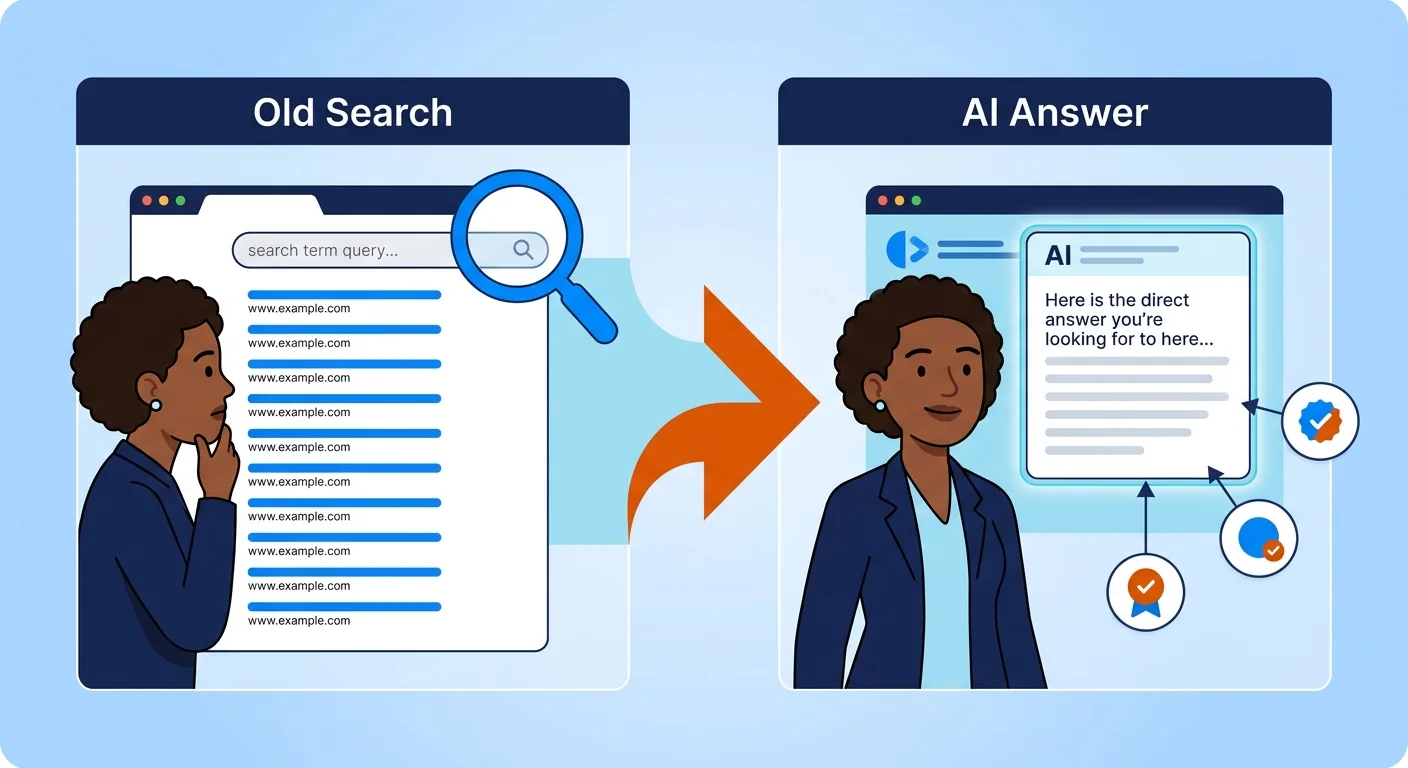
Here's the thing: the old rules assumed a searcher would click through a list of links and size up the sources themselves. In the era of AI-driven search, visibility is no longer about ranking on a list of blue links. It's about being the verifiable source for the answer itself.
And that shift breaks every assumption traditional search optimization was built on. A ranked position used to be the finish line. Now it's irrelevant if a generative engine never names the business as the cited source.
So why hasn't everyone adjusted? Because most businesses are still chasing traditional search optimization tactics that go obsolete as AI Overviews and generative answers eat a bigger share of queries. They keep digging the same shallow trench while the ground shifts underneath it.
But visibility built this way doesn't just fade — it can vanish overnight the second an algorithm stops recognizing the old signals. Understanding why an AI recommendation quietly disappears from generative answers over time shows why a one-time optimization push can't stand in for an ongoing authority-building system. The moat gets dug once and maintained on purpose, not checked off a list.
Why Chasing Placement in the Classic Ten Blue Links Is a Dead End

Chasing placement in the classic ten blue links is a dead end for one simple reason: the destination it points to is disappearing. A ranked link only matters if a searcher scrolls a results page and actually clicks.
But generative answers skip that step entirely. When an AI engine writes the answer itself, the ranked list underneath becomes decoration nobody reads.
So the tactic isn't just weaker than it used to be. It's aimed at a doorway that's closing, one query at a time.
The Failure Mechanism Behind Keyword-Only Tactics
Here's the failure mechanism: keyword-only tactics were built to satisfy a ranking algorithm, not a reader's actual question.
That worked when the output was a list a human would size up. It stops working the second the output is the final answer, delivered with no list to weigh.
A page stuffed with keyword variations gives a generative engine nothing to cite with confidence. The same clinics hitting this ceiling are usually the ones running into the zero-sum reality of AI engine recommendations for local clinics, where one practice gets named and the runner-up gets nothing.
The goal was never to trick the algorithm. It's to feed the AI signals so clear, consistent, and authoritative that it has no choice but to recognize your entity as a reliable source of truth.
Who a Defensive Authority Moat Is Not Built For
This isn't for a business chasing a quick keyword position tracking win before the next quarterly report. A Defensive Authority Moat is not that kind of asset.
If the plan is to game a ranking this quarter and move on, this framework will feel slow and frustrating. It was never built for that timeline.
Look, a moat gets dug once and defends indefinitely. But it doesn't dig itself in a weekend, and anyone expecting that isn't the right fit here.
The Four Pillars of a Verifiable Digital Entity
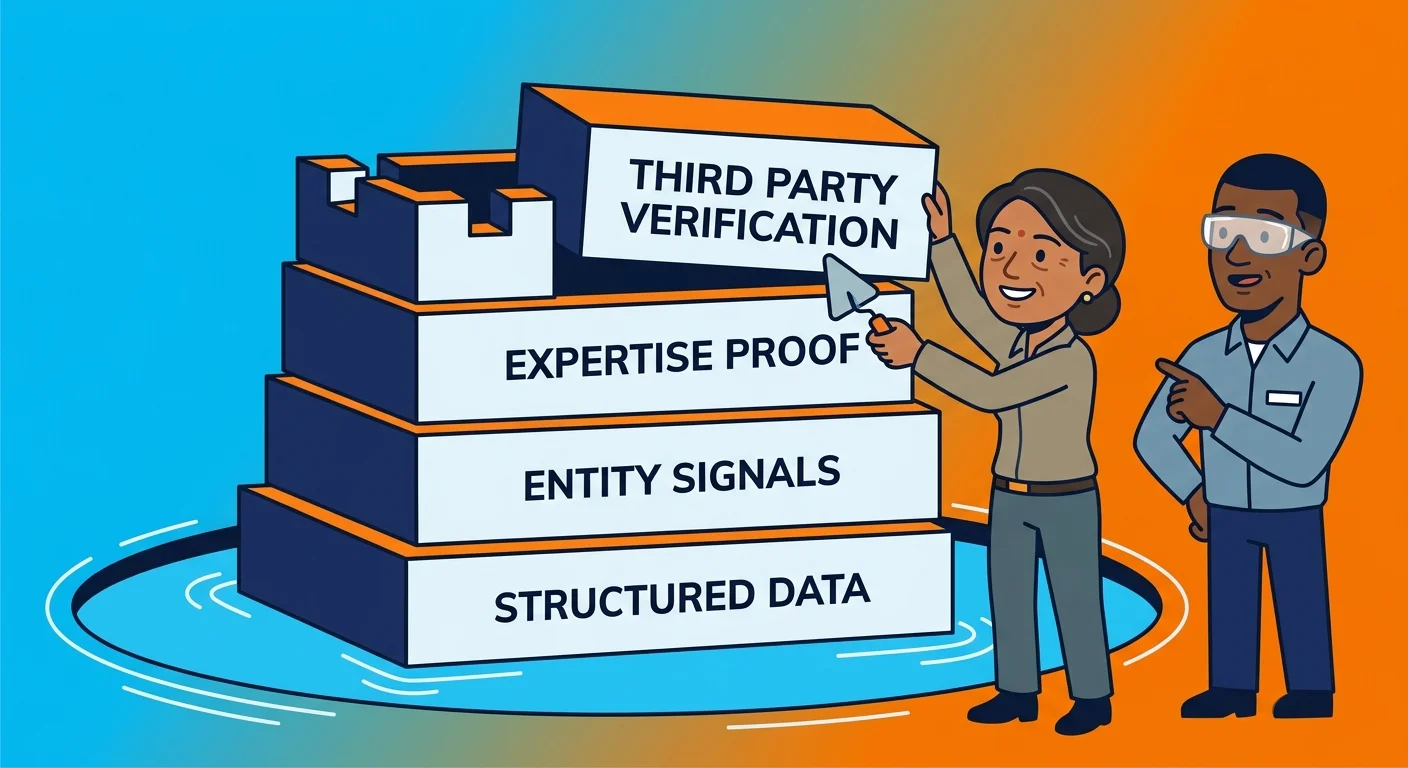
Now for the constructive half. A Defensive Authority Moat is a strategic framework for structuring a brand's digital presence so large language models understand it and trust it without ambiguity.
It isn't one tactic. It's four coordinated pillars, each one reinforcing the others.
Skip a pillar and the whole thing gets shakier. An AI model hunting for certainty hesitates the second a signal goes missing or contradicts itself.
| Pillar | What It Builds | Why AI Engines Reward It |
|---|---|---|
| Structured Data Foundation | A machine-readable map of who the entity is, what it does, and why it qualifies as an authority | Removes the guesswork a model would otherwise face when inferring meaning from unstructured prose |
| Consistent Entity Signals | Identical business information reproduced across every platform an AI model might consult | Eliminates the contradictions that cause a generative engine to hedge or omit a source entirely |
| Expertise and Trust Documentation | Verifiable credentials, named authorship, and demonstrated experience behind published content | Gives a model a documented reason to treat the entity as a credible originator, not just a repeated name |
| Third-Party Verification Footprint | Independent citations, directories, and platforms that corroborate claims made on owned properties | Supplies the outside confirmation a model weighs before trusting a source enough to cite it |
Structured Data as the Foundation Pillar
Structured Data Foundation is the pillar most businesses have heard of and almost none have actually built.
So what does it actually change? A 2023 study by Data.world found enterprise knowledge graphs pushed LLM response accuracy up by as much as 300% — and that number is exactly what structured markup does for a model trying to parse an entity.
Structured data hands a machine a clean map of who a business is, what it does, and why it counts as an authority — instead of making the model guess from loose prose. That gap between a mapped entity and a guessed one is where citation confidence lives, as Search Engine Journal's reporting on structured markup and generative answers has laid out.
Without that foundation, every other pillar is standing on sand.
Consistent Entity Signals Across the Web
Consistent Entity Signals is the pillar that punishes sloppiness the fastest.
An AI model that runs into three different phone numbers, two business names, or a founder credited on one platform and missing on another doesn't guess in your favor. It hedges, or it drops you entirely.
So identical business information across every platform isn't a formatting nicety. It's the difference between an entity a model trusts enough to cite and one it quietly routes around.
How AI Engines Decide Who to Cite
So how does an AI model actually pick who to name? It weighs exactly these signals against every other entity answering the same question.
A model doesn't reward effort. It rewards clarity, consistency, and corroboration — the three things the four pillars are built to produce.
That's a whole different discipline than the one most businesses were trained on. The shift from a one-time push to an ongoing practice is exactly what separates treating this as a single completed project from treating it as continuous authority reinforcement.
The businesses that get cited aren't the ones that optimized once. They're the ones whose digital identity leaves nothing for a model to question.
Where AI Overviews Pull Their Citations
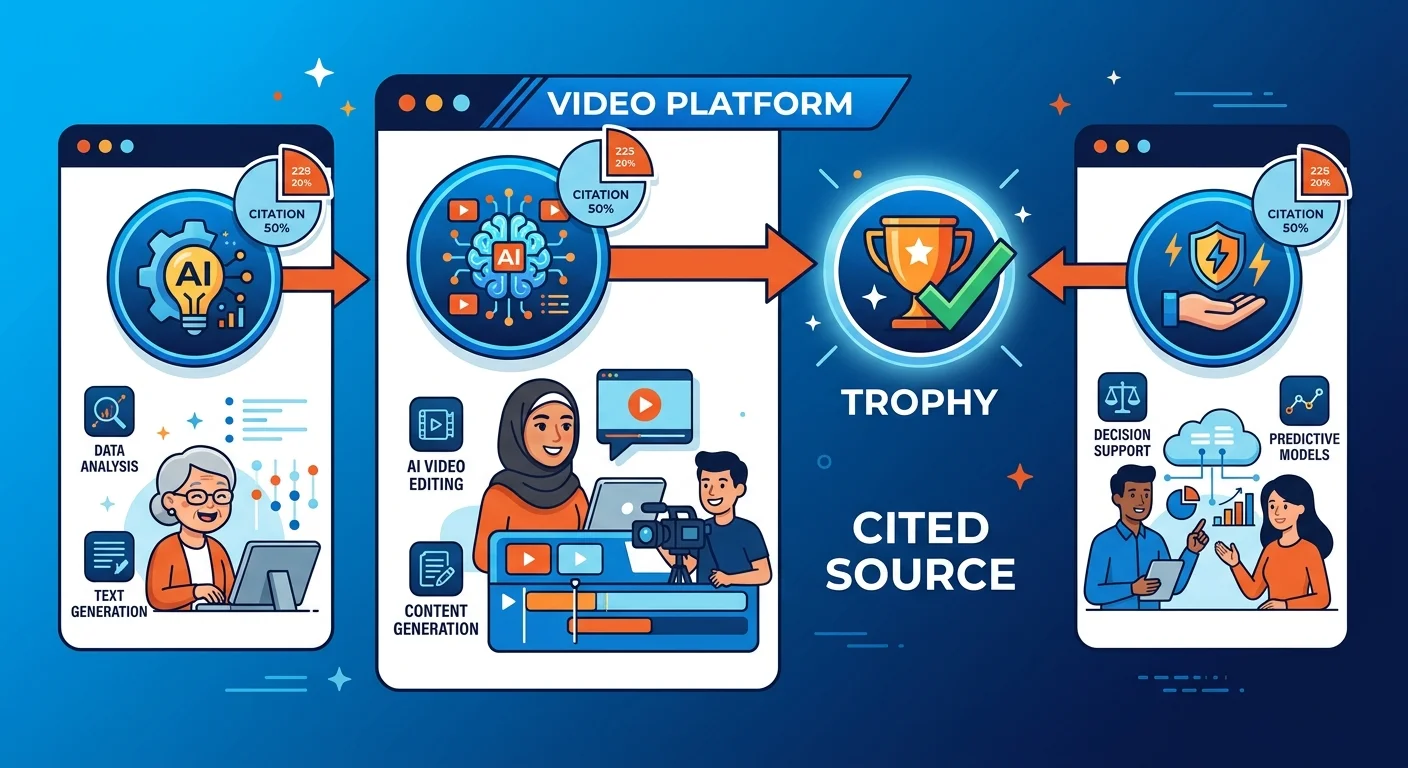
So where do these engines actually grab their answers from? It's not spread evenly across the web. It clusters hard on a handful of source types.
In Google AI Overviews, one platform runs away with the citation pool. It captures 22.9% of citations among the top sources tracked, meaning a single video platform outweighs most of the open web combined.
| Source Type | Share of Citations | AI Tool |
|---|---|---|
| Video Platforms | 22.9% of citations | Google AI Overviews |
| Social and Community Forums | 41.7% of citations | ChatGPT |
| Social and Community Forums | 14.4% of citations | Gemini |
How Local and Conversational AI Tools Differ in Sourcing
But the pattern flips depending on which AI tool a searcher opens. Local and conversational engines don't source the same way. Treating them as interchangeable is a mistake.
ChatGPT cites social and community forums for 41.7% of its citations in local business recommendations. Gemini cites those same forums for just 14.4% of its local citations — a gap wide enough to change where an entity needs a visible footprint.
That divergence is exactly the kind of detail Ahrefs' research has tracked across generative platforms, and it means you can't build one citation strategy and assume it covers every engine. Understanding how a rival's citation profile gets mapped and reverse-engineered makes clear why source diversity is now a competitive variable, not a footnote.
What Uncertainty Language Reveals About Trust
Here's what most businesses miss entirely: the language an AI model uses to deliver an answer changes whether a searcher trusts it.
Research from University of California, Irvine found that uncertainty language in AI-generated answers strongly shaped user trust. Low-confidence phrasing produced meaningfully lower reader confidence in accuracy than medium or high-confidence phrasing did — a finding also reflected in published industry reporting on how generative platforms source and frame local recommendations.
And that matters for the business being cited, not just the searcher reading the answer. An entity with a thin, contradictory, or unverifiable footprint hands a model every reason to hedge its language when naming that entity as the source.
Building the Moat Without a Knowledge Graph Budget
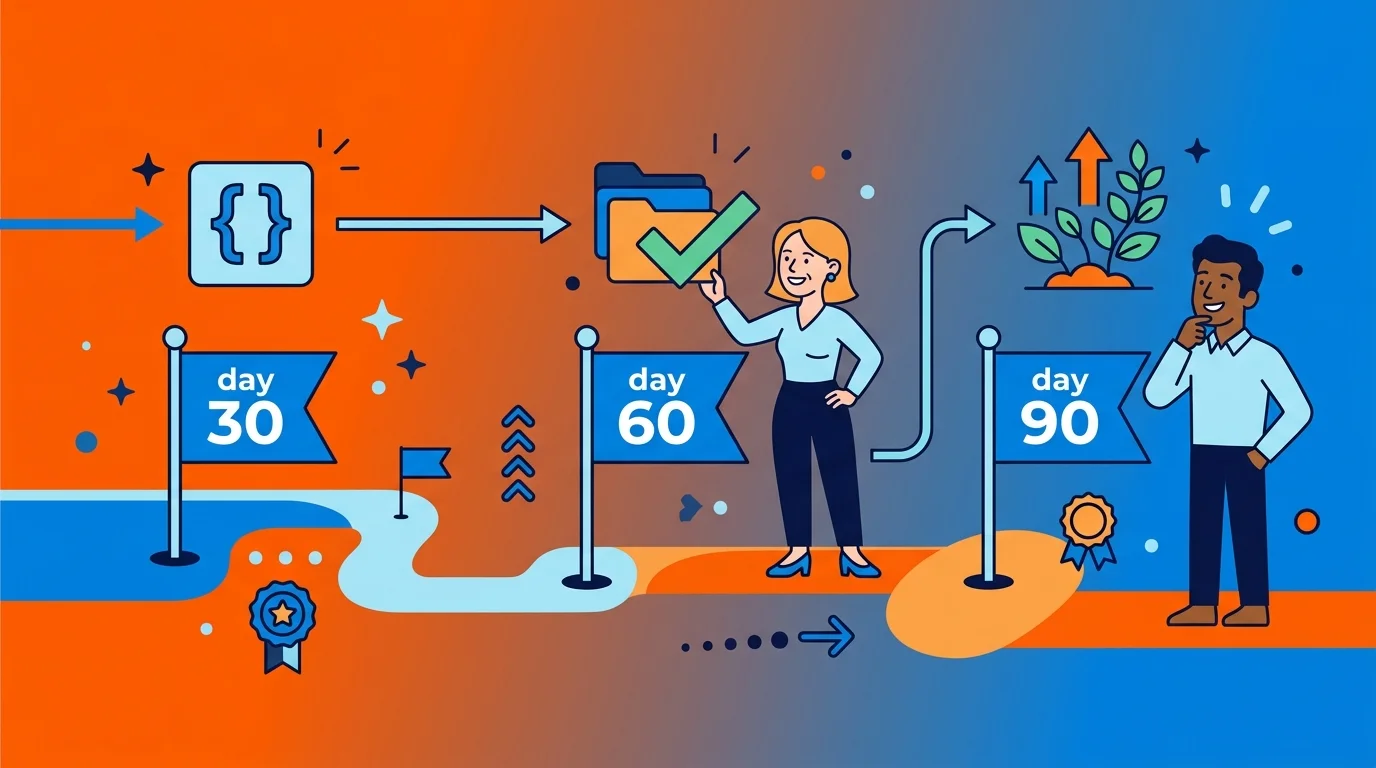
Here's the reassuring part. None of this needs an enterprise budget or a data science team.
A Defensive Authority Moat gets built from disciplined, repeatable actions, not expensive infrastructure. The four pillars scale down to one founder with a spreadsheet just as cleanly as they scale up to a whole marketing department.
So the question was never whether a small business can compete. It's whether the sequence gets run in the right order, starting with the foundation instead of the parts that feel more exciting.
| Milestone | Timeframe | What It Establishes |
|---|---|---|
| Entity Audit and Correction | Early build phase | A single verified identity across every platform, with no conflicting names, numbers, or credentials for a model to hesitate over |
| Basic Schema Implementation | Early build phase, alongside the audit | A machine-readable map of the business on its own site, forming the base layer of Structured Data Foundation |
| Citation Monitoring Setup | Once the foundation is corrected | A way to notice early whether the cleanup is translating into actual mentions, before drift can compound unnoticed |
| Expertise Documentation | Ongoing, after the foundation holds | A visible record of credentials and published expertise that a model can point to as evidence of authority |
| Third-Party Verification Accumulation | Ongoing, compounding over time | Independent citations and outside recognition that no single business can manufacture on its own timeline |
The First Ninety Days of Entity Structuring
The first ninety days belong almost entirely to Structured Data Foundation and Consistent Entity Signals — the two pillars that cost time, not money.
That means auditing every platform where the business name, address, phone number, and founder credentials show up. Then correcting every mismatch you find.
It also means putting basic schema markup on the website itself, so the entity's identity reads as machine-readable instead of getting buried in prose a model has to interpret.
Alongside that cleanup, this is the window for building a way to notice when the work is actually landing. Setting up a system for catching early signs of citation loss before it compounds during this phase means a business isn't flying blind once the moat starts drawing citations.
Signals That Compound Beyond the First Quarter
Signals that compound past the first quarter live in Expertise and Trust Documentation and Third-Party Verification Footprint — the pillars that take longer because they lean on outside recognition.
This is where credentials, published expertise, and independent citations from other authoritative sources start stacking up. None of it happens overnight, and none of it should get rushed to hit some arbitrary deadline.
But here's the payoff. Each verified signal makes the next one easier for a model to trust, and that compounding is what turns a maintained moat into a defense that outlasts any single algorithm update.
Frequently Asked Questions
A few objections tend to pop up once all four pillars are on the table. Let's knock them out one at a time.
How is a defensive authority moat different from traditional search optimization?
Traditional search optimization chases a spot in the classic ten blue links. A defensive authority moat chases something else entirely: being the entity an AI model names right inside its answer, with no click needed to get there.
Can a small business realistically build an authority moat against larger competitors?
Yes. The four pillars run on disciplined, repeatable work, not on outspending a bigger competitor's budget. A founder with a spreadsheet can nail Structured Data Foundation and Consistent Entity Signals just as cleanly as a whole marketing department can.
How long does it take to see results from building an authority moat for AI search?
The first two pillars are foundation work that compounds over time, not a quick win. Expertise and Trust Documentation and Third-Party Verification Footprint lean on outside recognition, so they build gradually instead of on a fixed schedule.
What is the role of structured data in an authority moat strategy?
Structured data hands an AI model a clean map of who a business is and why it counts as an authority. Without it, the model has to guess that from loose prose. And guessing is exactly where hedging and omission sneak in.
If AI provides the answer directly, why does my website's content still matter?
Because a model's confidence rides on how thin or verifiable the underlying source is. Uncertainty language shapes reader trust, and a business with a documented, consistent footprint gives a model less reason to hedge when it names you.
Will an authority moat protect my business from being negatively misrepresented by AI?
It cuts the risk sharply, since clear and consistent signals leave less room for a model to guess or misattribute. But that protection comes from the strength of your footprint, not from a guarantee any single tactic can make.
What are the first steps to take when building a defensive authority moat?
Start with Structured Data Foundation and Consistent Entity Signals. Audit every platform for mismatched business details, then put basic schema markup in place. Those two pillars cost time, not money, and they're the base the other two stand on.
Where This Leaves You
So here's where this leaves you. In 2026, visibility doesn't come from placing in the classic ten blue links anymore. It comes from being the entity an AI engine trusts enough to name out loud.
A Defensive Authority Moat isn't dug to win this quarter. It's dug once, brick by verifiable brick, and it defends indefinitely. A keyword position tracking win erodes the second a competitor outspends it — structured data, consistent signals, and a documented footprint don't.
So here's the bet worth making: not on a tactic that expires, but on an entity a model has no reason to hedge on. Want to see where your own digital identity stands against that standard? Start with an AI visibility check.