
Articles in this cluster
- Why template sites fail entity resolution — Why Template Authority Infrastructure Fails AI Search Engine Entity Resolution
- Medical schema markup that builds machine trust — How to Build Machine Trust with Advanced Medical Schema Markup
- AEO compared with a full-stack authority engine — AEO vs. Full-Stack AI Authority Engine Architecture in 2026
- Mapping clinician credentials into a knowledge graph — How to Map Clinician Credentials to the Google Knowledge Graph
- Rebuilding a static site as AI-readable infrastructure — How to Transform a Static Site into AI-Readable Authority Infrastructure
- What cheap authority infrastructure costs a practice — Why Cheap Authority Infrastructure Costs Healthcare Practices AI Visibility
- Healthcare directories and AI consensus — How to Leverage Healthcare Directories for AI Search Engine Consensus
- Content clusters built around patient conditions — Building Condition-Intent Content Clusters That AI Engines Cite First in 2026
- A queryable knowledge graph for a practice — How to Construct a Queryable Knowledge Graph for Your Medical Practice
- Wikidata and sameAs links for practice identity — How to Use Wikidata and SameAs Links to Resolve Practice Identity
- Ongoing maintenance for an AI authority engine — What Ongoing Maintenance Does an AI Authority Engine Actually Require in 2026?
What Full-Stack AI Authority Engine Architecture Actually Means

Full-stack means every layer is connected and verified against the others. A practice that has schema markup but no consistent provider data across directories is not full-stack. It is partial, and partial is where most AI visibility gaps start.
Forget the idea of a marketing stack. This is an authority structure, built so a healthcare practice shows up as a verified entity in a knowledge graph instead of a listed address on a results page.
That distinction is the entire shift. Buying attention through ads and keywords no longer determines whether a practice gets cited. Owning authority, through structured and verifiable data, does.
Building that structure consistently and correctly is detailed, grinding work that most practices don't have the in-house bandwidth to handle alone. That's the gap our AI visibility services exist to close.
Why Chasing Results-Page Position Numbers No Longer Builds Authority
For decades, online promotion for healthcare practices meant winning a game of visibility on a results page. A higher spot meant more eyes, and more eyes meant more patients.
But that game assumed a human was always the one doing the clicking. Generative AI and answer engines changed what gets rewarded. The prize now is being the cited source inside a definitive answer, not one more link in a list.
Position numbers and citations don't run on the same mechanism: a position number measures where a page sits against other links, while an AI surface checks whether a claim can be verified before it repeats it, which is the job the components of an authority engine are built for. One real-world check makes the gap concrete: across 200,000 localized searches on three platforms, a mapping platform mentioned a tracked business in 66% of searches, while the AI surfaces studied landed at just 32-38%. This published analysis reports Google Maps mentioned a tracked business in 66% of searches, compared with 32-38% for the AI surfaces studied.
That gap is not a tooling quirk. AI visibility gets sold as a fresh category, but the mechanism underneath is the same one results-page work always ran on: consistent, verifiable facts win placement, only now the placement is a sentence instead of a link.
The Problem With Treating AI Visibility Tools as a Patchwork Fix
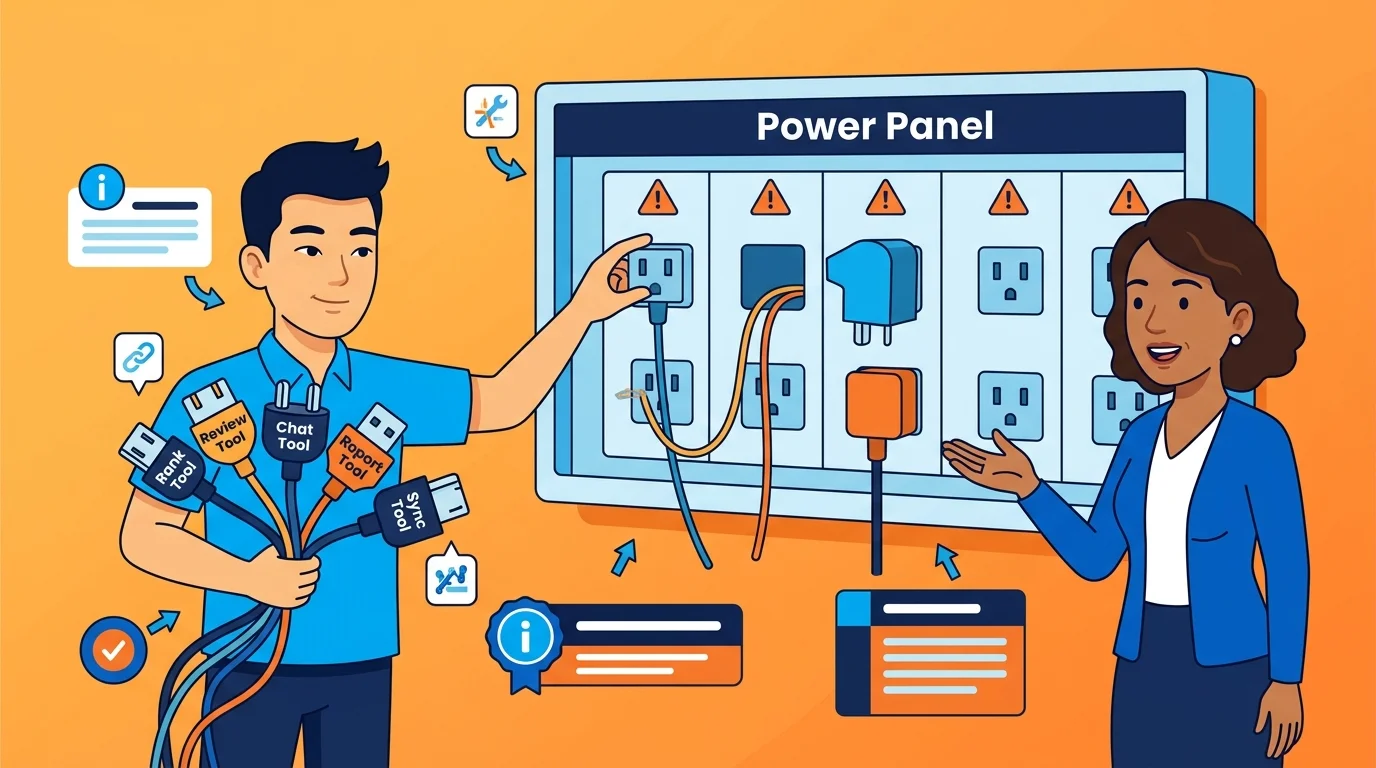
Most practices treat AI visibility the same way they once treated results-page position numbers. Buy a tool, aim it at the problem, then sit back and wait.
That instinct treats AI visibility as a feature to purchase rather than a structure to build. A subscription dashboard that tracks mentions does not create the verified data an answer engine needs to cite a practice.
Cheap retainers sold as AI visibility fixes are a trap: they isolate one layer, usually tracking or reporting, and leave everything else untouched. Schema stays inconsistent. Provider data stays scattered across directories.
A dashboard can't verify a credential, and it can't reconcile a provider's name across twelve directories. All it can do is report the gap after the fact. Then the gap just sits there, wide open.
Why Bolt-On Tool Subscriptions Create Gaps Instead of Coverage
So what's a bolt-on tool subscription actually built for? Watching one layer of the architecture in isolation, and connecting that layer to the others was never part of the job.
That isolation is exactly how it fails. A practice can pay for a tool that scans for AI mentions while its provider credentials sit unverified and its directory listings stay inconsistent across platforms.
The tool reports the gap. It does not close it, because closing it requires structured data, verified credentials, and consistent local information working together, not a subscription watching from outside the system.
Why Fragmented Tool Stacks Fail Under Real Patient Query Conditions
Fragmented stacks break the moment a patient's question gets specific. Broad accuracy numbers hide what really happens on a narrow clinical question, where a model has fewer sources to pull from and a lot less room to get it right.
Research published through Soonchunhyang University found ChatGPT returned only 7 directly relevant studies out of 1287 identified in a Peyronie disease treatment literature search, while Bing AI returned 19 relevant studies out of 48. Seven relevant studies out of more than a thousand is not a rounding error.
A tool that watches for AI mentions can't touch that gap. It was never built to check which sources a model actually pulled from, only to report whether a mention showed up or didn't.
How Structured Data Turns a Practice Into Machine-Readable Information
A practice's structural layer starts with schema markup. This code classifies what a page actually says, so a machine does not have to guess.
A provider name, a credential, a service, a location. Each one gets labeled in a format machines can read straight off the page.
Google's documentation says structured data is a standardized format for providing information about a page and classifying its content, which may help Google understand the page. That definition matters here because an AI system answering a patient question needs classified facts, not prose it has to interpret. Structured data is the difference between a page a model can quote and a page it can only guess at.
| Data Element | Structured Format | Machine Readability Role |
|---|---|---|
| Provider Credential | Named field mapped to a credential type, verified against licensing or board data | Lets a machine confirm a title or specialty instead of inferring it from page text |
| Service or Specialty Listing | Classified under a standardized service category rather than free-text description | Allows an answer engine to match a patient question directly to a listed capability |
| Location and Contact Data | Structured address and phone fields held consistent with every external directory | Gives a machine one reliable record to cite instead of several conflicting ones |
| Operating Hours and Availability | Coded into a standardized time format rather than written as prose | Reduces the guesswork a model would otherwise have to resolve on its own |
| Page Topic and Content Type | Classified so the page's subject matter is explicit rather than implied | Helps a system decide whether the page qualifies as a source for a given query |
What Schema Markup Covers and Where It Falls Short
Schema markup covers a defined set of facts well. Provider credentials, service types, operating hours, and location data all map cleanly into standardized fields.
What it does not do is verify that those facts are true. Schema tells a machine what a page claims. It does not confirm the claim against any outside record.
A practice can mark up a provider's credential in flawless schema and still be wrong. If the directory listing elsewhere lists a different title, the markup does not catch the conflict. That gap is where the trust layer has to pick up the work schema cannot do alone. Google's rules say structured data (schema) must match what's actually visible on the page.
How Knowledge Graphs Ground AI Answers in Verifiable Facts
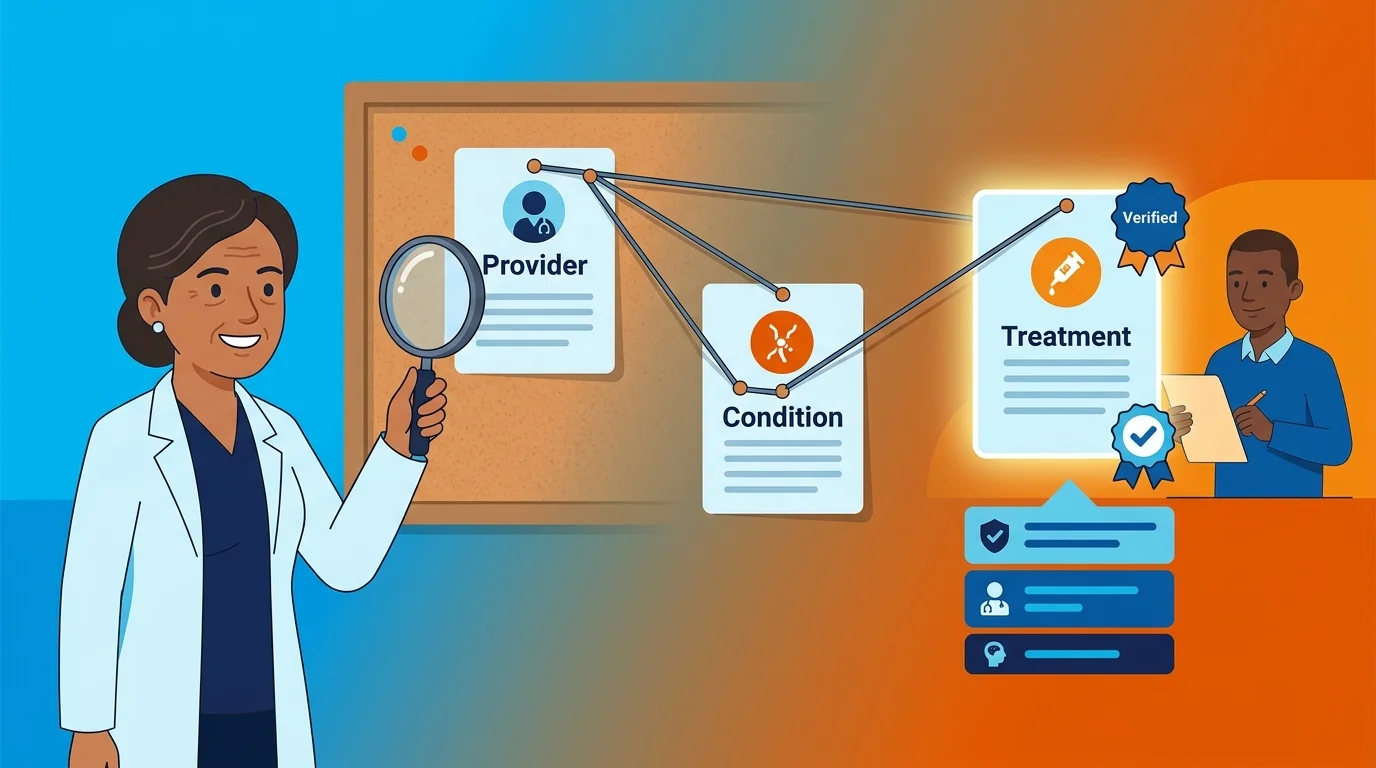
Schema tells a machine what a page claims. A knowledge graph goes a step further and links a practice's facts into a web of verified relationships a model can actually check against.
Think of it as a chain. A provider connects to a credential, the credential connects to an issuing body, and a service connects to a location. Every link becomes a fact a model can verify instead of guess.
That web is the difference between a verified entity and a listed address. An address just sits on a page. A verified entity sits inside a network of checkable claims an AI system can trace.
Why Knowledge Graphs Reduce the Hallucination Problem in Medical Answers
Alright, quick reality check: large language models build answers by predicting likely text, not by checking a source. That's exactly why one can state a wrong credential or an outdated service with total confidence.
Health questions raise the stakes on that mechanism. Study 1 found that large language models failed evidence-based health communication standards, with the quality of their responses depending on how informed the prompt was. University of Potsdam reports large language models may fail evidence-based health communication standards, with response quality depending on prompt informedness. An uninformed prompt produced a weaker answer. A knowledge graph removes some of that dependency by giving the model a verified fact to query instead of a pattern to predict.
One system built specifically for this problem queries a knowledge graph before it answers, rather than after. Research published through MIT Lincoln Laboratory found an open-source natural language interface called LinkQ was developed to combat LLM hallucinations by having the model query a knowledge graph for ground-truth data during question-answering. LinkQ forces that check during the question-answering process itself, not as a correction applied afterward. A practice's own knowledge graph entries work the same way, giving an AI system a verified fact to retrieve instead of a gap to fill with a guess.
How Large Language Models Weigh Trust Signals for Medical Content
Trust signals work differently for medical content than for ordinary queries. A model has to weigh who is speaking, not just what is being said.
Expertise, authoritativeness, and trustworthiness work like a filter a model runs before it commits to an answer. Ask it a health question and that filter gets a lot tighter.
A credential tied to a verifiable issuing body carries more weight than a title stated without one. A service description backed by consistent directory data carries more weight than a claim that appears only once.
That weighting explains why an uninformed prompt produced a weaker answer earlier in this breakdown. The model had less verified material to draw on, so it leaned harder on prediction instead of fact.
| Trust Signal | What It Demonstrates | Where It Lives in the Architecture |
|---|---|---|
| Verifiable Credential | A provider's claimed expertise traces to an issuing body a model can check | Knowledge graph entry linking provider to credential source |
| Consistent Directory Data | A service or title holds up the same way everywhere a model looks | Structured data layer, reconciled across every listed location |
| Structured Classification | A page states its facts in a format a model can parse rather than interpret | Schema markup applied to provider, service, and location fields |
| Checkable Relationship | A fact connects to another verified fact instead of standing alone | Knowledge graph linking providers, credentials, services, and locations |
| Source Density on Narrow Queries | A claim holds up even when a model has few sources to draw from | Verified entity data available for specific clinical or service questions, not just broad ones |
But Doesn't More Content Still Win? Why Volume Isn't the Same as Authority
More pages on a topic looks like more authority. It's not.
Volume adds more text for a model to parse, not more verified fact for it to check. A practice can publish at scale and still leave every credential unverified across the directories a model cross-references.
Results-page position numbers stopped predicting who gets cited the moment answers replaced links. Authority is how well a claim holds up when a model checks it, not how many times that claim gets repeated.
How Local Signal Consistency Determines Whether AI Surfaces Recommend a Practice
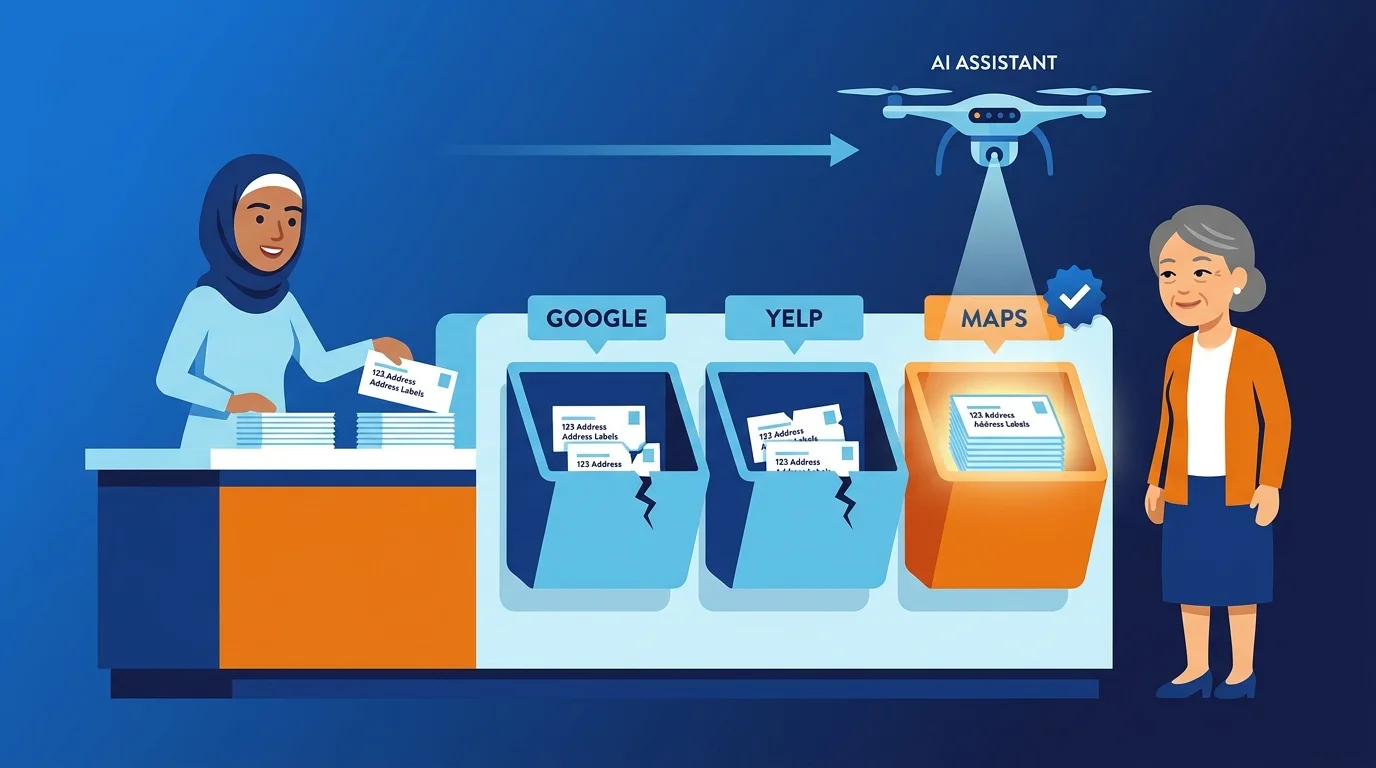
Credentials carry weight everywhere. But for a patient searching nearby, local consistency carries just as much.
An AI surface answering a local query cross-references a practice's name, address, and phone number against every directory it can find. One mismatched suite number or an outdated phone line breaks the chain a model relies on to confirm the practice is real and current.
A mapping platform already surfaces a tracked business far more often than the newer AI surfaces manage today.
| AI Surface | Mention Rate in Localized Searches |
|---|---|
| Google Maps | Mentions a tracked business more often than the newer AI surfaces. |
| AI Overview | Mentions a tracked business less consistently. |
| ChatGPT | Mentions a tracked business at a comparable but still lower rate. |
| AI Mode | Mentions a tracked business least reliably of the surfaces studied. |
Where Generative AI Models Source Answers for Health-Related Questions
Before a model writes a single word about a health question, it has to pick a source. And it picks from whatever verified facts it can actually retrieve, not from the full pile of published research on the topic.
The earlier literature search on Peyronie disease treatment showed how uneven these tools can be. On a narrow clinical question, only a small share of what one model returned was directly relevant, while a different tool returned a much higher share.
That gap is not a tooling preference. Different tools return very different shares of relevant material for the same question.
Building the Architecture in Practice: Sequencing the Layers

The layers already covered do not build themselves in a single pass. They build in sequence, each one depending on the one before it.
Schema without verified data? That just publishes structured guesses. And a knowledge graph fed messy provider data has nothing accurate to connect.
The goal is no longer a position in a list of links. It is becoming the fact a model retrieves when it writes the answer. Sequencing the layers correctly is how that fact gets built, instead of purchased as a monthly report.
| Build Phase | Primary Task | Layer It Strengthens |
|---|---|---|
| Audit the existing footprint | Check schema, directory listings, and provider data for conflicts and gaps | Structural layer |
| Restructure provider and service data | Convert prose descriptions into parsed fields naming credential, issuing body, service, and location | Structural layer |
| Connect verified facts into a knowledge graph | Link each provider, credential, and service field into checkable relationships | Trust layer |
| Align local data across every directory | Correct mismatched names, addresses, and phone numbers a model cross-references | Trust layer |
| Publish content built on the verified structure | Write pages that state the already-verified facts instead of introducing new unverified claims | Authority layer |
Auditing Existing Infrastructure Before Adding New Layers
Before any new layer gets added, the existing one needs an audit. That means checking what currently exists across schema, directories, and provider listings.
Most practices find conflicts here. A credential written one way on the website and another way on a directory. A phone number retired years ago, still sitting somewhere a model can find it.
This is where a cheap retainer breaks first. A subscription that only watches for mentions never surfaces these conflicts, because monitoring was never built to audit.
Structuring Provider and Service Data for Machine Parsing
Once the audit flags the gaps, provider and service data gets rebuilt into something a machine can parse. Not a paragraph describing a provider. Separate fields for the credential, the issuing body, the service and the location.
Every field becomes a fact a knowledge graph can hook to another fact later. A credential links to its issuing body. A service links to the location where it's delivered.
That structure is exactly what a listed address never had. An address sits alone on a page, unverified and unconnected. A machine-parsed entity sits inside a web of facts a model can check before it decides what to cite.
Frequently Asked Questions
This architecture raises mechanical questions as much as strategic ones. So here are straight answers to the ones that come up most.
How does an AI Authority Engine handle patient privacy and HIPAA compliance?
Any AI marketing tool that touches patient data needs a signed business associate agreement before it touches anything else. No signed agreement means no compliant tool, regardless of what the vendor claims.
What's the difference between a full-stack AI architecture and just running a few AI marketing tools?
A handful of AI marketing tools watch for mentions after the fact. A full-stack architecture builds verified structure first. That gives a model something accurate to find.
Can a smaller practice realistically implement a full-stack AI authority engine?
Yes, because the work sequences. A smaller practice audits its data, structures it, then connects it — the same order, just a smaller surface area.
How do you measure results from an AI authority engine if not by results-page position numbers?
Results-page position numbers never measured whether a model trusted a practice's facts. The better measure is whether a practice's provider data, credentials, and locations are consistent and verifiable across every directory a model checks.
What is the first step a healthcare practice should take to prepare its data for an AI authority architecture?
Audit what already exists. Most practices find a credential stated one way on the site and another way on a directory before they build anything new.
How does this architecture protect against AI models producing incorrect information about a practice?
Verified, connected data gives a model a fact to retrieve instead of a gap to predict. That's the entire function of a knowledge graph built on clean provider data.
The Bottom Line
A full-stack AI authority engine is not a bundle of tools. It is a sequence: schema first, verified data second, a connected knowledge graph third.
Skip a layer and the next one has nothing solid to stand on. Markup without verified facts just publishes a guess in a tidier format, and a knowledge graph fed messy provider data has nothing accurate to connect. The sequence is the architecture, not some optional polish you get around to later.
Being a listed address on a results page was never the goal worth keeping. Being the verified entity a model checks before it writes an answer is.
That shift rewards a practice that builds the structure, not one that buys a bigger spot in the old game. Start with an AI Visibility Check.