
Articles in this cluster
- Founder-led work compared to junior staff handoffs — Founder-Led Account vs Junior Staff Handoff: What Actually Changes?
- Why large agencies mishandle solo clinic entity data — Why Corporate Agencies Mishandle Solo Clinic Entity Data
- Verifying an agency's claims before signing a contract — How to Verify an Agency's Answers Before You Sign a Contract
- How boutique firms safeguard practice reputation — How a Boutique Technical Firm Protects Practice Reputation
- Reputation risks created by mass-production marketing shops — Mass-Production Marketing Shops: How They Put Clinic Reputation at Risk
- Boutique firms and multi-client agencies compared side by side — Boutique Firm vs Multi-Client Agency: A Side-by-Side Comparison
- Why bigger agencies do not mean better resources for clinics — Why 'Bigger Agency Means More Resources' Doesn't Hold Up for Clinics
- Signs a clinic account has quietly shifted to junior staff — Signs Your Account Has Been Handed Off to Junior Staff
- Consequences of clinic entity data errors found later — What Happens When Your Clinic Entity Data Is Wrong Later
- Telling a custom AI authority process from an automated one — How to Tell a Custom-Built AI Authority Process from an Automated One
- What ongoing founder access looks like after signing — After Signing: What Ongoing Access to a Founder Looks Like
What Building Clinic Authority For AI Search Actually Requires
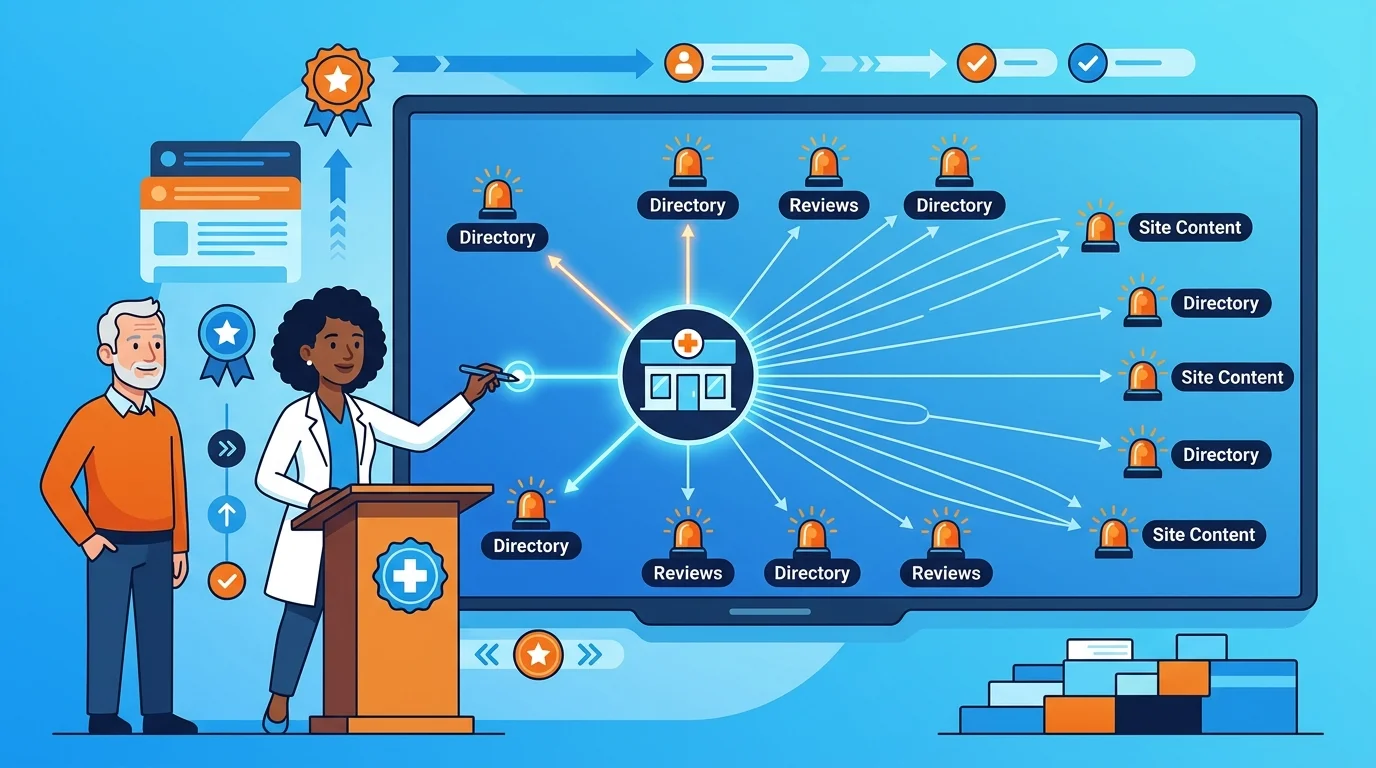
AI engines don't answer a question with one search. They build a case file first, pulling from a pile of subtopics before they write a single sentence.
That case file rewards verified specificity, and the retrieval step now happens inside the engine instead of on a results page.
How Query Fan-Out Changes What Counts As Authority
Google's documentation says AI Overviews and AI Mode may use a "query fan-out" technique, issuing multiple related searches across subtopics and data sources to develop a response.
A boutique model, built around a strategist who's actually in the work, can chase each of those subtopics with original, specific material. That's the real job behind AI visibility services: closing gaps one subtopic at a time, not one template at a time.
Where The Scale Playbook Breaks Down On Entity Accuracy
A clinic's case file runs on matched data points. Every directory, every citation source and every listing has to agree on the same name, address and credentials before an AI system trusts any of them.
And that matching job is exactly where the scale playbook cracks. Scale runs on templated processes stamped across many accounts, and those templates were never built to catch the small mismatches a single clinic's listings pile up over the years.
| Data Point | What The Research Found | Why It Matters For a Clinic |
|---|---|---|
| Database Cross-Match Rate | A 2010 study by Hoehner and Schootman (Washington University School of Medicine) found two commercial business databases agreed on only about a third of St. Louis businesses. | A clinic's listings sit across many of these databases. |
Why Standardized Agency Workflows Produce Mismatched Business Data
Let's keep it real: business data lives across dozens of aggregators, directories and platforms. Each one can hold a slightly different version of the same clinic.
A junior-level team executing a standardized workflow has no structural incentive to reconcile those versions by hand. The research shows how deep this problem runs.
A 2010 study by Hoehner and Schootman (Washington University School of Medicine) found two commercial business databases agreed on only about a third of St. Louis businesses.
That finding was measured for businesses generally, not clinics specifically.
Why Generic Content Mills Fail The Citation Test
Generic content built from a repeatable template fills a page without closing a case file's gaps. AI systems build their fan-out searches around specific subtopics, and a templated article answering a generic version of the question leaves each specific subtopic unaddressed.
Cheap retainers are structurally tied to generic content, because standardized, low-cost production only works at scale when the output stays interchangeable across clients. An interchangeable article carries no clinic-specific credential, no clinic-specific outcome, and no clinic-specific data point for an AI system to cite. Volume without verified specificity does not get an entity cited, it gets it ignored.
The Operational Difference Between Boutique Oversight And Large-Agency Throughput
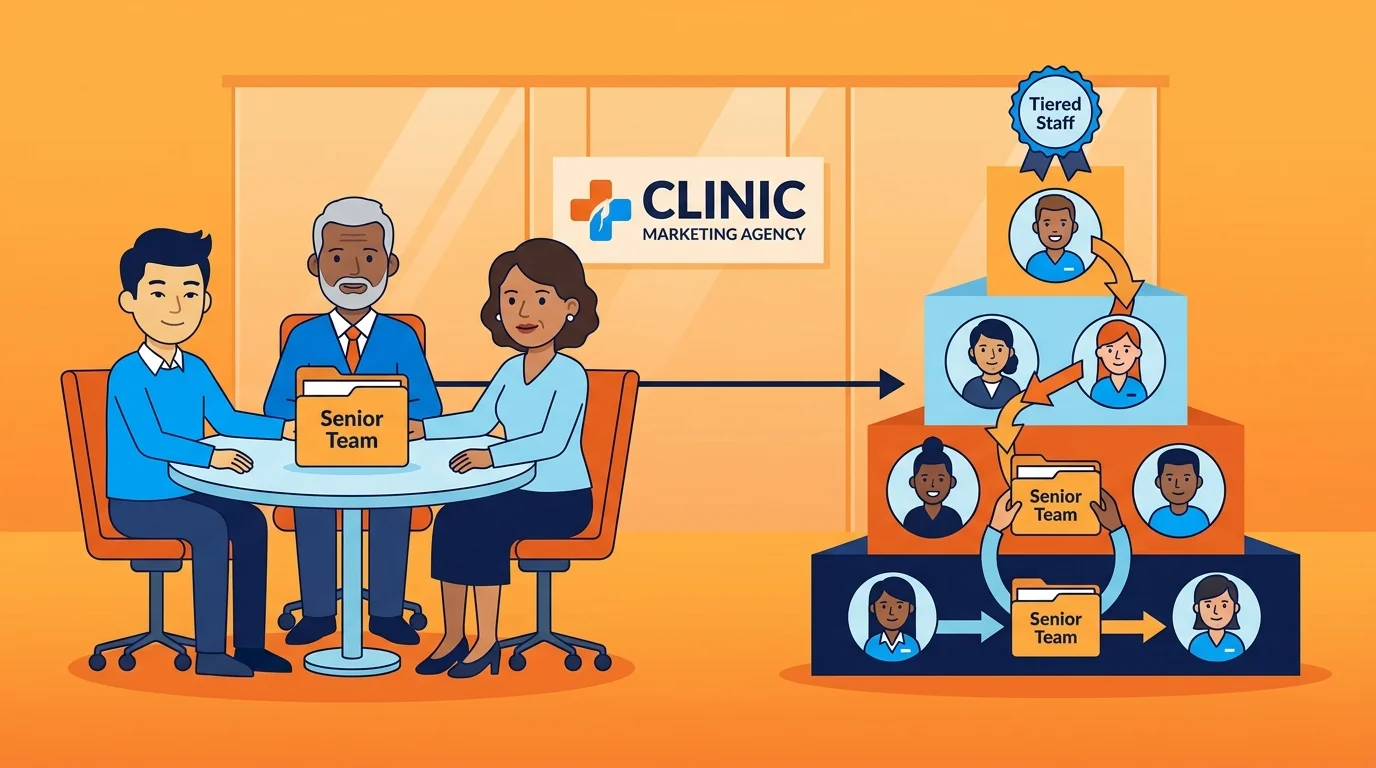
Both failure mechanisms are on the table now. So put the two models side by side: one built around a strategist who's actually in the work, the other around standardized throughput. Each one builds a very different case file.
A boutique agency runs on specialized focus, a smaller team of senior experts and a direct line between the clinic and its strategist. That setup puts a senior person right next to the clinic's actual data, not a layer removed from it.
| Structural Element | Boutique Model | Large Agency Model |
|---|---|---|
| Team Structure | Smaller team of senior experts, each carrying direct client-strategist relationships | Larger team with junior-level staff handling execution under senior manager supervision |
| Content Approach | Specialized focus producing clinic-specific, subtopic-level material tied to one strategist's full view of the case file | Standardized playbooks applied across many accounts, favoring repeatable templates over per-clinic depth |
| Data Oversight | Direct strategist involvement positioned to catch mismatches across listings, credentials, and content | Layered execution model with less structural incentive to reconcile data discrepancies by hand |
| Scalability | Built for depth over volume, scaling slower by design rather than by limitation | Built for volume, architected to run many accounts at once through systems and process |
How Senior-Led Teams Structure Client-Strategist Work
In a senior-led team, a clinic's listings, credentials and content all run through the same strategist, subtopic after subtopic. One person carries the whole case file in their head. That's what catches a mismatch before an AI system does.
Sure, that setup scales slower. It was never built to run hundreds of identical accounts at once (and it doesn't try to).
How Scaled Teams Structure Junior-Led Execution
Scaled teams flip the routing. Junior-level staff handle the day-to-day under senior managers, which is great for volume. But it parks a whole layer between the clinic's specific data and the person deciding what gets published.
And cheap retainers need that layer to stay thin. Low-cost production only holds together at scale when the work stays interchangeable across accounts.
What Fabrication And Citation Research Reveals About Unverified Content
Fabrication research puts a hard number on the risk both models are trying to manage.
Chen, Weng & Moro (Northeastern University) measured that across five U.S. cities and three large language models, restaurant recommendations may include fabricated venues at an average rate of 36.8%.
That was measured on restaurant picks, not clinics, but the mechanism carries straight over: LLMs asked for local recommendations can name businesses that do not exist.
| Study | Fabrication Or Citation Finding | Operational Implication |
|---|---|---|
| Urban restaurant recommendation study | Across five U.S. cities and three large language models, fabricated venues appeared at an average rate of 36.8% | LLMs asked for local recommendations can name businesses that do not exist |
| Stanford study of four generative search engines | About 50% of generated statements across 1,450 search queries had no supportive citations | Half of a generated answer can stand on nothing, which is the exact outcome unverified listings and generic pages invite |
| LLM citation quality benchmark review | Seven widely-used LLMs were evaluated for citation correctness and citation quality across two benchmark datasets | LLM citation quality varies by model |
Measuring Whether An Engine Treats a Clinic As A Citable Source
More published pages won't close that gap.
Per Qian, Fan, Zhang & Guo, seven widely-used LLMs were evaluated for citation correctness and citation quality on two benchmark datasets, and a Generate-then-Refine method was proposed that may improve citation quality.
A templated article adds a page to the count; it does not add the verified specificity an engine's fan-out search is checking for.
Building The Verification Layer That Makes a Clinic Citable
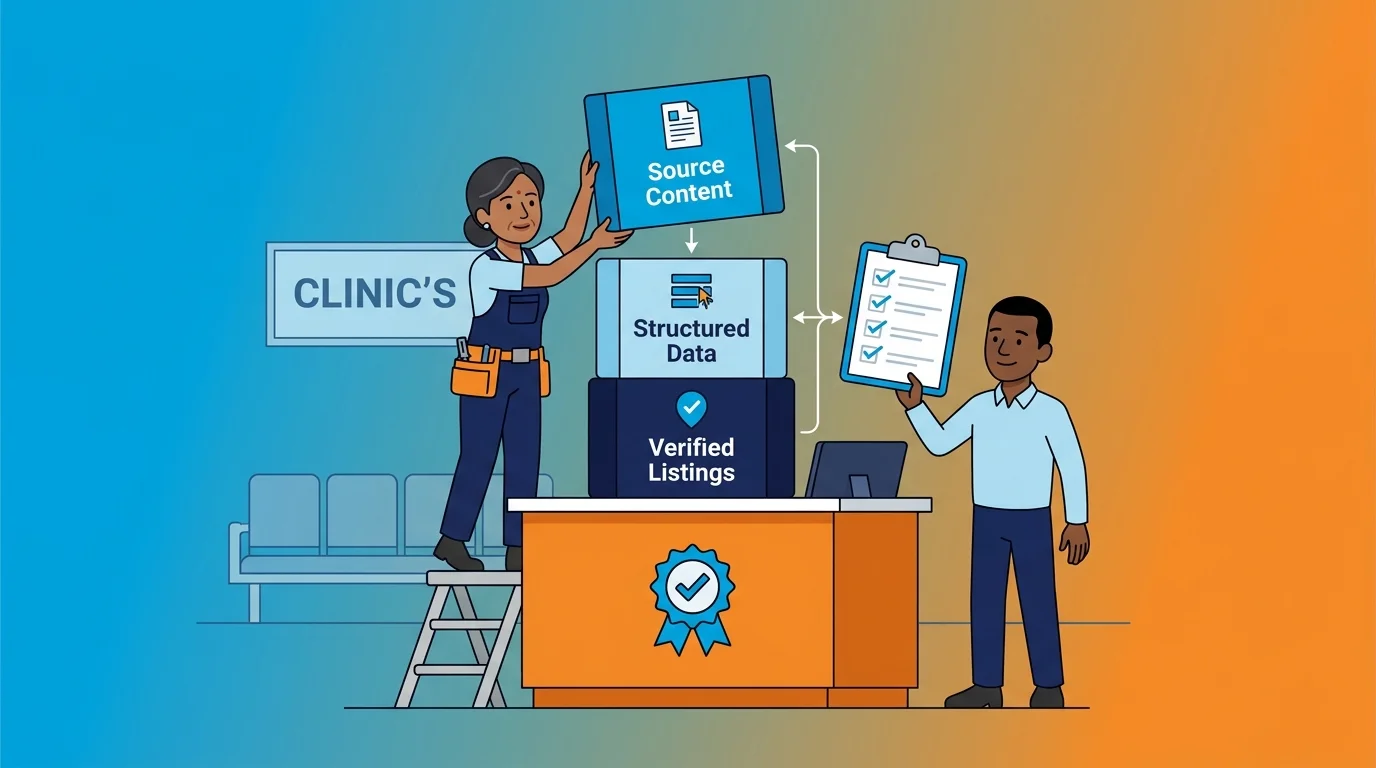
A case file is only as strong as its weakest entry. Verification is the layer that makes every entry agree, whether it wants to or not.
| Implementation Step | What It Fixes | Evidence It Produces |
|---|---|---|
| Entity Data Audit | Mismatched name, address, and credential fields across directories and listing sources | A matched, consistent data set an engine can verify instead of discard |
| Structured Data Implementation | Missing or incomplete schema markup that leaves credentials unreadable to automated systems | Machine-readable confirmation of a clinic's practitioners, specialties, and location |
| Subtopic-Specific Content Mapping | Thin or generic pages that leave individual fan-out subtopics unanswered | Original material tied to a specific subtopic rather than a generic keyword |
| Credential and Outcome Documentation | Generic claims with no verifiable data point behind them | A named credential or specific detail an engine can cite instead of guess at |
Auditing Entity Consistency Across Directories And Schema
An audit starts right where the matching problem lives: name, address and credentials, checked field by field against schema markup and every directory listing. Agreement across sources never shows up on its own. It gets built one correction at a time (tedious, yes, and that's the point).
Producing Source-Grade Content An Engine Can Cite Without Guessing
An engine does not reward a page for existing, it rewards a page for carrying something checkable. Here's the thing: a clinic's authority is either verified and citable or it is treated as a gap waiting to be filled with something else. A 2023 Stanford study (Liu, Zhang and Liang) of four early generative search engines found about half of generated statements had no supporting citation. A statement with no supportive citation is still a statement an engine can generate, just not one it can safely attribute. Producing source-grade content means naming a specific credential, a specific outcome, or a specific figure tied to this clinic.
Frequently Asked Questions
A few mechanical questions sit under this whole comparison. Here are the straight answers, no fluff.
Does a larger agency have better tools and technology for AI visibility?
Tools do not close a case file's gaps, verified specificity does. A larger toolset without a senior strategist reviewing each subtopic does not fix mismatched listings or thin pages.
How does agency size affect the creation of content that AI engines will cite?
A smaller, senior-led team routes a clinic's data through one strategist who catches mismatches across subtopics. A larger team's junior-level execution adds a layer between that data and the published page, which favors volume over verified specificity.
What does query fan-out mean for how a clinic gets cited by an AI engine?
Query fan-out means an engine runs multiple searches across subtopics of the question before writing an answer.
What's the difference in reporting and metrics between large and boutique agencies for AEO?
Large-agency reporting tends to track keyword position tracking and site visits, metrics built for the old results-page game. Boutique reporting tracks entity consistency and citable content, the inputs an AI engine's fan-out search actually checks.
Why do business directories often show different information for the same clinic?
Directories pull from different data sources updated on different schedules, and no central authority forces agreement.
How does a generative search engine decide which statements need a citation?
The Stanford study found engines often don't: about half of generated statements had no supporting citation.
The Bottom Line
Here's the verdict, straight up: your clinic's authority is either verified and citable, or it isn't. Every mismatched listing and every generic page is a hole an AI engine spots long before any strategist does.
The debate was never about which agency model is better in a vacuum. It's about which one is architected to close those gaps with verified specificity instead of volume.
A boutique model builds your case file one subtopic at a time, with a senior strategist who carries the whole picture in their head. Want to see exactly where yours still has holes? Start with an AI Visibility Check.